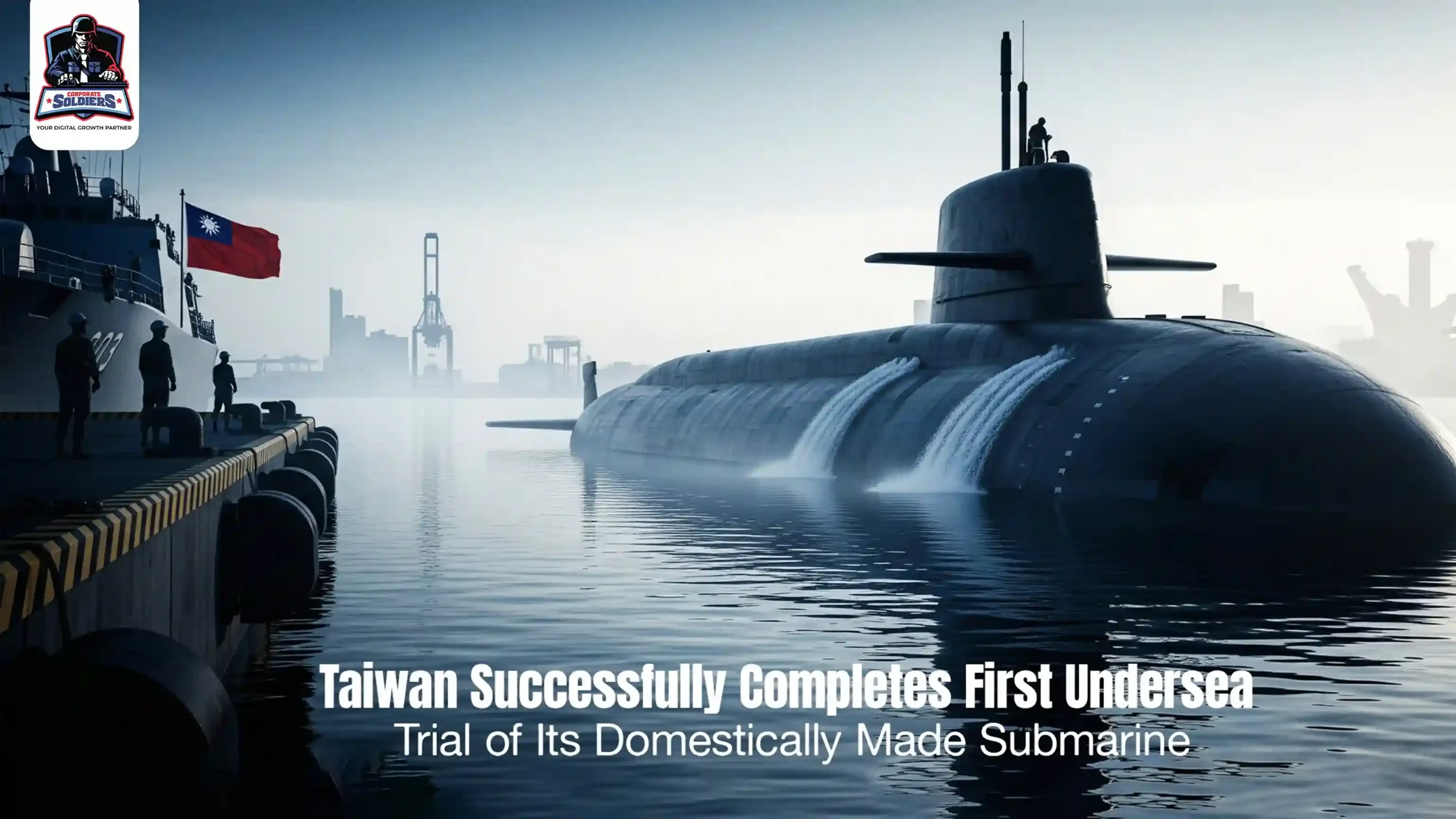
TAIPEI – Taiwan successfully completed the first underwater trial of its domestically built submarine, Narwhal, off the southern port of Kaohsiung on Thursday, marking a major step in strengthening its naval deterrence against China.
The Kaohsiung-based state shipyard, the CSBC Corp, said that its submarine, Narwhal, conducted its first test of shallow-water submerged navigation in the waters of the southern port of Kaohsiung, the start of what is expected to become a fleet of eight indigenous submarines (CSBC Corp 2208.TW).
CSBC said in a statement that submarines are a key strategic capability with significant deterrent power. The Narwhal was originally scheduled for delivery in 2024, but the program faced delays due to international constraints and pressure from China. Taiwan still operates two Dutch-built submarines from the 1980s.
Narwhal Completes Maiden Undersea Trial
Taiwan’s indigenous submarine programme is a cornerstone of its broader military modernization efforts, aimed at bolstering defense capabilities amid rising tensions with China. As China engages in almost daily military drills to declare its sovereignty over Taiwan, the need to develop local submarines is viewed as essential in the form of deterrence.
The use of expertise and technology of several countries such as the United States and Britain is a breakthrough to Taiwan, which is diplomatically isolated and thus its government denies Beijing its claims on the territory. The Narwhal has also had a combat system provided by Lockheed Martin Corp (LMT.N) and will be fitted with U.S. made Mark 48 heavyweight torpedoes as the international partnership that the project is based on.
Taiwan’s Submarine Program Faces Delays and Challenges
CSBC has recognized that the submarine program by Taiwan has gone through a lot of pressure since its inception. The company added that because of the limitations in the global environment and pressure exerted by the Chinese communists, the indigenous submarine programme has had its fair share of struggles and challenges since its inception to date.
Notwithstanding these challenges, Taiwan hopes that by 2027, it should have at least two domestically produced submarines into service. Subsequent models of the submarines could also have missiles making them even more effective in deterring. The Narwhal alone costs T$49.36 billion ($1.58 billion), reflecting Taiwan’s significant strategic and financial investment in modernizing its navy.
Countering China: Taiwan’s Asymmetric Strategy
The armed forces of Taiwan are still much smaller when compared to that of China who have three aircraft carriers, ballistic missile submarines, and the high-tech jets of stealth fighters. Taipei is in its turn pursuing a course of asymmetric warfare, using mobile and nimble platforms, including submarines, drones, and truck-mounted missiles, to balance the high firepower of the Chinese.
Consistent with this plan, in November 2025 the President of Taiwan, Lai Ching-te, declared another $40 billion in military funding, which further reflects the intentions of the government to enhance deterrence abilities due to the growing tension on the Taiwan Strait.
Strategic Implications of the Narwhal Trial
The Narwhal sea trial success highlights how Taiwan is determined to keep its defense in place in spite of geopolitical compulsions. Analysts regard this as a vital trend towards making sure that the island will be in a position to guard their maritime routes and to counteract any aggression in the future.
With the Narwhal undergoing tests and Taiwan advancing its submarine program, the trial sends a strong message to regional and international actors about the island’s strategic priorities. In a country facing a much larger military adversary, any technological development in domestic defense has symbolic and practical meaning.
Looking Ahead: Future Submarines and Defense Plans
The fact that Taiwan gave its own submarine the first undersea trial demonstrates a significant move in its continued modernisation of its military and deterrence against China. As the Narwhal proves its capability to navigate the submerged waters and more submarines are scheduled to be deployed by 2027, the island is gradually developing a fleet that already shows its orientation towards asymmetric defense measures and cooperation on the international arena.
This trend does not only enhance the maritime security of Taiwan but also shows the struggles and the aspirations of a small country in the quest to have its sovereignty in a sophisticated geopolitical environment.