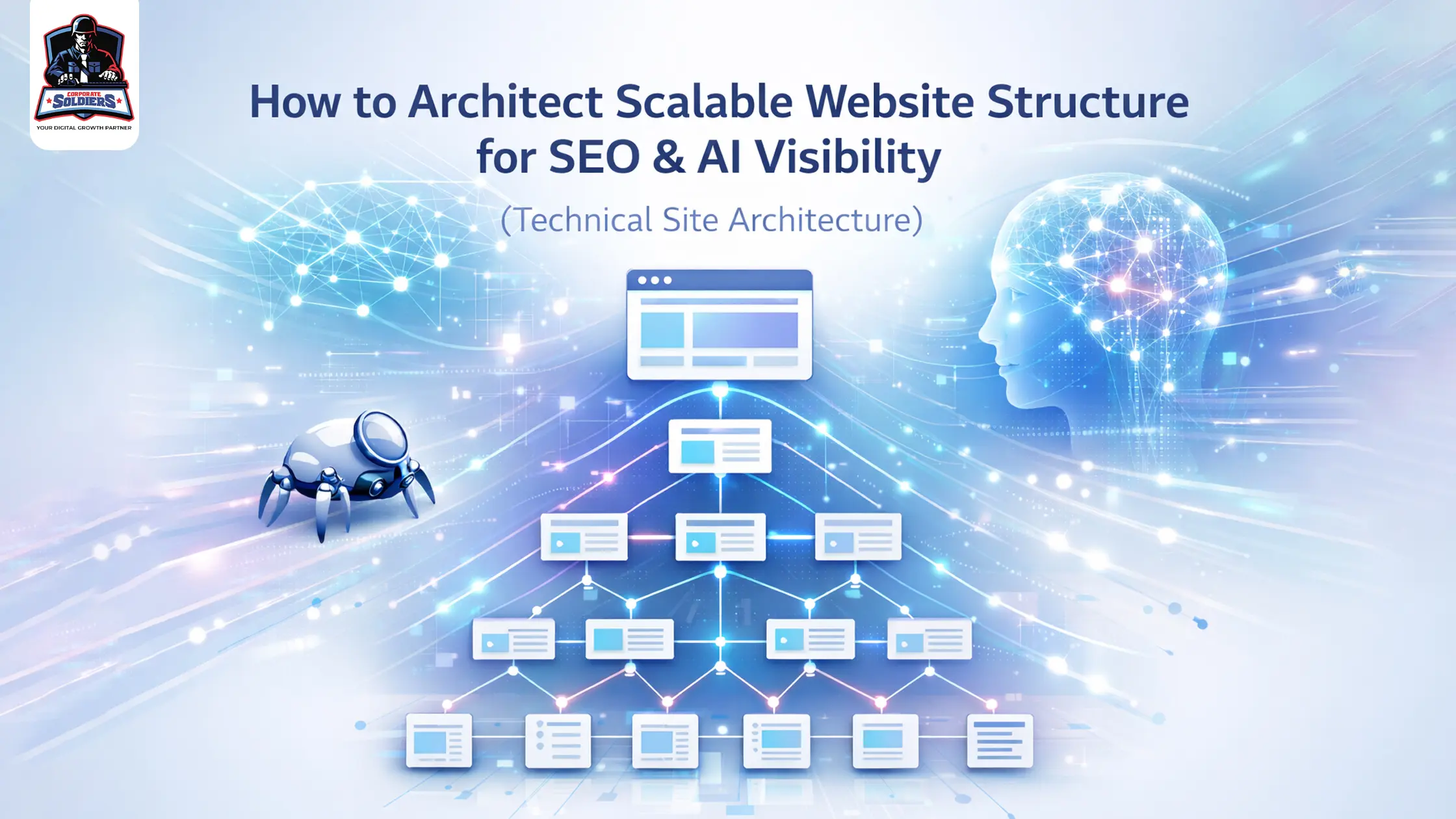
As search engines evolve beyond traditional keyword-based indexing, site architecture has become a foundational driver of scalable SEO performance and AI-driven visibility. Ranking in 2026 will not only be based on the quality of the content but also on the efficiency of search engines and AI technology to find, read, and rank your pages.
Scalable site structure will ensure Google crawlers and generative AI models (such as ChatGPT-driven search experiences, Google AI Overviews, and Perplexity) can logically access your content and establish what connections are relevant and present the correct pages as the expert answer.
This blog explores the core architectural principles that support scalable SEO performance and long-term AI discoverability.
The Website Architecture Is More Important in The AI Era Of Search
The traditional form of SEO paid a lot of attention to the optimization of individual pages. But nowadays more and more of the search algorithms consider websites as a network.
Google Search Central emphasizes that crawlability, internal linking, and logical site hierarchy directly influence discovery, indexing, and ranking of content. Moreover, AI-enhanced search engines are dependent on structured context, so the websites that are not organized well will find it hard to feature in the AI-created responses.
A scalable architecture helps:
- Enhance crawl performance and indexation speed
- Distribute authority across high-priority pages
- Improve topical and entity comprehension
- Help AI systems extract accurate, trustworthy information
In short, architecture has been turned into a ranking, visibility amplifier.
Core Principles of a Scalable SEO-Friendly Site Structure
- Establish a Clear Hierarchical Structure
The most scalable websites are organized in a logical pyramid structure:
- Homepage
- Category pages
- Subcategories
- Individual content pages
This structure helps search engines understand the priority of each page based on depth and placement.
One of the best practices that have been proven by technical SEO research is that significant pages should be within three clicks of the home page. Deeper pages do not receive as much crawl attention as they deserve or as strong ranking signals.
- Make AI Understanding Stronger with Topic Clusters
AI-based search engines are based on topical authority rather than single keywords. This is the reason why the topic cluster architecture is necessary.
A cluster model includes:
- An informational page (wide subject matter discussion)
- Supporting pages (particular sub topics)
- Strong internal linking between related pages
For example:
- Pillar: Technical SEO Guide
- Cluster pages: Crawl Budget,Schema Markup,Site Speed, Architecture
It is a kind of structure that assists AI systems to plot the relations and to consider your site as a piece of expert knowledge.
- Maximize Internal Page Linking and Crawl Flow and Authority
Internal links do not simply serve as navigation aids, they also influence ranking signals.
The industry research conducted by Ahrefs and Semrush states that the internal linking directly affects:
- Indexation of deeper pages
- Distribution of PageRank
- Topical semantic relationships
Best practices include:
- Link contextually within relevant content
- It involves the use of descriptive anchor text
- Eliminating orphan pages (zero internal links pages)
By having a scalable architecture all the significant pages are incorporated into the crawl ecosystem.
- Develop SEO Friendliness URL Structures
The design of the URLs should emulate hierarchy and simplicity.
A scalable URL structure looks like:
/services/seo/technical-seo/
Instead of:
/page?id=1234
Clean URLs help:
- Improve user trust
- Support AI systems in interpreting page context
- Reinforce topical grouping
Google suggests that URLS should be simple, consistent and should be relevant to the keyword and not overly parameterized.
- Value Technical Crawlability and Indexation Control
The most efficient structure will do little in so far as the search engines do not have the ability to crawl efficiently.
The main technical aspects are:
- XML sitemaps for discovery
- Crawl guidance robots.txt
- Duplication of tags is avoided using canonical tags
- Proper pagination handling
Massive websites also need to address the crawl budget, which makes sure that the Googlebot consumes valuable pages as opposed to the dead or redundant pages.
This is of particular significance to eCommerce and enterprise sites that have thousands of URLs.
Architecture Signals That Improve AI Visibility
Data and Entity Structure and Clarity.
Generative AI systems are very dependent on contextual structure. Schema markup helps define:
- Organization details
- Articles and authors
- FAQs
- Products and reviews
Schema enhances qualification to rich results and greater accuracy of AI extraction.
Indicatively, AI-generated summaries can be directly supported by FAQ schema.
Human and Machine-Supportive Navigation
Scalable architecture strikes the balance between UX and SEO.
The major navigation features are:
- Breadcrumbs that reinforce site hierarchy
- Menus in HTML (not entirely JavaScript-based)
- Consistent category structures
Breadcrumbs are also handy as they give both crawlers and AI models contextual information as to the relationship between pages.
Site Performance and Core Web Vitals
The speed is also affected by architecture
Core Web Vitals are damaged by poor structural choices, which might include heavy scripts, heavy navigation levels or renderers, or an inefficient renderer.
Google validates that performance indicators such as LCP and INP affect the search results, particularly in competitive queries.
Scalable architecture means that there is no slow down in growth.
Common Site Architecture Mistakes to Avoid
As powerful websites fail to pass the SEO scalability test, they also contain structural errors, such as:
- Nesting to a depth of more than 4-5
- Same category paths forming cannibalization
- Poor cluster to cluster internal linking
- AI systems are unable to place in context orphan content
- Excessive use of JavaScript and lack of SSR or prerendering
The architecture should also accommodate the traditional crawlers and AI-based systems of retrieval in modern search ecosystems.
Final Thoughts
Architecting a scalable website structure is one of the most research-backed, high-impact SEO strategies in the AI era. It determines how search engines crawl, how AI models interpret authority, and how users navigate content efficiently.
A well-structured site becomes more than a collection of pages—it becomes a trusted knowledge system that search engines and AI assistants rely on.
In an AI-first search landscape, scalable architecture is no longer optional. Websites that invest in strong hierarchy, structured data, and crawl-efficient frameworks will be the ones surfaced not only in rankings, but also in AI-generated answers.