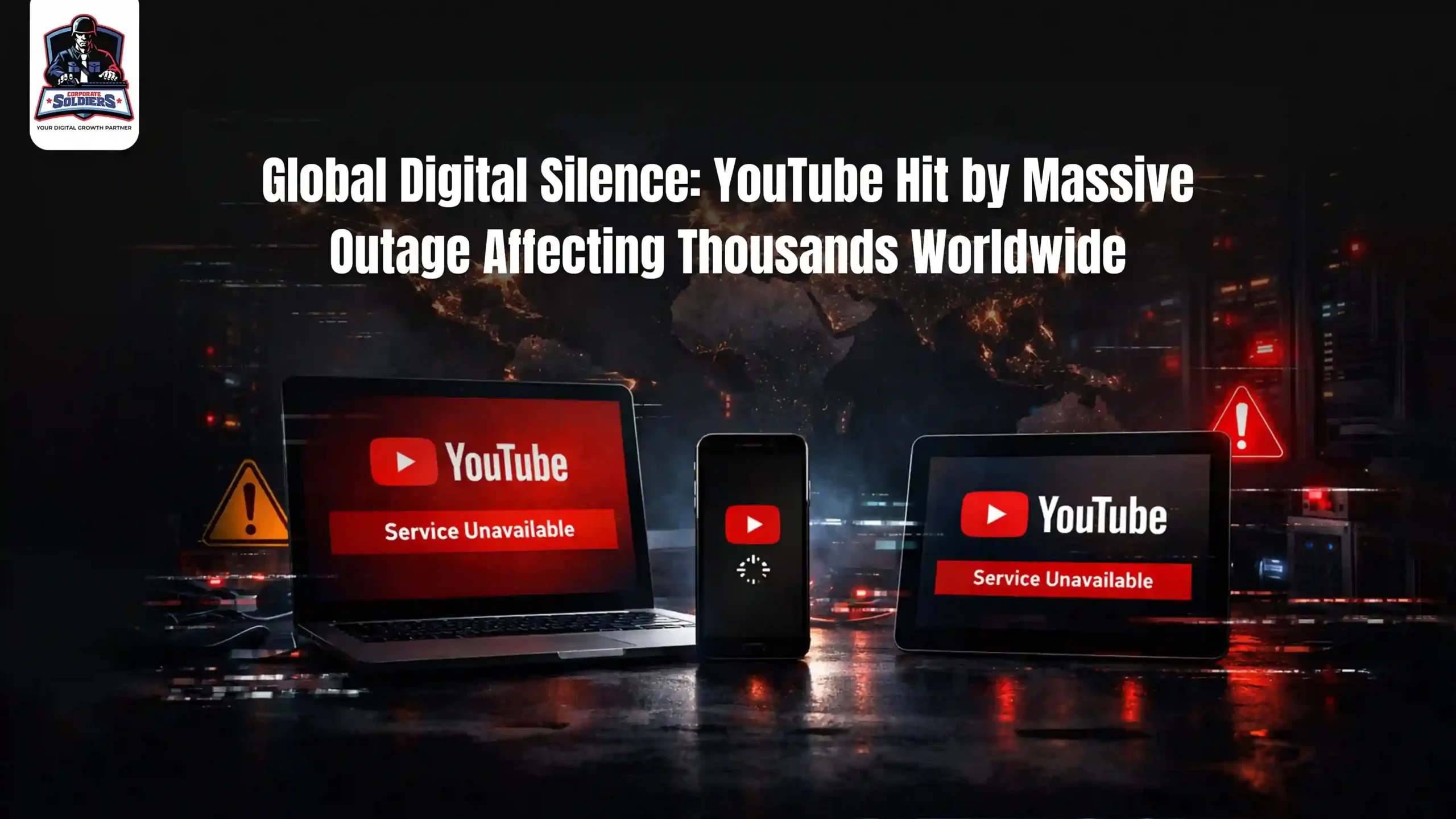
The internet pulse has missed a beat after YouTube, the world’s largest video-sharing platform, went offline globally recently. Thousands of users were forced to look at spinning wheels of death and error messages instead of their desired content on February 18, 2026. It was a several-hour disruption that was felt throughout the creator economy and emphasized how reliant the world has become on Google’s video infrastructure. To the common people in Mumbai and content developers in New York, the downturn was a sharp lesson on the vulnerability of our web-like digital existence.
The Scale of the Silence: Setting and Background
The initial shocks of the change were experienced in the early morning of the day when a sharp and abrupt spurt was observed in the reports on independent tracking sites. According to outage-tracking platform DownDetector, which compiles user-submitted reports and network diagnostics, the disruption was not limited to a single country. Rather, it was a coordinated failure that hit key hubs in North America, Europe, and Asia.
When the incident reached its climax, DownDetector registered hundreds of thousands of complaints globally at peak. Nonetheless, the analysts indicate that the real figure of the affected users was probably in the millions because many viewers just shut their apps without reporting them. These were complex problems: some users were able to open the homepage, but on clicking videos, they received the Playback Error messages. Others complained that the YouTube application would go dead as soon as they tried to open it and desktop users frequently encountered ‘500 Internal Server Error’ messages.
What Went Wrong? Technical Reflections and Recommendations
With the outage in progress, the technology fraternity was scrambling to find the cause of the problem. Although it is well known that Google is very guarded of its internal server architecture, the characteristics of the 500 Internal Server Error commonly indicate a server-level problem, i.e. that it was somewhere inside the data centers of YouTube or in a flawed update of their back-end code that the problem was occurring.
The official communication channel which is YouTube’s official support handle, @TeamYouTube, acknowledged the outage on X. The message was as follows: We know that some of you cannot access YouTube right now — our team is working on it. Here we will update you with any news.
Although the statement was rather short, experts in the industry were guessing that the problem could have been a deployment mistake in the Content Delivery Network (CDN) of the platform or an API bug that was making the frontend unable to contact the video storage servers. This was not merely a glitch but a major malfunction in the pipeline that transfers petabytes of data to global audiences every second.
The Social Media Firestorm: Response of the users
Without video material, users went to other platforms to express their dissatisfaction and a feeling of shared digital exile. The hashtag YouTubeDown was trending around the world within a few minutes of the initial report.
The responses were between the funny memes to the sincere concern on the part of the professional. One of the X users commented, YouTube is dead. I must now actually go and look at my family. Another one told how ironic the situation was: “Going to YouTube to find a tutorial on how to fix YouTube when it goes down only to realize that I can not do it.
To the professional fraternity, however, the note was darker. Digital marketers and full-time YouTubers showed concern with lost advertisement income and disrupted livestream programs. The loss of two hours of network connectivity may look insignificant to an average observer, but to someone doing a launch or a brand running a worldwide campaign it constitutes a big financial blow, as one digital strategist remarked.
Why Outages Like These Matter: The Expert View
According to industry observers, sporadic outages on platforms as large as YouTube have much larger implications than user inconvenience.
- Economic Impact
A huge creator economy lies on YouTube. Live commerce streams, monetized channels and brand partnerships are based on uninterrupted uptime. In the short term even interruptions can become:
- Lost ad impressions
- Discontinued sponsorship incorporations.
- Less real time donation revenue.
- Infrastructure Complexity
The video applications today are run on distributed cloud infrastructure across continents. Even a bug in a single layer of configuration, like load balancing, CDN routing or authentication services, can be used in minutes to propagate around the world.
- Trust and Platform Reliability
Frequent blackouts destroy confidence in the enterprise and creators particularly as YouTube grows to:
- Live sports streaming
- Subscription TV services
- High quality content distribution
According to analysts, with platforms developing into broadcast infrastructure, uptime expectations have shifted because of the telecom network as opposed to social applications.
Timeline of Events
- Early Morning (Global Time zone):
Initial customer complaints of problems with video playback and sluggish loading are registered.
- Within Hours:
DownDetector captures a drastic peak of outage reports in the U.S., U.K and India.
- Peak Disruption:
Millions of grievances recorded; the functionality of apps and websites is seriously restricted.
- Mid-Phase Response:
Customers experience occasional recovery – some videos will load and some will not.
- Gradual Restoration:
There is stabilization of playback and login systems regionally.
- Post-Incident:
To a great extent, services have been restored, and at the time of reporting, technical disclosure has not been shown in detail.
Conclusion: A Warning Signal for the Streaming Era
The global YouTube outage on February 18 might have been temporary, but it still stands as a strong reminder of just how ingrained streaming platforms have become in day-to-day digital life. YouTube has evolved to be a critical establishment instead of optional media, not just in the domains of entertainment and education but also in the lifestyles of creators and the marketing of their businesses.
Services were gradually restored within hours later, but the sheer magnitude of the disruption (in hundreds of thousands of complaints across the globe) underscores the fact that tech giants at planetary scales stand to lose a lot in terms of operations.
The most crucial questions at this point change to what follows:
- Will YouTube publish a complete technical post-mortem?
- Which redundancy upgrades will be taken?
- What will you do with the protections around creator revenue in the case of an outage?
Since streaming is positioning itself as the content layer dominating the internet, resilience and not reach will become the next frontier of platform dominance.