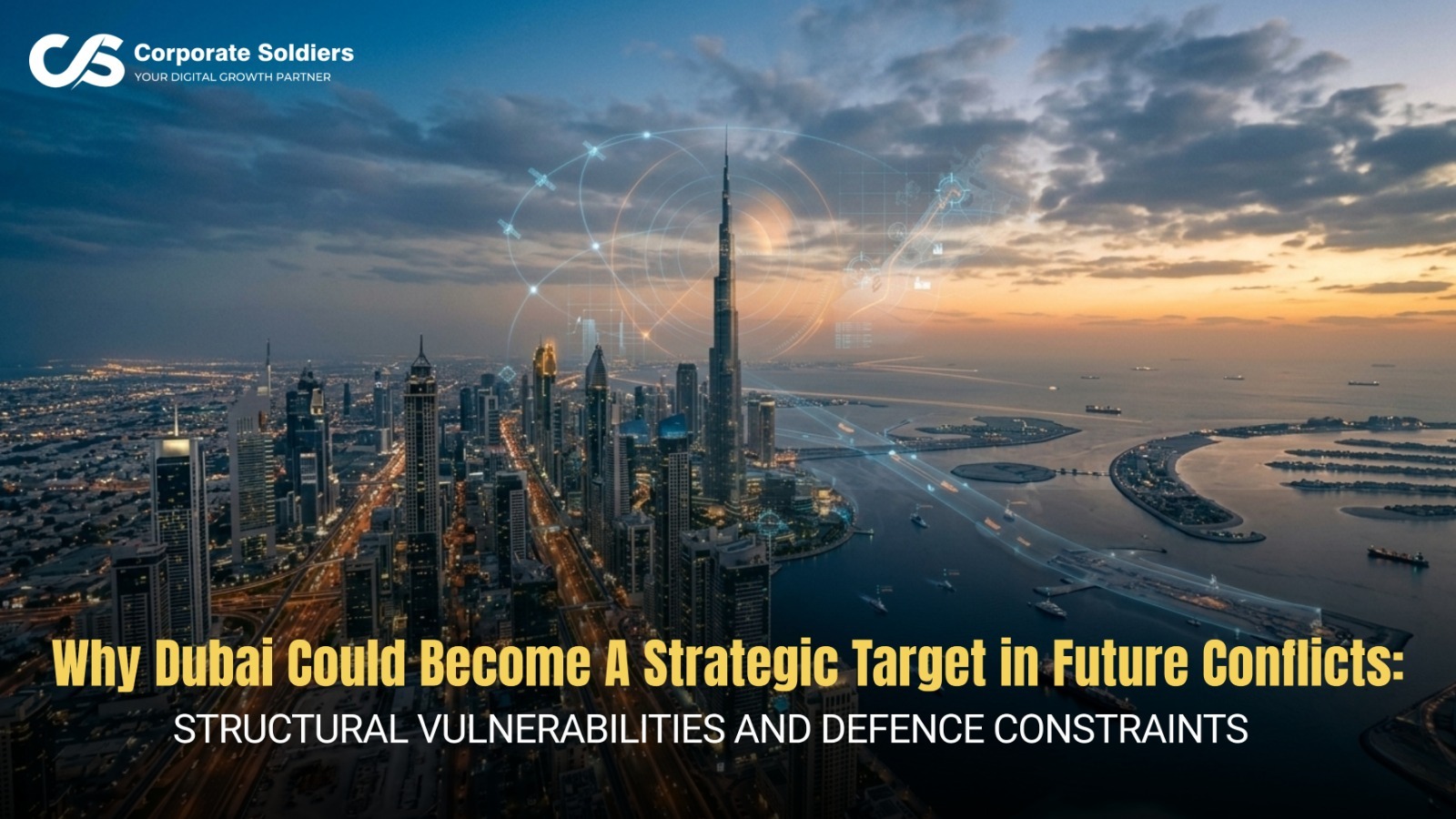
Dubai has established itself as one of the most successful cities in the globe with a financial-based city, based on luxury tourism, logistics infrastructure, and connectivity capabilities around the globe. In the last 20 years the city has metamorphosed itself to become a key economic centre between Asia, Europe and Africa. But the very things that drive Dubai to economical power, are the very things, which cause structural weaknesses, in the face of geopolitical conflict. Large financial centres that have a high population density and low depth of terrain usually are strategic targets in local wars in case of military strategy.
Dubai, a city in the gulf region that is encircled by intricate geopolitical contests, is occasionally considered by critics as the place that might experience some of the unreasonable threats in the event of massive military build up. This paper will look at the structural factors which make Dubai appear to be a relatively vulnerable target in the case of a war. It considers variables including exposure to geography, concentration of crucial infrastructure, defensive manpower constraints, dependence on foreign security arrangements, the recent incidences of missile and drone attacks in the broader Gulf region.
Strategic Geography and Regional Tensions
The geographical location of Dubai is the greatest strength of the country in peacetime but a possible weakness in times of conflict. The United Arab Emirates is located in one of the most sensitive regions in the world in terms of military interests in the Persian Gulf. Geopolitical conflict over the Gulf is not new and has seen regional players like Iran and Saudi Arabia and some non-state actors fight it out in the region. Even Dubai itself is not far away, a few hundred kilometers, remotely, in relation to a number of strategic flashpoints. As military analysts would observe, modern ballistic missiles and long range drones can be used to cover such distances within minutes. This distance creates a major impact on reaction time to the defensive mechanisms and it makes it more difficult to defend the high-density urban infrastructure.
The strategic significance of the Strait of Hormuz is another variable that adds to the vulnerability of the region. The maritime route is a very skinny strip joining the Persian Gulf to the rest of the world’s shipping routes and it is one of the most powerless routes of energy export and commerce. Although it is generally considered to be a chokepoint in terms of oil shipment, its purpose goes way beyond the energy markets. The strait is also a logistic lifeline of food and commercial cargo to the Gulf region. Any activity that disrupts this corridor can hence have an impact not only on the energy markets but also on vital civilian supply chains that support the high civilian populations in the Gulf cities.
The recent wars in the region are a typical illustration of such a danger. In the recent upsurge between Iran and the Western allied forces, missile and drone assaults were directed in the gulf infrastructures, airports, and military bases. These strikes showed how the contemporary weaponry system enables enemies to pose threats to the cities in the region without the need to use their conventional means on the ground. (Reuters) In the case of a city such as Dubai, which is the home to some of the busiest ports and the busiest airports in the world, this geographical vulnerability implies that even minor attacks would establish a major economic and psychological havoc.
Recent developments in the region also demonstrate how quickly such risks can translate into real disruptions. In the aftermath of Iranian missile activity in the Gulf region, debris from intercepted missiles reportedly caused a fire near Jebel Ali Port, the largest port in the Middle East. As a precautionary measure, the port temporarily shut down operations, highlighting how even indirect damage from missile incidents can interrupt one of the most important logistics hubs in the global shipping network.
Concentration of High Value Infrastructure
The other reason why Dubai may be considered as a strategic target is an unparalleled concentration of high value economic assets on a relatively limited urban footprint.
The emirate of Dubai is a home to one of the most important infrastructure in the middle east region with major airports, seaports, financial exchanges, logistics hubs and energy facilities being located in the city.
They are crucial both to the UAE economy and international supply chains. Infrastructure concentration tends to make infrastructure vulnerable in military strategy. Few successful strikes on critical facilities can create a disproportionate economic harm. In case, missile and drone attacks have been used before in the Gulf region, airports, ports, and energy infrastructure have been the targets.
In recent tensions, the UAE and the neighboring countries had strikes that hit airports, ports and residential zones which created significant disruptions and even led to temporary shutdown of financial markets. (Reuters) This explains how economic powerhouses such as Dubai would be exposed to cascading effects when a conflict arises in the region even when it has few attacks.
The financial markets themselves have recently reflected how sensitive Dubai’s economic ecosystem is to geopolitical stress. Within a short period of market volatility, the Dubai Financial Market (DFM) reportedly declined by around 10% in two days. Major companies that form the backbone of the emirate’s economy also experienced steep losses during the same period. Emaar Properties, one of Dubai’s largest real estate developers, and Emirates NBD, a leading banking institution in the UAE, both saw their shares fall by roughly 10% over the same timeframe.
The sharp decline prompted market regulators to tighten circuit breaker mechanisms on the Dubai Financial Market, reportedly reducing the daily limit to a negative 5 % threshold in an effort to prevent a more severe market collapse. Overall, financial analysts estimated that approximately $75–77 billion in UAE market wealth was erased within 48 hours during the period of heightened regional tensions.
Limited Military Size Compared to Regional Powers
The other structural issue is the relatively small size of the armed forces of the UAE compared to larger armies in the region. The United Arab Emirates Armed Forces is estimated to have about 65,000 active forces in all fields of the army, air force, navy and specialized forces. (GlobalMilitary.net)
The UAE military is technologically superior and is well-financed, but its total manpower is much lower than that of the larger states in the region. An example of this is that regional powers like Iran or Saudi Arabia have far greater military bases.
This is reflected in the military strength rankings. UAE is placed around 54th in the world in terms of ranked armed forces in the Global Firepower military index. (Global Firepower) This does not imply that the UAE does not have strong forces.
As a matter of fact, the nation has greatly invested in hi-tech equipment such as modern fighter jets and missile defence. Nonetheless, the small size of the personnel and little territorial depth may present operational challenges when the country is subjected to sustained attacks or multi direction attack.
Heavy Reliance on Imported Defence Systems
The UAE defence structure is also reliant on foreign military technology and international alliances, another structural element of the UAE defence structure.
The UAE has emerged as a major importer of high-technology weapons systems in the world and depends on the services of foreign defence suppliers to upgrade their military forces. During the period of 2019 to 2023 the country was also one of the largest importers of arms in the world as it acquired sophisticated systems in the United States and other European companies. (@RSIS_NTU)
The UAE has advanced air defence systems like Patriot and THAAD interceptors including missile launchers and advanced aircrafts like F 16 fighter jets. (Welcome | UAE Embassy)
Nevertheless, the use of imported technology may introduce strategic limitations in case of long term conflicts. The external partners may supply a chain of spares, munitions and interceptor missiles. The continuous supply of these systems becomes one of the key issues in case of high intensity conflicts.
According to recent military observers, in contemporary missile wars, defence mechanisms have to counter very high amounts of incoming missiles. Individual interceptions demand costly missiles such that defensive inventories might be lost in a short period in case the attacks are sustained over a long duration.
Urban Density and Civilian Exposure
Dubai is considered to be one of the most highly populated urban environments in the Middle East. The geographic areas of its skyline, high rise residential towers, luxury hotels, and financial areas are clustered in relatively smaller geographical areas.
Although this density fosters economic life and tourism, it may make a person more vulnerable in case of the war. The secondary hazards that may arise due to the interception of missiles in urban regions include falling debris or collateral damage.
Recently in the region, intercepted missiles have led to deaths and damage in spite of their successful interception by air defence systems. (WIRED)
A city with millions of visitors and thousands of international businesses cannot endure any inconvenience, and even small interruptions can cause significant effects in reputation and the economy.
A different aspect of civilian vulnerability played out in the recent escalations in the region as people were reported to practice panic buying in various cities in the UAE. People ran to empty shelves in supermarkets and stock the necessary items, which resulted in long queues in grocery stores and delays in online grocery delivery services.
This scenario was also made worse by the structural fact that the UAE relies on imports to provide more than 80% of its food. As far as the regional tensions interfere with the shipping routes, supply chains, or the functioning of ports, the impact can soon be transferred to the lack of supplies and consumer panic in such major urban centres like Dubai.
Food security has therefore become one of the less discussed but potentially critical vulnerabilities in the Gulf region. The United Arab Emirates imports roughly 80–90% of its food supply, while neighboring Saudi Arabia imports around 80% and Kuwait nearly 98%. The majority of these supplies travel through maritime routes connected to the Strait of Hormuz and other regional shipping corridors. This means that geopolitical instability affecting maritime transport could rapidly disrupt the availability of essential goods in urban markets.
In periods of heightened tension in the Strait of Hormuz, shipping costs and maritime insurance premiums can rise dramatically. Industry observers have reported instances where shipping rates surged by as much as 650%, while insurance costs for vessels operating in the region increased sharply due to the perceived security risks. Such spikes can significantly raise the cost of transporting essential goods into Gulf economies that depend heavily on imported supplies.
Such vulnerabilities can also trigger wider economic and social reactions. Global wheat prices have already shown sensitivity to geopolitical disruptions, and fertilizer shipments and agricultural supply chains have faced interruptions in recent years. Supply networks that were only beginning to recover from pandemic-related disruptions could again face strain if regional shipping routes become unstable.
Another concern highlighted by regional analysts is the limited duration of strategic food reserves across many Gulf states. Due to harsh climatic conditions and limited agricultural capacity, several countries in the region are estimated to maintain only two to three months of strategic food reserves. In the event of prolonged shipping disruptions or maritime blockades, such limited reserves could quickly place pressure on domestic supply systems and consumer markets.
Economic Dependence on Global Stability
The economic model of Dubai is heavily relying on international confidence, open trade, tourism and financial investment. Contrary to the situation in most oil producing regions, the Dubai economy is diversified in several ways like real estate, aviation, finance and tourism.
The city has experienced a fast growth due to this diversification. It however, is also true that the geopolitical instability may soon have a rapid impact on investor mood and world capitals.
Geopolitical tensions have in the past been met with a strong response by financial markets within the region. In recent regional escalation, the stock exchanges in the UAE have shut down temporarily as the authorities evaluated the situation after missile and drone attacks in the area. (Reuters)
These reactions show that even the sense of vulnerability may affect markets and investment flows.
During moments of heightened crisis, information control has also emerged as an additional factor shaping public perception. Reports circulated that authorities warned residents and social media users against spreading unverified footage or crisis-related information online. Posting material from unknown sources or circulating unconfirmed videos was said to carry severe penalties, including fines that could reach approximately $54,000 and potential prison sentences of up to 1 year.
Influencers and public figures in Dubai were reportedly advised to refrain from publishing commentary about the crisis situation on social media platforms. While official communications urged the public not to panic, restrictions on information sharing and precautionary security measures — including airport lockdowns and financial market controls — demonstrated how quickly authorities may act to contain instability during regional crises.
Limited Strategic Depth
Strategic depth is the distance between the national borders and major economical centers of a country. Nations enjoying sizable portions of land usually enjoy this buffer since the major infrastructure can be placed distant to the regions that may be at risk.
Smaller states with concentrative urban centers on the other hand are likely to have limited strategic depth. The large infrastructure in Dubai such as airports, ports, and financial areas are situated near the coast and close to relatively short distances of the potential threat vectors.
This geographical fact implies that the defensive systems have to act quickly in case of any threat-related situation and there is not much room to err.
Dubai has continued to be one of the most vibrant economic cities in the world and a central business and logistics hub. It has been fueled by strategic infrastructure, connectivity, and business friendly policies which have enabled it to become an international financial center.
Nevertheless, structurally speaking, there are a number of reasons as to why it may prove vulnerable in large scale conflicts based on geopolitical reasons and military ones. These are its closeness to regional flash points, concentration of vital infrastructure, an otherwise small military force, reliance on imported military technology and limited depth in strategy.
Although UAE has made significant investments into the advanced defence systems and alliances with other regional security agencies, the dynamic nature of present day warfare, particularly missile and drone based attacks, ensures that such economic centres as Dubai might still be vulnerable to strategic dangers at times of geopolitical tensions.
This knowledge of the vulnerabilities is critical to policymakers, investors, and security analysts when assessing the viability of major global cities in geopolitically sensitive locations in the long term.