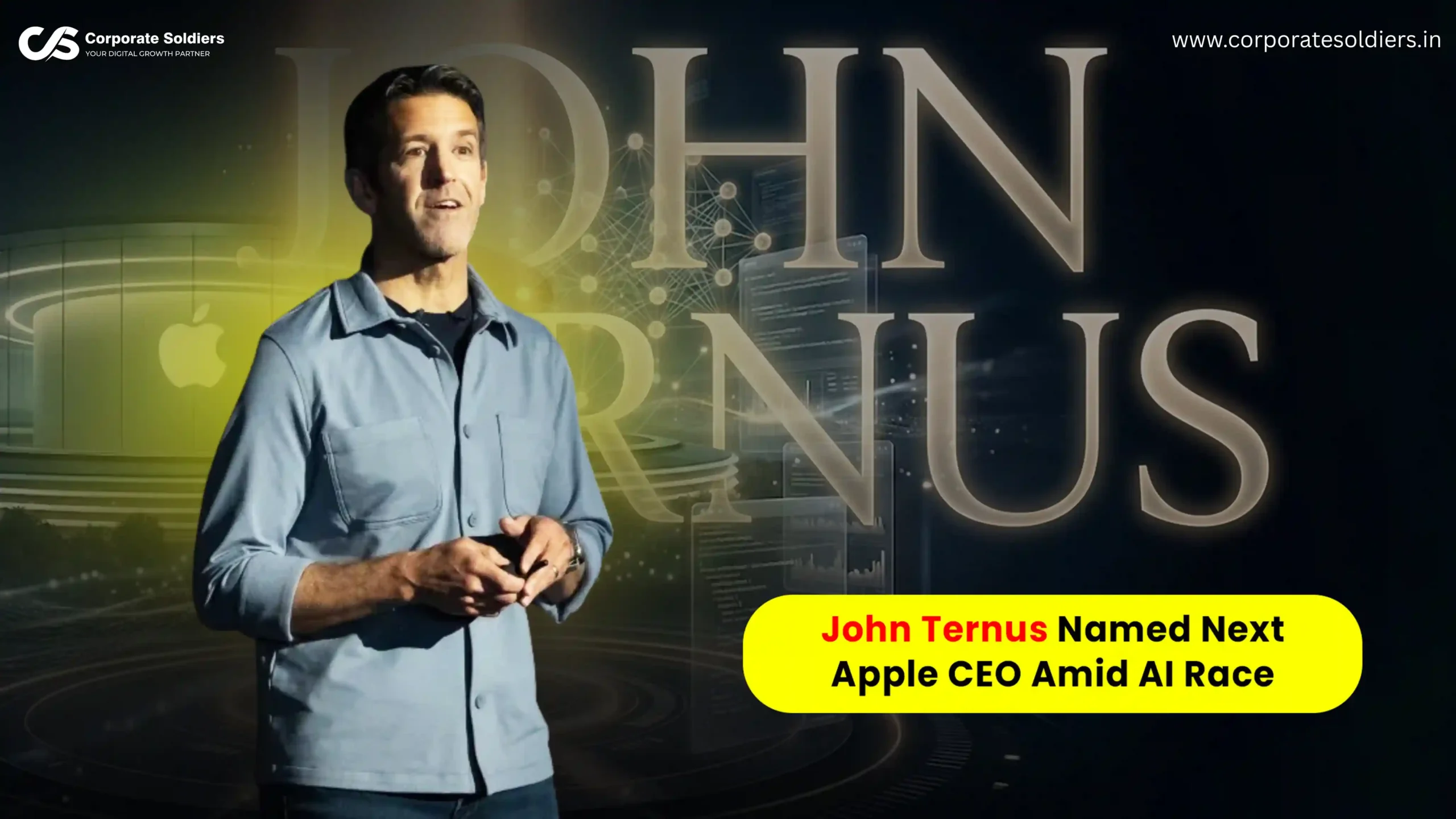
The long-term leadership path of Apple Inc has recently returned to the spotlight thanks to industry discussions, with reports and commentary by analysts slowly but surely confirming John Ternus as the next CEO of Apple Inc, with Tim Cook set to transition into the role of Executive Chairman later in 2026.
With the leadership transition now formally announced, the development highlights a larger strategic concern that Apple is grappling with: how the company can position itself in a new world that is more and more dominated by artificial intelligence, as the competitive landscape becomes more and more cutthroat, both in hardware and software.
The global presence and dominance of Apple in consumer technology, along with its highly-connected ecosystem, makes any debate about executive succession the center of attention in the whole industry. The fact that a hardware-oriented executive may become the top executive, adds another dimension of strategic importance.
The leadership transition has been formally announced and is scheduled to take effect on September 1, 2026.
Tim Cook Era: The Operator Who Built a $4 Trillion Giant
Tim Cook became the leader of Apple in 2011 and he had to replace Steve Jobs in the era of severe scrutiny as to continuity and innovation. During the next 10 years, Cook transformed the internal organization of Apple with the emphasis on the operational discipline and supply chain excellence.
The main features of the Cook era are:
- Operational mastery: The Apple global supply chain was one of the most efficient and resilient technology industry supply chains.
- Growth in finance: During his tenure, Apple has become one of the most valuable companies in the world, briefly reaching a valuation of $4 trillion in its highest points.
- Scaling of the ecosystem: The company enhanced its services business and retained its leadership in the flagship hardware products like the iPhone, Mac and iPad.
Cook is commonly considered to be one of the most successful operations CEOs in technological history with his leadership approach being more characterized by execution than product creation.
Who is John Ternus?
John Ternus is a vastly different leadership profile in the Apple executive set up. Ternus, unlike a lot of the Silicon Valley executives, is technologically based, instead of being financial or MBA-heavy.
He has an academic and professional background of:
- University of Pennsylvania B.S. degree in mechanical engineering.
- A career that is wholly developed in the Apple hardware engineering organization.
- No business-school training, a strength supporting his engineering-first type of leader.
In the hierarchy of leadership at Apple, Ternus can be said to be a member of a new breed of leaders that has ascended to the top through technical expertise rather than general management channels. He is also known to be one of the youngest in the executive team of Apple.
The Hardware Legacy: Ternus’ Contributions
Within the last 10 years, Ternus has been at the core of the Apple hardware development. Some of the biggest technological changes within the company have been directly linked with his leadership.
Notable contributions include:
- Apple Silicon transition: Ternus has been widely credited with a leadership role in Apple’s shift from Intel processors to custom-designed Apple Silicon chips, beginning with the M1 generation.
- Efficiency transformation in performance: This change was a major enhancement in performance-per-watt in all Mac devices, redefining the Apple-computer line.
- Involvement in product ecosystems: His work has spanned several product lines, such as Mac, iPhone hardware integration, iPad architecture considerations, AirPods, and more recent product lines, such as Vision Pro.
This hardware-first strategy has strengthened the capability of Apple to closely unify silicon, devices and software into a single ecosystem- one of its longest lasting competitive advantages.
Apple in the AI Era: The Core Challenge
Irrespective of its leadership in hardware, Apple is confronting a changing competitive environment that is influenced by artificial intelligence. The wider technology sector is quickly focusing on AI-native functionality at the device, service and cloud infrastructure levels.
Within this context:
- The competitors have been vigorously promoting big AI models and platform integrations.
- Apple has focused its efforts on a more privacy-conscious and on-device AI, and has focused on controlled rollout instead of quick growth.
- The perception-action issue in AI capabilities has become a cliched theme in industry analysis.
This is a strategic contradiction: Apple has not been surpassed in its hardware integration and ecosystem design, but it is often compared to its competitors who are leaders in the large-scale generative AI systems.
Strategic Analysis: Why Ternus, Why Now?
The leadership transition to a hardware executive like John Ternus represents more than a mere change of personnel, but a broader strategic shift.
Some of the most important interpretive aspects are:
- Change of innovation focus: A shift in leadership towards product- and engineering-oriented leadership, possibly at the expense of operations-oriented leadership, might reflect a new interest in hardware-software co-design.
- Integration of AI requires: AI systems of the future are anticipated to be wholly incorporated into devices, which means that hardware architecture will gain more importance in AI performance and efficiency.
- Engineering-based approach: A CEO who has a solid technical background can be in a better position to coordinate chip development, device design, and AI integration with one roadmap.
Nonetheless, it would also be a structural change of philosophy of leadership and no longer be as much of an operational stability that has characterized the modern Apple.
Industry Implications
Should any talk about a leadership change in the event of John Ternus being elevated manifest as a formal change of leadership in the future, the impact on the industry and Apple would be enormous:
- The development of product roadmap: More focus might be put on hardware innovation cycles and silicon-first development plans.
- AI-device integration: The Apple strategy towards artificial intelligence can be more deeply incorporated as a hardware-level feature, as opposed to being a cloud-based one.
- Competitive positioning: The company can also further differentiate by re-investing in vertically integrated AI hardware ecosystems instead of competing in the open AI platform markets.
These are all hypothetical, yet they underscore the importance of the strategic baggage of leadership stories at Apple.
The transition from Tim Cook to John Ternus represents a fundamental evolution for Apple. Cook took the blueprint of a visionary and built it into a global empire; Ternus now inherits that empire at a moment when the very nature of computing is changing.
Whether an engineering-led future is enough to close the gap in the AI race remains to be seen. However, by placing a product expert at the helm, Apple is betting that its hardware-software fortress is the best foundation for the next 50 years of innovation. The “Operator” has built the stage; now, the “Engineer” must build what comes next.