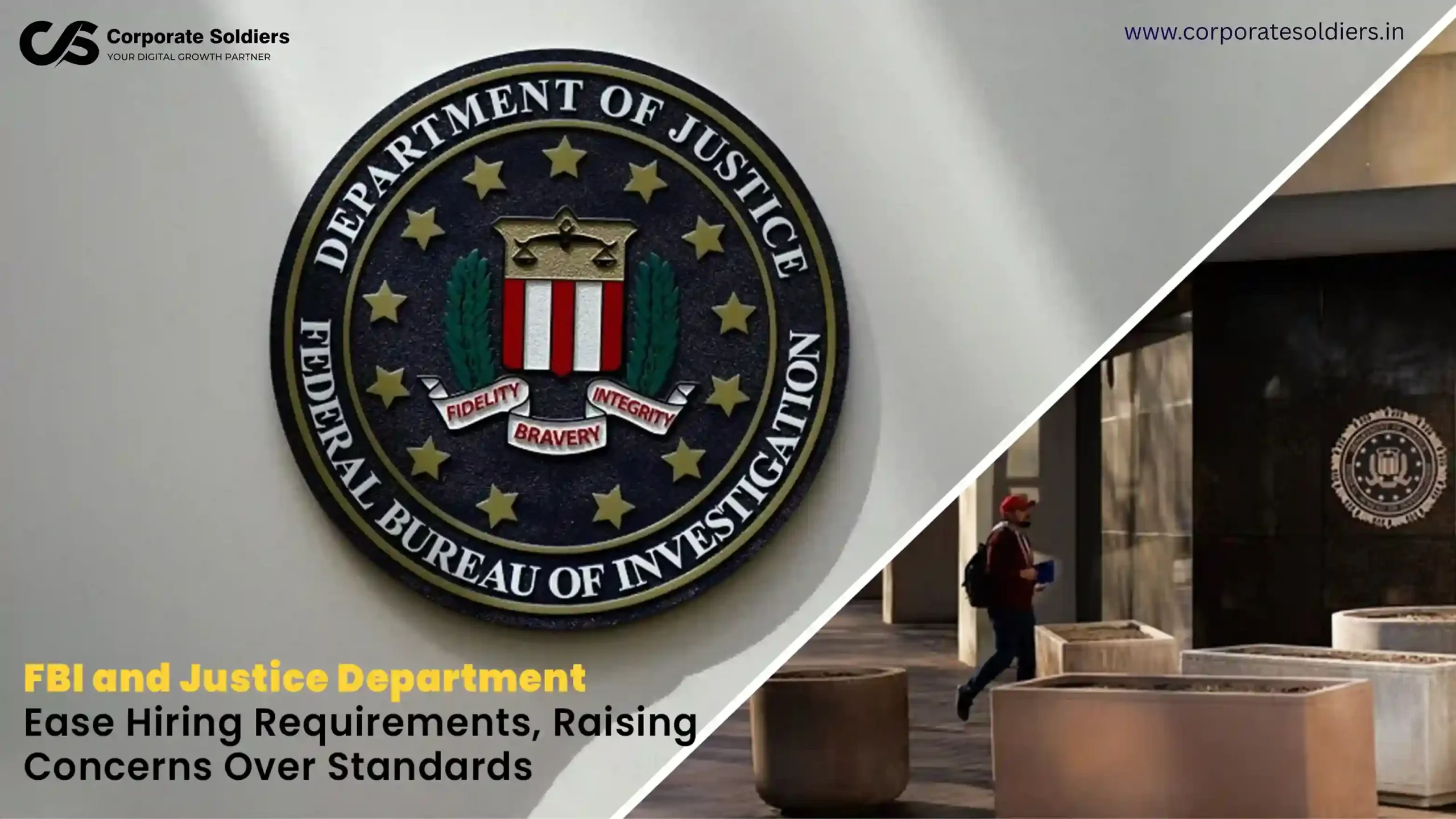
Introduction: Recruitment Standards and National Security
The effectiveness, credibility and operational integrity of the national security institutions is highly determined by the standards of the recruitment. Law enforcement and intelligence gathering agencies depend on stringent selection procedures that make sure that the staff fulfills high ethical, physical and professional standards.
This issue has been brought back into the limelight as of late with the Federal Bureau of Investigation (FBI) and the US Department of Justice (DOJ). The two institutions have also come up with changes in their hiring conditions, an act that has elicited debate among policy makers and ex-officials. The key question which arises as a result of this change is whether the relaxation of entry requirements will impact on institutional norms.
What Has Changed in the Hiring Requirement?
In a bid to increase the number of candidates, the FBI and the US Justice Department have changed some of their recruitment requirements. These are the changes in the form of softening certain eligibility requirements that used to be viewed as tough entry barriers.
Although the nature of the changes may differ depending on the role, the general pattern is that it will entail increased flexibility in regards to background factors and eligibility criteria. This is not meant to eliminate vetting procedures but to instead tune them to the present-day workforce realities. Some of the specific adjustments include shortening training requirements for candidates transferring from other government agencies and waiving certain assessments for internal applicants in select cases. Additionally, there is increased flexibility in hiring prosecutors directly from law school without prior professional experience, along with efforts to accelerate recruitment through alternative outreach methods.
These changes are more or less operational in nature. The two agencies are experiencing the growing need of specialised skills, especially in the field of digital intelligence, cybersecurity, and data analysis. They eliminate some requirements to recruit the candidates that could have the essential technical skills but not fit the conventional eligibility standards.
Reasons Behind the Policy Shift
The move to restructure the FBI hiring needs and recruitment policies of the US Justice Department indicates that there are more structural issues in the labour market.
- Workforce Depletion Due to Resignations and Firings
Both agencies have experienced a significant reduction in staff over the past year due to a combination of resignations and dismissals. This has created operational gaps, prompting an urgent need to rebuild the workforce and maintain institutional capacity.
- Talent Shortages
Federal agencies are facing challenges of receiving a good pool of qualified candidates. This is mostly apparent in specialised areas where the demand is much higher than supply.
- Competition from the Private Sector
The opportunities in the private sector are usually very attractive to highly skilled professionals, in particular, the ones with a strong focus on technology and cybersecurity, as they are better paid and have more flexible working processes. This restricts the government in competing to get the best talent.
- Evolving Skill Requirements
The modern police are relying more and more on high-tech abilities. Conventional methods of recruitment, whereby emphasis was laid on physical and procedural skills, is being reconsidered to fit new skills.
All these aspects lead to the necessity of changes in the FBI policies that focus on flexibility and at the same time make an effort to ensure operational efficiency.
Concerns Raised by Officials
Although there was a strategic motivation of these changes, some current and past officials have been worried about their possible implications.
One of the concerns is the risk of a lowering of standards. According to critics, even partial loosening of hiring requirements could weaken over time the high standards that have traditionally characterized the federal law enforcement agencies.
Long-term institutional impact is also a matter of concern. The organisational culture, discipline, and perception of the organisation are closely related to recruitment standards. Any change, even a minor change, can impact the perceptions of these agencies within and without.
It should be pointed out that these issues are not the final decision as these issues are the subject of a continuous debate. The agencies have not shown any plan of compromising core vetting procedures and ethical demands.
Balancing Accessibility and Standards
The present condition of affairs is a key difficulty in the recruitment of the public sector: balancing inclusivity and excellence.
On the one hand, the increase of access to a wider range of talents will help increase the level of diversity, introduce new views, and close the important skills gaps. Conversely, it is important to have high standards in hiring law enforcement personnel to keep accountability, professionalism and reliability of its operations.
In the case of agencies such as the FBI and DOJ, it is necessary to achieve a balance between a strong recruitment process and the ability to adjust to modern working requirements. This is by enhancing assessment techniques instead of abolishing them.
Implications for National Security and Public Trust
Recruitment criteria directly relate to the national security workforce effectiveness. Staff quality impacts decision-making, accuracy of investigations and capability to react to intricate threats.
In addition to operational issues, the element of public trust is also important. The law enforcing bodies acquire legitimacy based on their perceived effectiveness and uprightness. Any implication that there is a watering down of standards may have an impact on trust in citizens.
These policy adjustments in the long term will depend on results. In case the agencies can retain the level of performance and diversify the talent pool, the transformations can be considered to be a natural evolution. On the other hand, any decrease in performance would strengthen the existing anxieties.
Global Perspective
The change witnessed in the United States is a global trend. Numerous nations are reevaluating the systems used in recruiting the security and intelligence services due to such setbacks.
In Europe and Asia, governments, in particular, have started to place more emphasis on digital capabilities and interdisciplinary skills, when hiring. This usually entails a change in the conventional requirements of eligibility to suit candidates whose backgrounds are not the conventional ones.
The changes in the FBI policy in this case can be regarded as part of the broader response to changing security situations and the dynamics of the workforce.
Conclusion
The resolution by the FBI and the US Department of Justice to relax some of the hiring conditions is a crucial move in federal recruitment strategy. It highlights that there has been an increasing necessity to adjust to evolving skills requirements and labour markets.
Meanwhile, the issues brought up by officials demonstrate the need to uphold the institutional standards. The discussion is indicative of a larger conflict between access and quality in the hiring processes of the public sector.
The success of such changes in the future will be determined by the ability of agencies to cope with this balance. The inclusion and rigor of recruitment processes will be key to ensuring the integrity of operations and public trust in the coming years.