A Ticking Clock
At the sterile, fluorescent-lit corridors of Indraprastha Apollo Hospital, New Delhi, time was no longer measured in hours and minutes, it was a countdown. On May 2nd, a 14-year-old boy from Sudan lay in the intensive care unit, his failing heart barely sustaining him. He had less than 24 hours to live.
Meanwhile, 250 kilometers away in a military hospital in Panchkula, another story was unfolding one that would ultimately change his life forever. Medical teams were navigating the intricacies of international transplant protocols. There, the clock was ticking for a different reason. It marked the commencement of a great cycle of loss and salvation a contest to fill the gap between a tragic ending and a new beginning.
The Hero in the Shadows: Sudeshna’s Legacy
\Sudeshna Singh, 41, a teacher devoted to her job and the wife of an Army officer, is the hero of this story. She had lived a selfless and caring life, which abruptly and painfully ended due to a huge brain hemorrhage. Her family was forced to confront an unimaginable decision. In the depth of their grief, they chose to look beyond their loss. With remarkable courage led in part by her daughter they decided to donate her organs. Her decision did not save just one life it gave multiple patients a second chance at survival.
The Race Against Time
The logistical mission commenced when the confirmation of the cross-match came in. The heart is a very delicate organ; it has a very narrow window of viability – normally four to six hours – once it is removed from the donor. Every second was critical, and any delay could have jeopardized the mission.
- The Retrieval: A special medical team at Apollo Hospital was rushed to Panchkula to extract the organ in a medical manner.
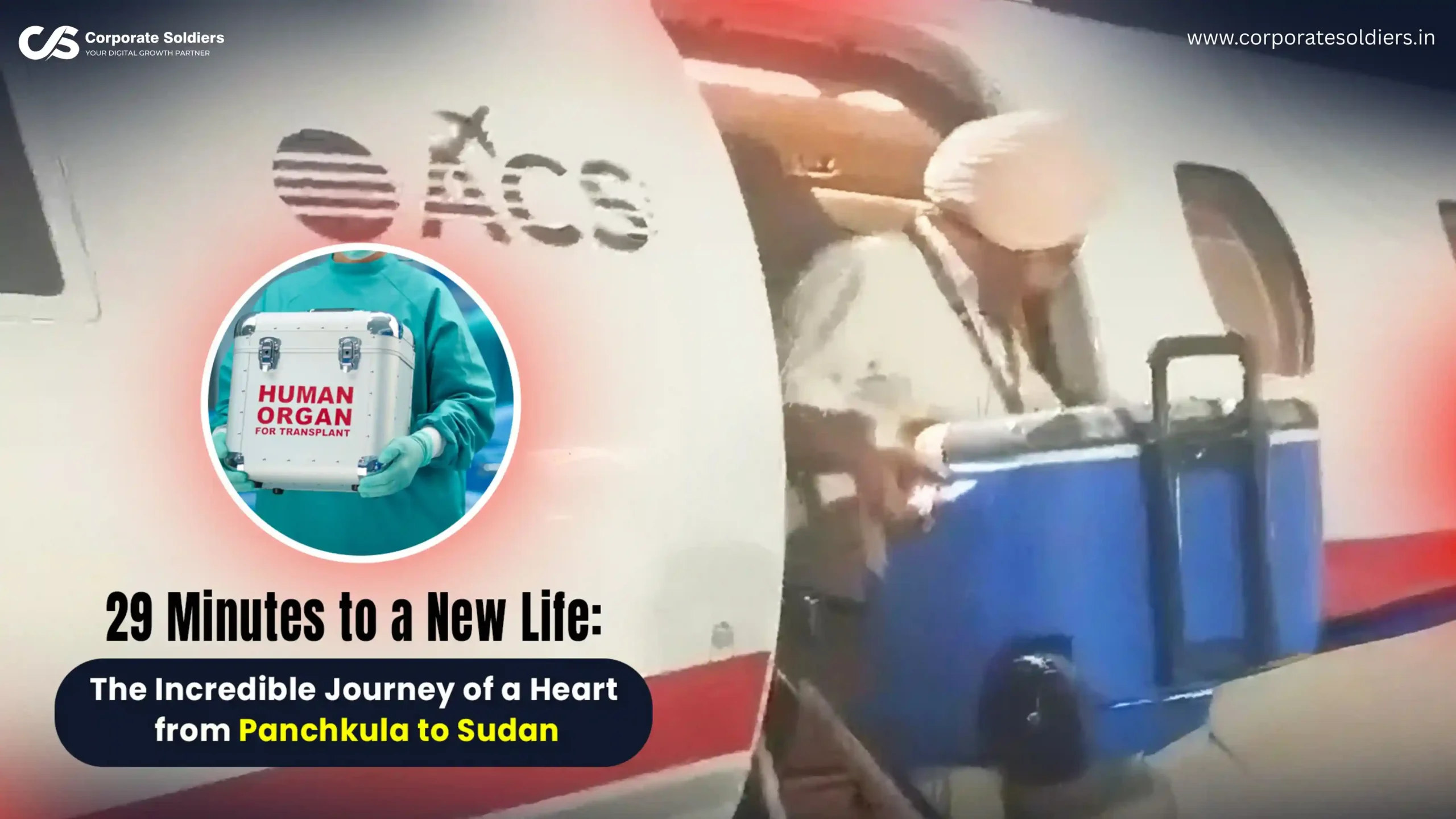
- The Flight: The team had the heart and boarded a flight, which travelled the distance to Delhi in a whopping 29 minutes.
- The Ground Movement: When the organ landed, the pre-coordinated Green Corridor executed with the precision of the Delhi Police. allowed the ambulance to cut through the hustle and bustle of Delhi traffic in just 20 minutes.
How a Green Corridor Works
A Green Corridor is an extremely coordinated, high stakes logistics action. It entails coordination with the Delhi Police and traffic authorities to create a route without traffic signals or congestion for an emergency vehicle. All the traffic lights along the route are manually switched to green to keep the ambulance moving at a steady and high velocity taking it through the organ delivery time window.
The Miracle at Midnight: Sudan Meets India
The environment in the operating theatre in Indraprastha Apollo Hospital was one of extreme and silent concentration. Dr. Mukesh Goel and his surgical team were on the alert and the burden of the moment lay upon them.
The operation was started with the highest degree of accuracy when the harvested heart arrived. The team operated in a delicate, hours-long procedure, to replace the failing organ. As the final sutures were completed and circulation was restored, the room fell into tense silence. Then, the monitor registered a steady, rhythmic pulse. The heart which had belonged to a teacher in Panchkula, had started to beat in the chest of a Sudanese teenager.
Humanity Without Borders
This mission went beyond the geographical, national and political boundaries. It was a tribute to the fact that when medicine comes in contact with humanity, the barriers are broken down.
The collaboration between the Army family in Haryana and the medical staff in Delhi and the international patient highlights a universal truth that biology is not discriminative towards nationality. This surgery was a success and it is a heartrending reminder of how weak we all are and how much we can do to be altruistic.
In the operating theater, there are no borders, only the pulse of a second chance.
Why This Matters to You
This story is not an isolated case, it highlights a critical gap in organ donation.
Did You Know?
- The Impact: One organ donor can save as many as 8 lives by donating their heart, lungs, liver, kidneys, pancreas and intestines.
- The Need: In India, there is still a significant gap between the amount of patients who are waiting to get an organ transplant, and the availability of donors. Thousands of lives are lost every year because a suitable organ is not found in time.
- The Action: Becoming an organ donor is a not-so-complicated process, taking only several minutes of your time, though leaving countless possibilities to those who are on the brink of life.
You may register your intentions to be an organ donor on the Internet on the site of the National Organ and Tissue Transplant Organization (NOTTO) or in the transplant registry of your local hospital.
Final Thoughts: A Silent Thank You
The journey of the heart from Panchkula to Delhi was more than a medical triumph; it was a profound act of love. As we reflect on this mission, we pay tribute to the memory of Sudeshna Singh and the extraordinary strength of her family.
While the boy from Sudan received a new life, the legacy of the teacher from Panchkula continues to beat, pulsing with vitality in another chest. Her story serves as a reminder that even in the face of death, there is the potential for profound, enduring life.