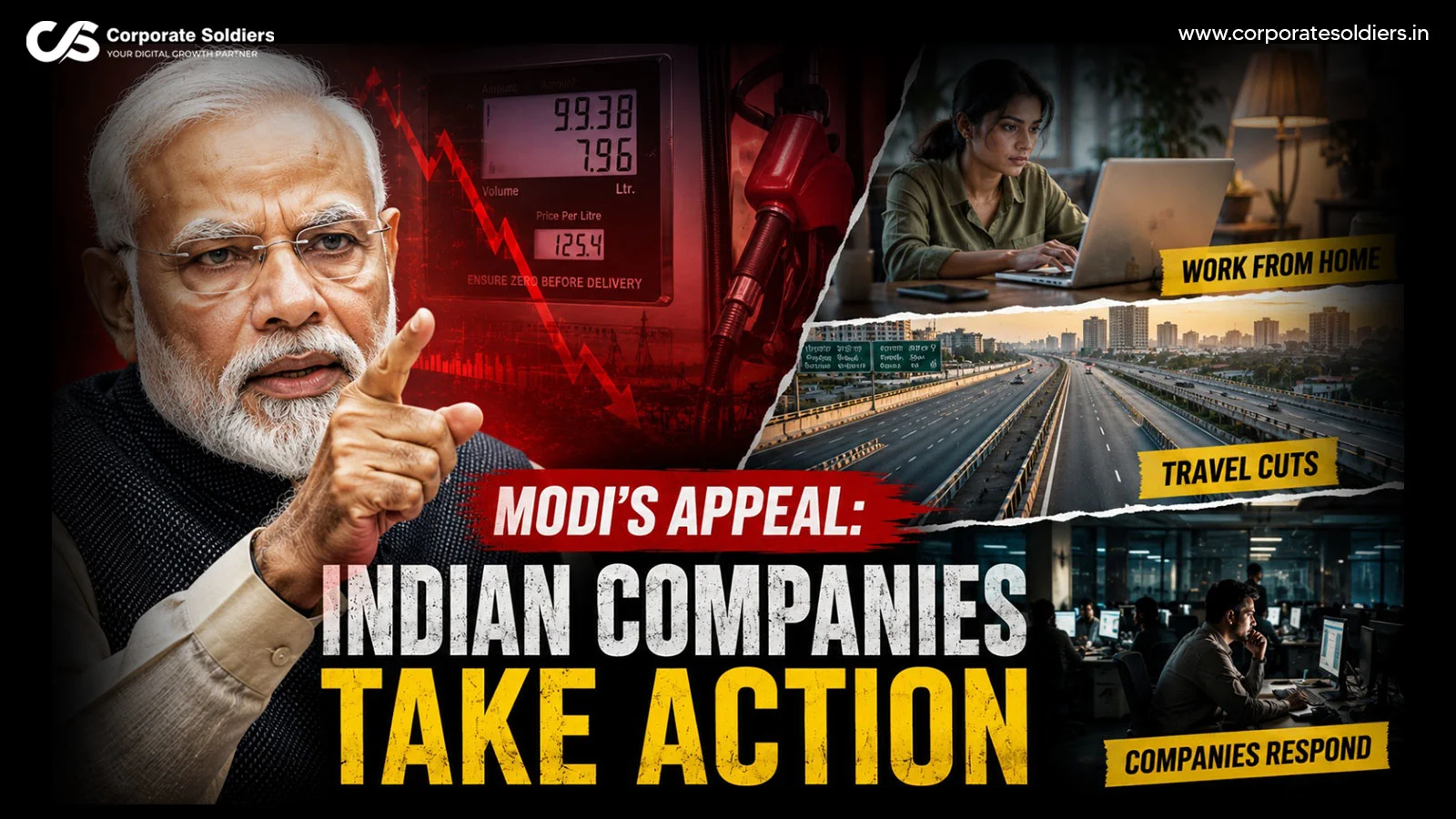
The government recently urged the business community to prioritize foreign exchange (forex) conservation by adopting operational measures such as work-from-home (WFH) flexibility and reducing non-essential travel. With uncertainty in the world economy, it is important to adopt a more conservative approach to resource management, which is what this appeal calls for.
The Prime Minister’s appeal has received support from several major business groups and industry leaders, who have now accepted that they need to work together and harmonize with macro-economic stability. The development also reflects a broader shift in corporate India toward aligning business operations with larger national economic priorities.
What PM Modi’s Appeal Focused On
The move by the government had multiple aspects to it – in terms of being agile in operations and being prudent in finances, so as to safeguard the economy from shocks that could emanate from the outside.
Encouraging Work-From-Home Flexibility
Flexible working practices being made operationally feasible were emphasised. The government wants to reduce the huge daily human migration by allowing work from home, thereby reducing the strain on public infrastructure, and, significantly, India’s overall fuel consumption, a major contributor to its import bill.
Reducing Non-Essential Business Travel
One of the fundamental principles of the appeal was to cut down unnecessary domestic and international trips. The Prime Minister called on companies to adopt digital communication channels to hold meetings and conferences. Travel optimization is considered as a direct weapon to reduce excessive costs of a business firm and especially its outflow of foreign currency, associated with air travel and accommodation abroad.
Focus on Forex Conservation
It was not just a benefit to the company in terms of saving on their expenses, it was also more important in terms of conserving India’s foreign exchange reserves. The government feels that the operation decisions taken by corporations like imports, travel etc. are important aspects to maintain macroeconomic stability and Rupee strength in the prevailing volatile oil price environment, which has got badly affected by the disruptions in global supply chains.
How Indian Businesses reacted
The corporate world has taken an active role – some corporate leaders and trade organisations have expressed their support on these goals.
Companies That Support a Hybrid and/or Remote Work Model
Several leading IT, GCC (Global Capability Centers), and professional services firms indicated that they are prepared to continue hybrid workplace models. Industry leaders noted that the digital infrastructure and collaboration systems developed during the pandemic continue to support efficient remote operations. The new collaboration tools that are digital have come a long way and in many aspects have made it possible to work collaboratively from a distance, yet still perform tasks with a high degree of efficiency.
Corporate Push Toward Cost Optimization
Many organizations are already prioritizing cost optimization by reducing discretionary spending, including travel and office infrastructure expenses. The cost of travel is being reduced as well as office space usage, with fewer international “fly-ins” for leadership meetings, and the office space used more efficiently. This convergence of the national interest and corporate profitability has been speeding up the implementation of these measures.
Business Leaders Backing Responsible Corporate Practices
This has been termed as the “responsible corporate citizenship” by leading business leaders in the Indian Inc. Operational efficiency, resource optimization is no longer just a measure to be internalized, but a factor which is necessary to create a sustainable and resilient Indian economy, argue business leaders.
Why This Matters for India’s Economy
This change in approach by companies has wide ranging repercussions for India’s economic parameters and its digital course of action.
Impact on Fuel Consumption and Imports
India still continues to import the largest amount of crude oil from all over the world. In addition to the above, the corporate sector can also save on the daily commute, particularly by working from home, as well as on air travel which if significant would result in a significant saving of fuel for the nation. This translates directly into reduction in current account deficit (CAD) and helps the economy not be affected by price rise in energy markets in the world.
Digital Transformation of Corporate India
That’s the government’s push that’s been a factor that’s helping to drive higher digital adoption. The industries are investing heavily in the following to support the ability to work remotely and collaborate virtually:
- Cloud infrastructure to improve accessibility and remote operations
- Cybersecurity systems to secure decentralized digital networks
- AI-powered collaboration tools to improve virtual coordination and workflow management
Operational Resilience and Business Continuity
Flexible work arrangements can provide a cushion against weather and other local events or conditions that can disrupt work, such as the weather or physical health. It is a positive development for India Inc, which has improved the business continuity plan, as it is the shift from a work-from-office to work-from-home model – which it has been implementing for a while now – as a measure to sustain the economy in the times of constrictions.
Challenges Associated With Extended WFH Models
The advantages are clear, but the change is fraught with complexities and some of the aspects are not comfortable with India Inc.
Productivity and Team Coordination Concerns
There’s a discussion that’s going on about “spontaneous collaboration”. Many managers remain concerned about collaboration gaps, employee engagement, mentorship, and communication efficiency in extended remote work environments.
Impact on Office Ecosystems
The permanent shift to WFH, the commercial real estate industry, facility management and the small businesses (catering, local transport) surrounding offices are all impacted by the change in the “office economy”. Challenges include the trade-offs of benefits of WFH and health of these secondary ecosystems.
Well-Being of employees and Work-Life balance
While WFH offers flexibility, it has also blurred the boundaries between professional and personal life for many employees. A large number of corporate HR are now struggling with ‘digital burnout’, and are asking for new policies that will safeguard the right to mental health and disconnect from employees.
How Corporate Work Models Are Evolving in 2026
The Corporate world is moving to a “new normal” with a balanced approach and not the extreme
Hybrid Work Becoming the Preferred Model
The majority of employers are moving towards a more formal hybrid working arrangement – usually three days in the office and two days working from home. This helps to utilize the benefits of face to face contact, but meets the goals of reduced travel and flexibility.
Increased Reliance on AI and Digital Collaboration Tools
AI-powered productivity systems are increasingly supporting virtual operations through automated scheduling, workflow management, meeting summaries, and collaboration tools.
Sustainability and Corporate Responsibility
As the amount of travel and office energy consumption has decreased, it is now being reported in Environmental, Social, and Governance (ESG) goals. Adhering to the PM’s call could be a tangible way of demonstrating their commitment to mitigating their carbon footprint for many businesses.
Broader Implications for Businesses and Employees
Financial Efficiency for Companies
- Lower ‘Capex/Opex’ requirements as a result of lower office asset needs.
- The budget that was earlier spent in traveling is now allocated for R&D and upskilling in the digital space.
Greater Workplace Flexibility for Employees
- Workplace flexibility has become an important factor for employee retention, particularly among professionals seeking improved work-life balance.
- Geographic Inclusion: Companies will be able to hire employees from Tier 2/Tier 3 cities without the need to move them, which will help to grow a more decentralised economy.
Long-Term Workplace Transformation
A more ‘office-first’ culture is gradually being transformed into an ‘outcome-first’ workplace model. The focus has shifted from being in the office to creating output and good quality of work.
Final Thoughts
The corporate houses have taken an affirmative response to PM Modi’s call to ‘India Inc’ in a landmark meeting in India’s corporate history. Indian companies are increasingly aligning operational strategies with broader national economic priorities such as fuel efficiency, forex conservation, and cost optimization.
The key challenge for companies on their way to making the transition a success will be to strike a balance between productivity and flexibility in the future. India has a strong digital system in place to shape the future of work in the world without compromising on its macro-economic policies in the process of shifting towards a hybrid system of working.