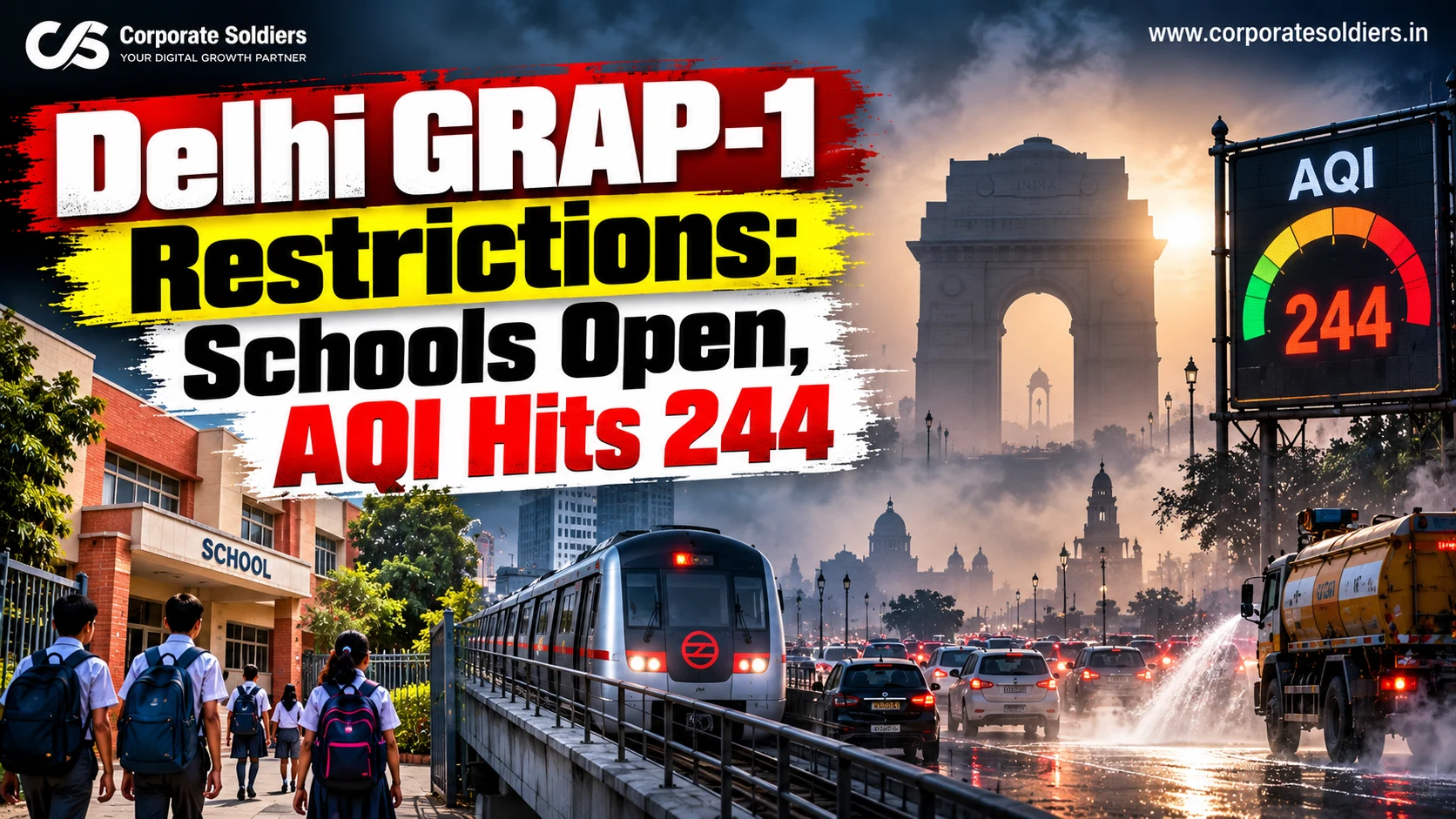
Delhi GRAP-1 restrictions came into effect across the National Capital Region (NCR) on Wednesday, October 21, 2026, after Delhi’s Air Quality Index (AQI) rose from 179 to 244. The reading at 2 pm moved the city from the ‘moderate’ to the ‘poor’ air quality category, prompting the Commission for Air Quality Management (CAQM) to activate Stage I of the Graded Response Action Plan (GRAP).
As of Thursday, October 22, schools and offices continue to operate normally under Stage I. The measures focus on controlling road dust, construction debasement, vehicle emissions, and waste burning. The Delhi Metro Rail Corporation (DMRC) has also announced 20 additional weekday train trips from now to encourage public transport use.
Why Were GRAP-1 Restrictions Imposed in Delhi-NCR?
Delhi’s AQI increased from 179 on October 20 to 244 at 2 pm on October 21, according to reports citing the CAQM. Forecasts from the India Meteorological Department (IMD) and the Indian Institute of Tropical Meteorology (IITM) indicated that air quality could remain in the ‘poor’ category over the coming days.
GRAP is a set of pollution-control measures introduced in stages as air quality deteriorates. Stage I applies when the Air Quality Index falls between 201 and 300 and aims to prevent further deterioration.
Are Schools Open or Closed Under GRAP-1?
Schools across Delhi-NCR remain open for regular classes under Stage I. These restrictions do not, by themselves, require school closures, hybrid classes, or work-from-home arrangements for employees.
Parents should check for any separate notices issued by their schools or local authorities in case additional directions are announced.
What Are the GRAP-1 Restrictions in Delhi-NCR?
The key GRAP Stage I measures include:
- Construction and demolition: Construction and demolition activities at plots larger than 500 square metres that are not registered on the relevant government portal are prohibited under the applicable rules.
- Road dust control: Authorities must intensify dust suppression, including mechanised road sweeping and water sprinkling where required.
- Waste burning: Open burning of municipal solid waste and other prohibited materials is not allowed.
- Parali burning: Stubble burning in Punjab and Haryana contributes to Delhi-NCR’s air toxication and is prohibited under existing laws, although GRAP Stage I does not introduce a separate blanket ban.
- Restaurant tandoors: Hotels, restaurants and open eateries cannot use coal or firewood as fuel in tandoors.
- Diesel generators: Their use is restricted, subject to permitted essential and emergency requirements.
- Vehicle pollution: Authorities are expected to enforce pollution-control requirements and take action against visibly polluting vehicles.
- Traffic and public transport: Agencies must work to reduce congestion and strengthen public transport measures to help curb vehicle emissions.
These rules do not mean that every construction project or all private cars are automatically banned. Restrictions depend on the applicable GRAP provisions and any additional orders issued by the authorities.
Delhi Metro to Run 20 Additional Trips
The DMRC will operate 20 additional train trips on weekdays from Thursday, October 22. The extra services are intended to encourage commuters to use public transport instead of private vehicles.
The Metro authority is also stepping up dust-control measures at construction sites and nearby roads. These include removing accumulated road dust and garbage, checking that construction materials are properly covered, and ensuring that wheel-wash facilities for vehicles leaving construction sites are working.
What Should Delhi-NCR Residents Do?
Residents can help limit toxication by using public transport where practical, keeping vehicles properly maintained, avoiding unnecessary engine idling, and not burning household or garden waste outdoors. People should also follow official pollution advisories and any additional directions issued by local authorities.
GRAP Stage I is intended to prevent Delhi’s air quality from deteriorating further. Authorities will continue monitoring Air Quality Index levels and weather forecasts to determine whether stronger measures are needed.