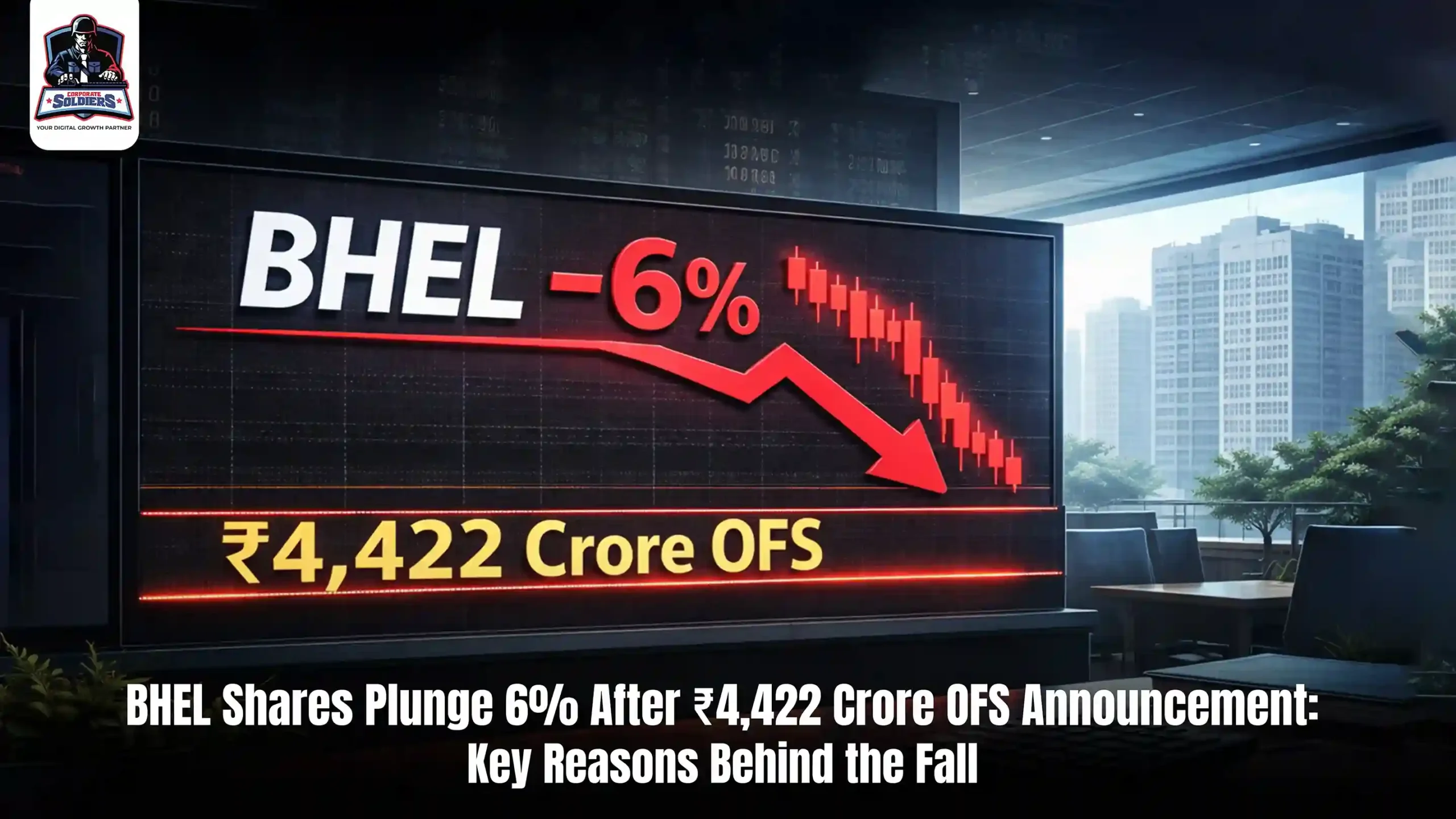
On Wednesday, the shares of Bharat Heavy Electricals Ltd. (BHEL), which is one of the largest public sector engineering and manufacturing companies in India, experienced intense selling pressure after the government decided to initiate a large-scale stake sale. The BHEL stock price was down by almost 6 per cent at the very outset as the Centre made a 4,422 crore open Offer for Sale (OFS), which caused investor panic over imminent share dilution and discount deals.
BHEL Share Price Falls After OFS Announcement
During morning trade, BHEL shares fell 5.8% to ₹260.10. In the Bombay Stock Exchange (BSE), the stock fell 5.74% to ₹260.2, as the whole market responded to the disinvestment move.
The downfall followed close after the government had affirmed its intention to sell up to 5% of the share in the state-owned engineering giant via the OFS route. With a full subscription, the sale will bring about ₹4,422 crore to the exchequer.
Market participants typically react cautiously to large stake sales as they increase the floating supply of the outstanding shares in the market, which may exert downward pressure on prices in the short run.
OFS Details: Price, Size and Structure
The government has set the OFS floor price at ₹254 per share, which is about 8% lower than the previous closing price of ₹276.05.
This discount made a significant contribution in pulling the BHEL share price down with investors re-calibrating values by the offer price.
Key OFS highlights:
- Base issue size: 3% stake sale
- Greenshoe option: 2 percent more.
- Total potential dilution: 5%
- Shares on offer: ~17.41 crore shares
- Base offer shares: Over 10.44 crore
- Greenshoe shares: Over 6.96 crore
The OFS was initially opened to non-retail investors and on the next day, retail investors were allowed to make bids.
The government currently holds 63.17%, which will decline after the sale.
Why the BHEL Share Price Is Falling
The precipitous decline is attributable to a number of issues which are intertwined:
1. Discounted Floor Pricing
The price of the OFS floor was pegged much lower than the market rate. The intention of such discounts is to involve institutions but in most cases this has been corrected instantly in the secondary market.
2. Equity Dilution Concerns
Stake sales increase the total floating shares. Increased supply at constant demand is expected to cause short term downward movement of the price.
3. Short term arbitrage involves activity.
When investing in the market, investors sell stocks in the open market and buy them back at the lower price in the open market, which causes a temporary selling pressure.
4. Profit Booking After Rally
PSU and capital goods stocks which comprise BHEL have been on good rallies in the last couple of quarters. The OFS was a spur to lock in gains by investors.
Strong Financial Performance Failed to Support the Stock
Interestingly, the decrease in BHEL share price is despite the fact that the company reported high quarterly profits implying that the decrease is event-based but not performance-based.
BHEL reported a sharp rise in profitability:
- Net profit: ₹382 crore
- YoY growth: 206% (vs ₹125 crore last year)
This was because the increase in profit was due to the improved project execution and operating leverage.
Revenue Growth Signals Strong Order Momentum
- Revenue from operations: 8,473 crores.
- Previous year: ₹7,277 crore
- Growth: 16% YoY
The total income with other income increased to ₹8,700 crore compared to ₹7,393 crore in the previous year with greater order pipeline and pace of execution.
It means that operationally, BHEL is on a recovery track with the help of infrastructure and power sector expenditure.
Disinvestment Push by Government Gathers Steam
The BHEL OFS is one of the broader disinvestment strategies of the Centre which is to raise more resources and efficiency of the public sector.
This transaction means that as much as 8768 crore in the current financial year has been raised through disinvestment of the undertakings of the public sector (PSUs).
According to analysts, although such stake sales can impact the stock prices in the short-term, the effect of the liquidity, the expansion of the shareholder base, as well as the adherence to fiscal goals, are favorable.
Market Prospects: What Investors need to be aware of
In the future, the trajectory of the BHEL share price will be influenced by several factors:
- Response to the subscription to the OFS.
- The involvement of institutional investors.
- Inflow of orders in the power and infrastructure industry.
- Implementation of project pipeline in existence.
- Government capex momentum
In case the OFS is in good demand, then it may stabilize after the short-run decline.
Conclusion
The recent 6% drop in BHEL share price is largely attributable to the government’s ₹4,422 crore OFS announcement, discounted floor pricing, and dilution concerns rather than any weakness in business fundamentals.
In fact, BHEL’s strong quarterly earnings, rising revenues, and improving execution metrics highlight operational resilience. While short-term volatility may persist until the stake sale process concludes, long-term investors will continue to track order visibility and infrastructure spending as key drivers of valuation.