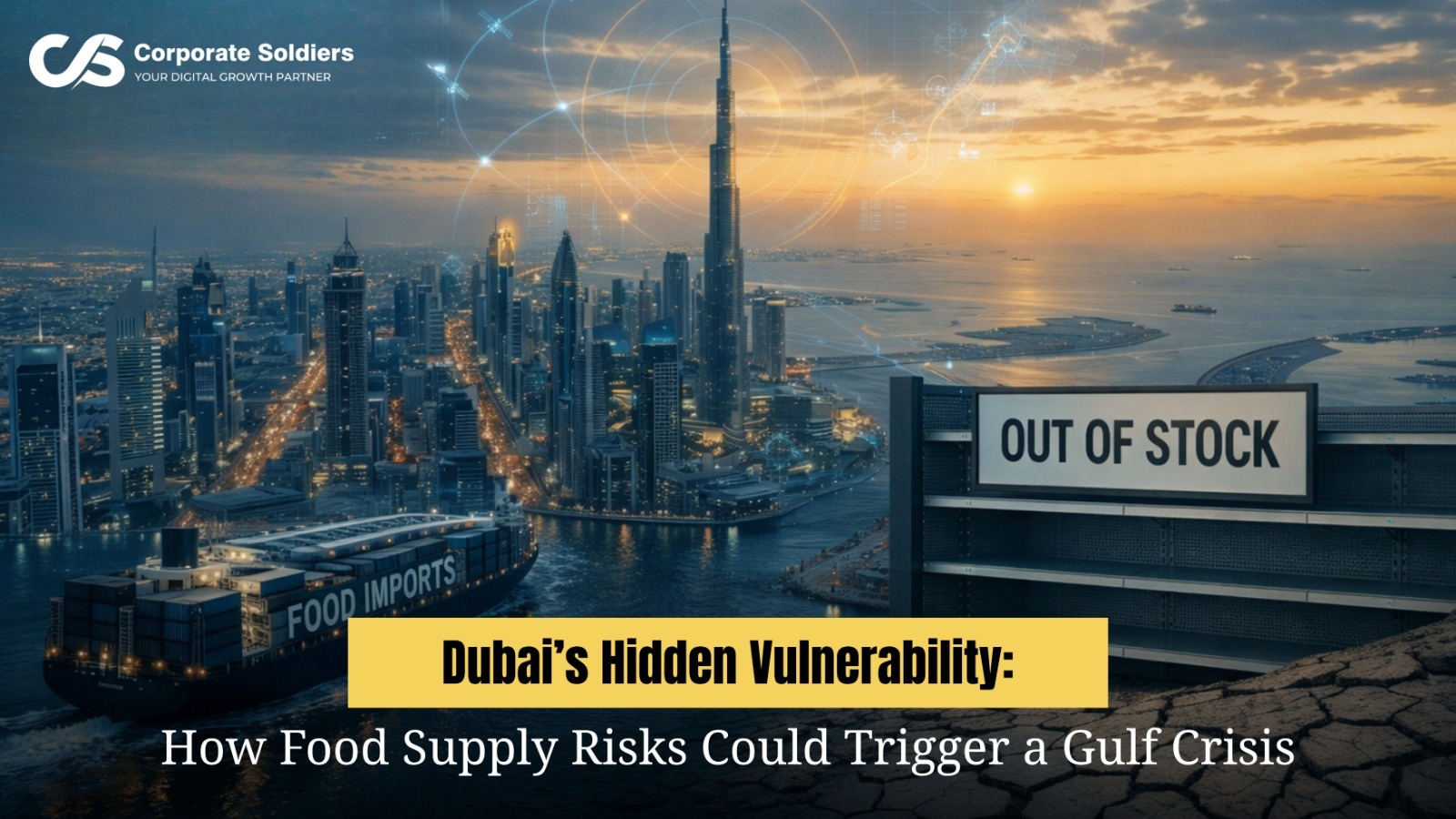
Some of the most spectacular cities in the world have been constructed in the Gulf region. Skyscrapers, extensive infrastructure and international business centers such as Dubai have made people believe that the economy is invincible. But behind such prosperity a structural weakness is barely noticed and that is food security.
Over the decades the countries of the Gulf Cooperation Council such as the United Arab Emirates, Saudi Arabia and Kuwait have been depending on imported food. Large-scale agriculture in the region is extremely hard due to the harsh climate, scarce freshwater resources and geography of the desert. Consequently, most of the food that is consumed in such countries is transported by sea.
Recent geopolitical tensions and disruptions to shipping routes are once again highlighting how fragile this system can be.
The Gulf’s Heavy Dependence on Imported Food
The United Arab Emirates is an importer of 80-90 percent of the food needs. Saudi Arabia is an importer of about 80 percent and Kuwait is almost 98 percent dependent. This dependence is not merely an issue of logistics but a weakness of strategy.
The core reason is geography. The arable land in the Arabian Peninsula is very limited. There is low rainfall, scarcity of groundwater resources and temperatures are often very high to support conventional farming. Although the governments have financially invested so much in technologies like desalination, hydroponics and controlled environment agriculture, the domestic production continues to serve a very small portion of what is demanded.
Consequently, the food system relies on the steady supply of the cargo ships with wheat, rice, meat, dairy products, vegetables and processed foods produced by international suppliers.
The Strategic Significance of the Strait of Hormuz
One of the most important parts of this supply chain is the Strait of Hormuz. It is a very narrow waterway that links the Persian Gulf with the Arabian Sea and one of the most significant sea routes in the globe.
Although it is commonly referred to as the main pathway of international oil shipments, the strait is also an important exit to food imports to the Gulf countries. Commodities like food are transported in large quantities of thousands of tons per day via this route to the major ports like Jebel Ali in Dubai.
In the event of a tension build-up in the area or disruption of maritime transportation, the impact is far-reaching beyond energy markets. Directly impacted would be food supply chains.
Shipping companies are already very fast in responding to security threats. As the risk escalates, the insurance premiums skyrocket, ship fees go up and some ships go round the high risk areas. Even short-term disruptions may delay deliveries and cause logistical bottlenecks.
Strategic Food Reserves and Their Limitations
The majority of the Gulf nations have strategic food stores which are intended to cushion against short term disturbances. In these reserves, there are usually staple commodities like wheat, rice and flour.
Nevertheless, these reserves are usually meant to be used within a short time. Food security experts have estimated that the strategic reserves in some of the Gulf regions can support national demand in a few months based on the patterns of consumption and the levels of stock.
While governments continue to expand storage capacity and diversify suppliers, prolonged supply chain disruptions could still put pressure on food distribution systems.
Global Supply Chains Under Stress
The susceptibility of the Gulf food system is increased by the general condition of world supply chains.
The international food system has undergone numerous shocks over the last few years. The COVID-19 pandemic interfered with the shipping networks and labour supply. The exports of wheat and fertilizers were influenced by the Russia-Ukraine conflict. The effect of climate change has gradually hit agricultural production in major production areas.
In a stressed supply chain, a crisis in one area can have a secondary effect on the markets of other areas worldwide. The increase in the cost of shipping, a lack of fertilizers, and unstable prices of various commodities may all lead to higher food prices in the world market.
To the import dependent countries, these changes have a direct correlation into more import bills and economic pressure.
Currency Stability and Import Costs;
Because most Gulf countries rely heavily on international food imports, fluctuations in global commodity prices and currency exchange rates can significantly influence domestic food prices.`
Although several Gulf currencies are pegged to the U.S. dollar, global inflation and rising commodity prices can still increase the overall import bill for governments.
As food imports become more expensive, governments may need to increase subsidies or public spending to maintain price stability in domestic markets.
Over time, sustained price pressures could place additional strain on fiscal budgets, particularly during periods of global economic volatility.
The Economic Ripple Effect
Food security is not only a humanitarian concern but a major economic parameter.
Rapid food price increases may be the cause of inflation, consumer purchasing power may decrease, and the cost of the government subsidies may rise. This can have a quick impact on both households and national budgets in countries that have high levels of food importation as a percentage of their total consumption.
Geopolitical uncertainty can also cause a response in the financial markets. During the tensions in the region, the mood of investors tends to change rapidly, particularly in such economies that are closely related with international trade and shipping.
Large ports including Jebel Ali which is one of the biggest container ports in the Middle East are a key hub in sustaining supply chains. Any interruption in the operation of the port can have the effect of trickling down through the retail, logistics and distribution networks.
Financing the Gulf’s Food Security
The growing vulnerability of food supply chains has also created a significant financial challenge for Gulf governments.
Ensuring food security requires large-scale investments in infrastructure, including grain storage facilities, cold chain logistics, port capacity expansion and supply chain technology.
In recent years, Gulf countries have begun allocating billions of dollars toward food security financing, often through sovereign wealth funds, public-private partnerships and strategic foreign investments.
For example, sovereign investment vehicles in the region have funded agricultural projects in Africa, Eastern Europe and Central Asia, securing access to farmland and long-term crop production.
These investments represent a shift from simple food imports to financial control over production and supply chains.
However, such strategies also carry financial and geopolitical risks, particularly in regions with political instability or changing regulatory environments.
As a result, food security financing is becoming a major strategic component of economic planning in the Gulf.
Lessons From the Past
The Middle East has been through instances in the past when the increased food prices led to political and social volatility. The high food prices during the late 2000s and early 2010s affected the food economy of most economies in the region.
Those incidents demonstrated the relationship between food affordability and economic stability. Since that time, the governments of the Gulf have substantially enhanced their investments in food security programs.
These initiatives include expanding food storage infrastructure, investing in overseas agricultural projects, encouraging agritech development, and strengthening trade relations with food producing countries. Some Gulf states have also pursued overseas farmland investments in regions such as Africa and Eastern Europe in an effort to secure long-term food production capacity.
Food Security as a National Security Priority
In recent years, Gulf governments have increasingly begun to treat food security not only as an economic challenge but also as a matter of national security. Countries such as the United Arab Emirates and Saudi Arabia have invested in overseas agricultural land, long-term supply agreements with major food producing nations, and strategic partnerships with global logistics companies.
These policies aim to secure reliable food sources even during geopolitical disruptions or global supply shocks.
The Path Forward: Diversification and Resilience
The Gulf region has been struggling to enhance resiliency in spite of the vulnerabilities that the region has.
Other countries like the UAE have introduced national food security plans which concentrate on diversification of sources of supply, expansion of local production with technology based agriculture and the establishment of sophisticated logistics networks.
Vertical agriculture, desalination-driven agriculture, and intelligent irrigation systems are already being considered as ways of lessening overdependence on imports. Meanwhile, governments are still building strategic stocks and are keeping good trade relations with large food exporting nations.
Although these measures will not eliminate import dependence, they will go a long way in mitigating risk.
Conclusion
Global connectivity has formed the basis of the economic success of the Gulf. The region is able to import the resources that it is not able to produce locally through trade patterns, shipping networks and international supply chains.
But the same interconnectedness is a weakness in case geopolitical tensions cause disruptions to such critical corridors like the Strait of Hormuz.
The problem of food security in the Gulf is thus not merely the issue of agriculture but the issue of logistics, diplomacy and world stability.
Ensuring stable supply chains, diversifying food sources, and strengthening domestic resilience will remain key priorities for Gulf nations in the future.