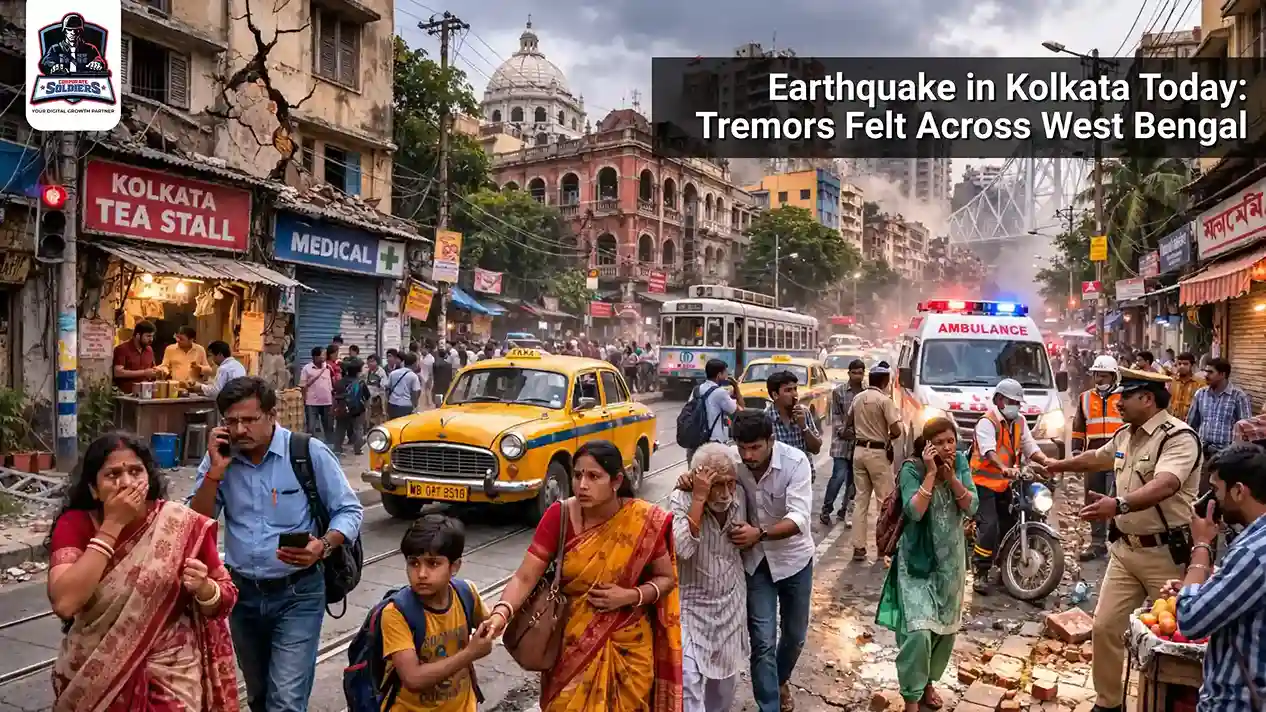
On 27 February 2026, residents of the city of Kolkata and the surrounding areas complained of the felt shaking due to seismic waves of an earthquake that occurred a very long distance in the Eastern part of India. The earthquakes were caused by an important seismic activity in Bangladesh and were felt across most parts of West Bengal leading to precautionary evacuations and reconsideration of the geological hazards in the region.
Overview of the event and reports on the event.
A moderate earthquake took place in southwestern Bangladesh, with the epicenter being in Bangladesh on the border of India and Bangladesh, on 27 February 2026 at approximately 13:30 -13:52 IST. A number of seismological agencies including the European Mediterranean Seismological Centre (EMSC)reported the magnitude at approximately 5.4 on the Richter scale. This quake was of moderate depth that had a depth of approximately 35 km implying that this focus was moderate and the seismic wave could be easily propagated within the neighbourhood areas.
The inhabitants of Kolkata, Howrah, as well as the surrounding regions of West Bengal asserted that the earthquake in Kolkata was felt as some kind of sudden rolling or swaying motion of a few seconds. The employees of the offices and the high-rise buildings as a preventive step relocated into the open fields. No serious structural damage or casualties were reported at the time of initial assessment.
Seismic Information: Magnitude, Time, Epicentre
- Magnitude: EMSC recorded the magnitude at approximately 5.4 on the Richter scale.
- Time of Occurrence: 13. 30-13.52 IST 27 February 2026.
- Location: Southwestern part of Bangladesh, borders Indo-Bangladesh (Khulna/Agargaon area).
- Depth: It is estimated to be 35 km, and this implies that the crustal event was experienced on a regional level.
The quake epicenter was discovered a few hundred kilometres off Kolkata but seismic vibrations were passed to geological structures that were beneath the surface; this is also a factor that led to the felt tremors in the city and the felt bigger tremors in West Bengal.
Geologic and Regional Seismic History
Kolkata and much of eastern coastal India is located in Seismic Zone III that indicates the presence of moderate seismic risk. The neighboring space and Bengal Basin are influenced by complicated interactions between tectonic Indian Plate and the neighboring microplates. All of these geological settings along with huge alluvial plains can pass seismic waves over a great distance. The epicenter was across the border, but tremors in West Bengal reflect the occurrence of the crustal pathways that pass the propagation of offshore and other events on the nearby continents.
Bangladesh lies near active tectonic zones associated with the convergence of the Indian Plate and the Himalayan region. The historic seismicity has been described as having significant quakes that have affected the region and this brings out the fact that activities that occur in distant places have to be kept track of as a way of affecting the east part of India.
Public Impact and Response
Shaking has been reported as being experienced in Kolkata as well as the neighbouring districts in various neighbourhoods. Residents in high-rise buildings reported shaking fixtures and vibrating furniture and many of them fled to find a safer place. Short-term office building evacuations and residential towers and open space were also observed as people hesitated to know the extent of the occurrence.
No structural damage, injuries or disrupted infrastructure was confirmed when the first report was done. Local authorities were still assessing in order to determine the delayed effects.
Authoritative Orders and Safety Warnings
To enhance the magnitude and depth estimates, several seismological monitoring centres were analysing seismic-related data on the earthquake, including the National Centre for Seismology (NCS) and international agencies, including EMSC. The values of the first order are steady with magnitude 5.4.
Even though disaster management authorities in the states did not mention any serious destruction, the officials repeated the usual regulations of earthquake safety: remain calm, do not remain near the shaking structure, and listen to the local emergency services. It had not yet released any official disruption warnings (transport or utility). None of the official press releases existed in the immediate reporting window.
Seismic History in the Area
The immediate neighbouring Bangladesh and Eastern India have experienced the seismic events that have impacted differently. In November 2025, the quake in Bangladesh was 5.7 magnitude, which caused earthquakes in much of Kolkata and other states, and most victims and injuries were confined to Bangladesh.
The Assam earthquake of 1897 which occurred in the northeast, though had sprawled across large territories of eastern India, including Kolkata, can be attributed to why such large local impacts could be as a result of tectonic release of stress.
Episodic seismicity in the larger eastern Indian Basin is also indicated by other quakes in the area like the 1984 Cachar earthquake. These events show that geology is quite complicated and that one should always be ready.
Preparedness Measures and Safety Guidance
Earthquake preparedness is required in the urban population of Kolkata and West Bengal, in general, despite the fact that major earthquakes are rather infrequent:
- During a quake: Drop, Cover and Hold On to heavy furniture, do not use unsecured doorways or fixtures.
- Post-event: Move to the open spaces, avoid going into the affected buildings, and wait when they are instructed to do it.
- Sustainable: Community education and regular safety drills and adherence to seismically sensitive building codes help to increase resiliency.
It should also be a regular urban safety area where the residents and organisations have access to local emergency contacts and local disaster management helplines (different numbers in locality and district).
General Reflections: Urban Resilience and Planning
This incident shows the reason why long-term consideration should be given to urban resilience within the high population cities like Kolkata. Earthquake related building codes planning and implementation are the infrastructural necessities especially in the areas with high population density and high rise constructions.
Emergency preparedness, including public education and effective early warning systems, helps reduce panic during seismic events. Professional networks, corporate disaster protocols, and population institutions enjoy the benefits of the adoption of routine scenario planning in the working structures.
Conclusion
On 27 February 2026, an earthquake with an epicentre in Bangladesh produced measurable seismic waves felt across West Bengal, including Kolkata. With an estimated magnitude of 5.4 and depth near 35 km, tremors were widely perceived but no immediate damage or casualties were reported. Official agencies continue refined assessments, and authorities emphasise adherence to safety practices.
As after-effects and evaluations proceed, residents and institutions are advised to monitor updates from seismological services and local authorities. The event reaffirms the necessity of preparedness and resilience in regions where cross-border tectonic activity can influence local communities.