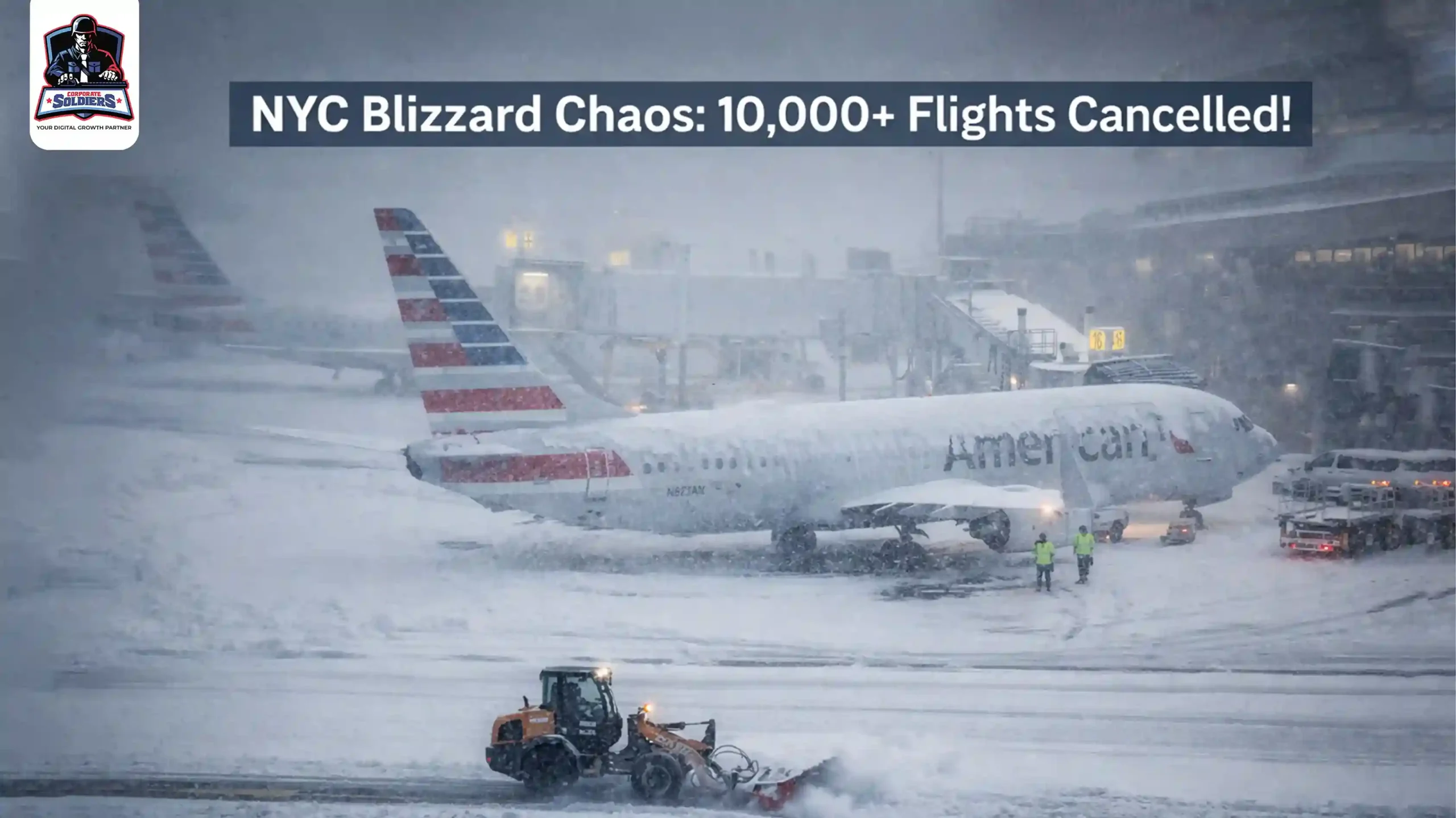
A severe winter storm has paralysed New York City and the wider tri-state region, disrupting transportation and infrastructure across the Northeastern United States. According to flight-tracking data, more than 10,000 flights were cancelled across the Northeast, disrupting domestic and international air travel. Authorities declared emergency measures as conditions worsened across the region.
Blizzard Overview and Meteorological Data
Meteorologists described the system as a “bomb cyclone,” formed by a rapid drop in atmospheric pressure, which began affecting the Atlantic coast earlier this week. The National Weather Service (NWS) reported snowfall rates of two to three inches per hour in certain areas. Snow accumulation in parts of New York City reached significant levels, with heavy snowfall recorded across Central Park and surrounding boroughs.
Blizzard warnings issued by the NWS extended from northern Virginia to Maine, with New York City among the hardest-hit areas. Heavy precipitation and low temperatures led to significantly reduced visibility. The Federal Aviation Administration (FAA) and local emergency management agencies warned against all unnecessary travel.
Aviation Disruption and Airport Operations
The aviation sector has been among the most significantly affected industries. Flight-tracking service data indicate that more than 10,000 departures and arrivals were cancelled across the region. This interruption revolves around the three largest gateways that are under the management of Port Authority of New York and New Jersey: John F. Kennedy International (JFK), LaGuardia (LGA), and Newark Liberty International (EWR).
Large carriers such as Delta Air Lines, United Airlines and American Airlines have cancelled a major part of their Northeast flights. Though there are runways that are technically open due to emergency services, most of the commercial flights have been grounded because of failure to have safe braking action on the tarmac and the dangers of extreme cross winds. Trans-Atlantic flights have been rerouted to Midwest hubs or called off at their origin because of the congestion already experienced in the Eastern Seaboard terminals.
Impact on Passengers
The thousands of cancellations caused thousands of passengers to be stuck at terminals or off their scheduled itineraries. A lot of travellers experienced long stay periods in airports, rebooking of flights and additional delays on flights coming back home. Airlines provided waivers to travel without charges, changed the destination without charges and offered money back options as customers dealt with uncertainty in operations.
Operations at airports were also changed because of the importance of safety: runways and taxiways were closed or restricted, de-icing crews were 24/7 and AirTrain connections at some airports were also canceled and replaced by shuttle services where feasible.
Local Infrastructure and Public Services
Ground transportation across New York City and surrounding areas was significantly disrupted. During some of the storm period, travel bans were created on all unnecessary road travel, and the surface transportation services were delayed or suspended. It was indicated by the fact that schools were shut down throughout the city.
The snow clearance, management of traffic and support of vulnerable populations were assigned to emergency services. Municipal workers were using snowploughs, salters and emergency operators to ensure important travel routes and safety. Electricity blackouts spread on the territory of the whole region, hundreds of thousands of houses and enterprises were affected by power outages.
Broader Regional Effects
The effect of the storm was not limited to New York City but also to the rest of the northeast region. States as far as Maryland to Maine were covered with blizzard conditions prompting the travel ban and the emergency declaration and the shutting of schools and businesses. Amtrak trains and other corridors suspended their operations during the peak hours, further worsening traveling problems.
Hazardous conditions and restrictions on commercial vehicles were reported on interstate highways as a measure to maintain road safety. Snow drifts and strong winds were some of the reasons behind prolonged road closures and mobility inconveniences both in the urban and rural regions.
Governmrent and Institutional Response
The city and state governments established warnings on their social media accounts that people should remain in their homes rather than travel without reasons. In New York City, Mayor Eric Adams declared a state of emergency and imposed a travel ban in order to ease emergency management and clear away snow. Equivalent emergency legislation was also passed in New Jersey, Massachusetts and other states in the Northeast.
The federal aviation regulators and the airport management team worked in collaboration with the airlines to coordinate the storm responses. The NWS issued warnings and advisories on blizzards and this informed operational decisions as the conditions changed.
Economic and Operational Implications
The cancellations carry significant economic implications. The disruption affects airline revenue through cancelled service, extra accommodation and rescheduling expenses of the crew. Major hubs are logistical centres and their closures are felt in cargo networks, freight delivery, and business travel industries.
Hotels, ground transport providers, tourism operators and local businesses near airports experienced reduced activity as passenger volumes declined. Storms also increased logistics and supply chain timing weaknesses during the peak times of the travel.
Future Outlook
According to meteorological predictions, the storm system will start moving towards the northeast to the Canadian Maritimes in the coming 24 hours. Nevertheless, the recovery of aviation operations is expected to be gradual. Airlines also face the complex task of resetting their networks, placing thousands of crew and planes that are not in their position after clearance following runways.
People are recommended to keep an eye on carrier apps and stay updated with the real-time information and not to go to the airports unless the flight is confirmed. It is expected that it will take the end of the week to fully restore normal operations as the authorities try to clear the backlog of passengers and stabilize infrastructure in the region.
Conclusion
The current snowstorm is a bitter reminder of how vulnerable modern transport infrastructure can be to severe weather events. According to flight-tracking data, more than 10,000 flights were cancelled across the Northeast, significantly disrupting the region’s transport corridor, with authorities prioritising public safety and the gradual restoration of essential services. As conditions improve, emergency management efforts are expected to shift toward restoring regional air operations and stabilising economic activity.