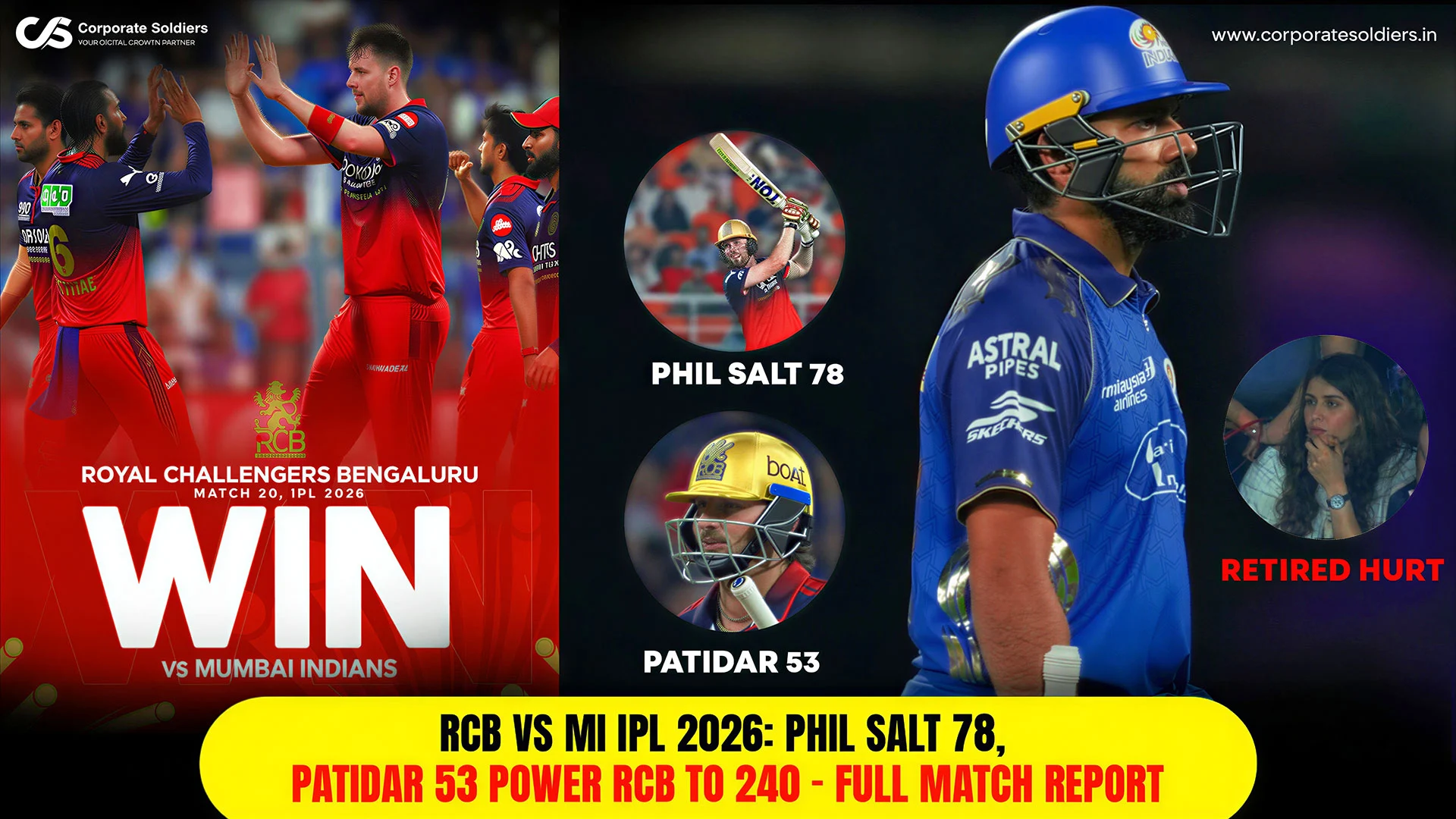
RCB posted a stunning 240/4 at Wankhede powered by Phil Salt’s 78 and Patidar’s 53. MI fought back hard but fell 18 runs short. Full match report inside.
RCB Dominate Early at Wankhede
Wankhede Stadium was a lights-spectacle with two giant rivals of the IPL, Royal Challengers Bengaluru (RCB) and Mumbai Indians (MI) taking on each other in a tense match. Since the very first delivery, there was a feeling of expectation but it was RCB who silenced the home crowd early on with power hitting that was cruel. RCB, powered by a blazing start and a captain’s knock, made a season high of 240/4 and Mumbai was tasked with a daunting target to follow. The target was out of reach, and yet the five-time champions got the target off with a late-inning flood which turned a runaway RCB victory into a one-over nail-biter. MI made it a strong contest but ultimately fell short by 18 runs. But MI weren’t done not by a long shot.
Toss & Team News
Mumbai Indians captain Hardik Pandya won the toss and opted to bowl first, based on Wankhede’s chasing advantage under lights. MI fielded a full-strength XI with Rohit Sharma included, while RCB were without Josh Hazlewood and opted for an alternate bowling combination. RCB, in the meantime, continued to play in an aggressive manner, and their XI was deep-batting in character, and of a well-balanced composition. The decision to bowl first seemed justifiable when the toss began since MI had defended their bowling team to keep the openers of RCB at bay but the move failed miserably after just a few seconds when the visitors took the lead of the match.
RCB Innings – The Carnage
Phase 1 – Powerplay: Salt Explodes
Phil Salt set the tone with one of the most devastating Powerplay performances in recent times. Salt smashed 78 off 36 balls at a strike rate of 216.67. He hit 6 fours and 6 sixes in his assault and a sizable portion of his hits were against the new-ball pair of Trent Boult and Jasprit Bumrah. With Virat Kohli, Salt wove a great 120-run opening partnership that had MI at the receiving end.
Stat Callout: RCB scored 82 runs in the Powerplay – their highest against MI in IPL history.
Salt hit more sixes in his 36-ball knock than MI bowlers managed wickets.
Phase 2 -Middle Overs: Kohli Anchors, Patidar Attacks
After Salt’s dismissal, Virat Kohli anchored the innings, with a calculated 50 off 38 balls. However, it was the very fireworks of the RCB skipper Rajat Patidar. Patidar was in an aggressive mood, hitting 53 runs off a total of 20 balls with a phenomenal strike rate of 265.00. Patidar was the second-quickest half-century by RCB, as he took even fewer 17 balls to reach his fifty. The duo added 65 runs in under 4 overs and MI bowlers, most notably Mitchell Santner, were struggling to get into a rhythm as the economy rates were skyrocketing.
Phase 3: Death Overs: David Finishes
Tim David gave it the last flourish as he turned on his old franchise, and was unmerciful. David’s unbeaten 34 off 16 balls ensured RCB maintained momentum in the final overs. Even reliable Jasprit Bumrah could not contain the onslaught of runs and ended with figures of 0/35 in an innings as boundaries flowed consistently in the death overs. RCB ended their 20 overs with a gigantic 240/4.
MI Chase – So Close, Yet So Far
The pursuit by Mumbai got a huge psychological setback when Rohit Sharma (19 off 13) was compelled to retire with utmost pain after receiving a hamstring injury in the sixth over. Ryan Rickelton started the ball rolling with 37 off 22, but the tide was halted, when Tilak Varma could only score 1 when trapped by the rising bounce of a RCB attack.
However, Suryakumar Yadav (33) and Hardik Pandya (40) made sure MI was on the hunt with hard-hitting cameos. Yet, Suyash Sharma of RCB was the game-changer in the middle overs with 2 wickets at a cost of 47, who had some breakthroughs in the middle order which shattered MI. An important role was also played by Krunal Pandya, however with an economy of 6.50 things were tight.
When it appeared all was lost, Sherfane Rutherford went on a killing spree. Making his entry as a substitute, Rutherford touched 71 out of 31 balls, 9 of which were immense sixes. MI needed 68 runs to be made over the final four overs and a late fireworks display by Rutherford, who had four sixes in the final over, to narrow the gap significantly and bring MI close.
But that’s a story for another post entirely.
MI eventually fell short by 18 runs, finishing at 222/5.
Key Stats & Numbers
| Stat | Detail |
| Highest partnership | Salt–Kohli: 120 runs |
| Fastest cameo | Rajat Patidar: 53 (20) |
| Top MI scorer | Sherfane Rutherford: 71* (31) |
| Most expensive bowler | Shardul Thakur (16.00 Econ) |
| Best MI bowler | Hardik Pandya (1/39) |
| Match result | RCB won by 18 runs |
Player of the Match Analysis
The highlight of the RCB victory was the innings by Phil Salt. His 78 off 36 was defined not just by volume, but by timing and impact. By attacking MI’s frontline bowlers early, Salt affected their bowling strategies and made them change their fielding strategies during the powerplay itself. This enabled RCB to retain a high scoring rate without involving too much risk in the later part of the innings.
The fact that pace and swing are two goals that Salt achieved with ease, made him especially useful at Wankhede where early momentum tends to determine the results of matches. The fact that he had a strike rate of 216 meant that RCB would always be ahead of the par curve. Within the context of IPL 2026, this innings solidifies Salt as a high-impact starter who can turn the course of matches in the initial six overs.
Takeaways & What It Means
The victory of RCB gives them an extra boost in the IPL 2026 points table, demonstrating their ability to be deep in batting and flexible. The blend of fast acceleration at the start and in the middle of the order seems to be a stable secret of success.
In the case of MI, there is always a question of the consistency of the bowler, despite having Jasprit Bumrah on the field. The fact that runs are not contained in the powerplay as well as in the death overs is a significant problem. There will also be close monitoring of the fitness of Rohit Sharma since his absence may affect the balance of the team.
The good news to MI is the form of Sherfane Rutherford who provides firepower to their lower middle order. In the future, the two teams have important matches that might determine their mid-season momentum and therefore tactical changes are very necessary.