In early January 2026, the longstanding tension between the United States and Venezuela reached an unprecedented turning point. Reports from international news agencies confirm that the U.S. launched military strikes on multiple sites in Caracas and other strategic locations, resulting in explosions and chaos across the Venezuelan capital. U.S. authorities later stated that Venezuelan President Nicolás Maduro and his wife had been captured and flown out of the country following the operation, a move that casts a deep shadow over global geopolitics.
This dramatic escalation succeeds months of mounting pressure, sanctions, covert operations, and explosive U.S. military actions against alleged drug trafficking networks operating in and around Venezuelan waters. Earlier in late 2025, the U.S. reportedly struck a vessel it claimed was being used to transport narcotics, resulting in at least 110 deaths and heightening bilateral tensions.
But while U.S. leaders frame their rhetoric around democracy, drug trafficking, and security in the hemisphere, many analysts argue that the underlying motivations may be more complex and intimately tied to energy interests, particularly oil.
Venezuela’s Oil Wealth: The World’s Largest Reserves
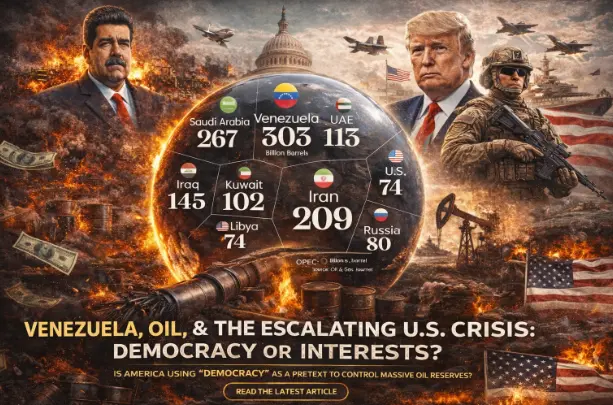
Venezuela holds an astonishing 303 billion barrels of proven oil reserves, the largest share of any country on the planet.
This “black gold” has shaped Venezuelan politics for decades. Under Presidents Hugo Chávez and later Nicolás Maduro, the state sector PDVSA was nationalized and restructured, often prioritizing political goals over commercial oil output. Poor investment, mismanagement, and infrastructure decline meant that, despite staggering reserves, Venezuela’s oil production and export capacity fell sharply over the past two decades.
From the U.S. perspective, this presents a strategic imbalance. The Trump administration has repeatedly accused Maduro’s government of aiding organized crime and narco-terrorism, but critics, including Venezuelan officials, see this narrative as a cover for reasserting control over the country’s energy resources.
Democracy vs. Dominance: Official Narrative and Critics
One consistent U.S. justification for its policy has been democratic legitimacy. The U.S. and other Western nations have long labelled Maduro’s elections as flawed and undemocratic, challenging his right to govern. Sanctions, diplomatic pressure, and licensing decisions, such as permitting Chevron to resume limited oil operations, were framed as incentives for democratic reforms.
Yet opponents in Venezuela and beyond dismiss the democracy argument as a façade. From Caracas to online discourse, critics argue that the real aim is regime change to create a government more favourable to Western energy interests. This argument is bolstered by the fact that Venezuela’s oil industry, crippled by sanctions, has remained disconnected from its massive reserve potential precisely because the U.S. limited exports to American refineries and financial markets for years. (Reddit)
In late 2025, the U.S. seizure of the oil tanker Skipper, laden with Venezuelan crude, marked a significant escalation. This was the first such seizure under tightened sanctions, prompting regional condemnation and raising the stakes in a conflict that increasingly looks like a battle over resources as much as ideology. (Wikipedia)
Geopolitical Chessboard: Allies, Adversaries, and Power Plays
This crisis isn’t happening in isolation. Venezuela’s government has sought backing from allies such as Russia, China, and Cuba. Reports show Russia’s president publicly reaffirming support for Maduro, condemning U.S. pressure and signalling a broader East–West tug-of-war in Latin America. (AajTak)
From Washington’s perspective, countering Russia and China’s influence in the Western Hemisphere has long been a priority. Securing friendly governments in regions rich in natural resources, like Venezuela’s oil fields, fits into that larger strategic calculus.
Meanwhile, U.S. military activities in the Caribbean, including upgrading bases and conducting operations against alleged drug trafficking vessels, have poured fuel on the interpretation that this conflict may be about expanding Washington’s footprint in a geopolitically vital region, not simply countering narcotics or safeguarding democracy. (AajTak)
Economic Realities: Impact on Ordinary Venezuelans and the Region
Notwithstanding the grand political narratives, the Venezuelan populace bears the brunt of this turmoil. The country has suffered years of hyperinflation, economic collapse, and social dislocation. Oil, which could have been a path to prosperity, instead became a conduit of mismanagement, international sanctions, and geopolitical contestation. (Serviços e Informações do Brasil)
The consequences extend far beyond Caracas. Countries reliant on Venezuelan oil, like India, which imports significant crude supplies, face disruptions that can ripple through global markets, potentially raising fuel costs and straining supply chains. (Navbharat Times)
Oil, Power, and the Limits of Democracy Rhetoric
In the fog of modern geopolitics, truth is rarely binary. While the U.S. government insists its actions in Venezuela are about restoring democracy, a growing body of evidence, from sanctions patterns to strategic military actions and oil industry recalibrations, suggests a far more layered motive.
Oil is unlikely the only reason for the U.S. push, but it is almost certainly a central one.
Whether framed as promoting democratic governance or combating narco-terrorism, U.S. actions now intersect with a historical pattern. Whenever a nation holds vast natural resources, major powers find a way to justify strategic intervention.
Only time will tell if Venezuela’s oil wealth becomes a shared global asset, a point of internal national renaissance, or a cause for ongoing conflict between great powers.