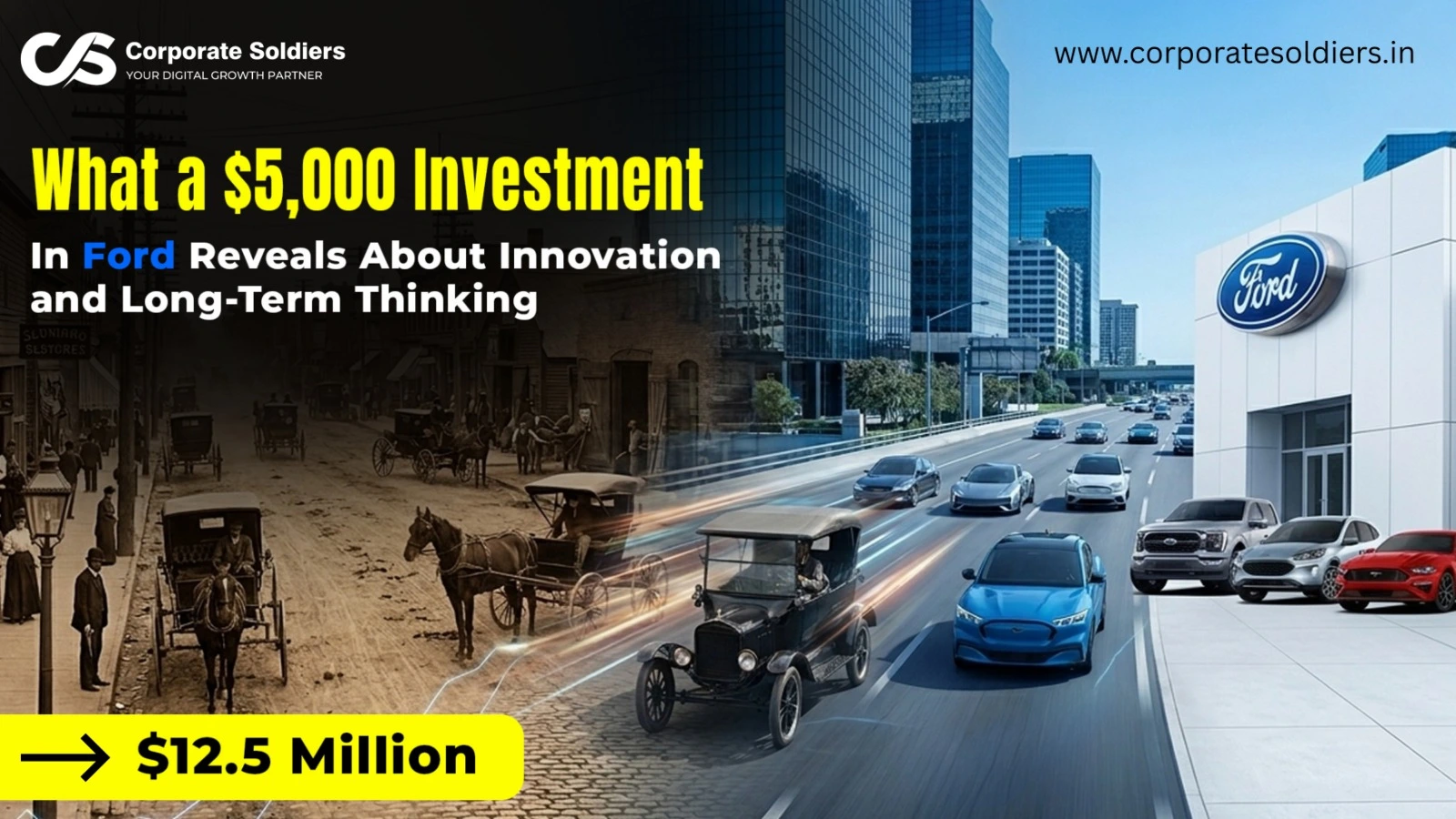
Historical Context: An Economy Built Around the Horse
The beginning of the 20th century had the United States working in a highly established transportation ecosystem that was dominated by horse mobility. When Ford Motor Company was founded in 1903, horses were not just a way to travel; they were the primary driver of logistics in both urban and rural areas.
Whole sectors of the economy had developed based on this system: carriage-making, smithing, feed distribution, stable management, veterinary services, and sanitation in urban areas. Horses were physically planned into the cities and the infrastructures were built to facilitate their movement, care and maintenance. The interdependence of these sectors on the economy strengthened the stability of the status quo.
Such an atmosphere produced a strong momentum. Any other technology would not only have to demonstrate its usefulness, but also would have to surmount the economic and social dependency that was entrenched in an existing, operative system.
Scepticism Around Automobiles: Perceived Impracticality
In this regard, the novel automobiles were largely regarded with suspicion. They were costly, were not mechanically reliable and did not have the supporting infrastructure that would be needed in their application. Roads were mostly in bad conditions, the fuel distribution system was almost absent and expertise to service vehicles was insufficient.
The general mood of the period can be summed up in the opinion that the horse is here to stay. This was not a nonsensical position- this was a sensible analysis of what can be seen. Horses were a stable, abundant and well-established ecosystem. Cars, on the other hand, symbolized uncertainty.
The problem of resistance to technological change was, however, not only cultural but also economical and functional.
The Role of Henry Ford: Vision Beyond Constraints
In this atmosphere, Henry Ford expressed an entirely new worldview. He did not focus on the weaknesses of early automobiles but instead on how they could be scaled for mass production. His vision was not limited to making motor vehicles to be sold to the rich, he wanted to make motor vehicles affordable and mass produced so that they could be sold to the common people.
Ford was not focused on short term achievement but on long term structural transformation. He realised that the innovation would necessitate not only the development of products but a systemic change, that is, enhancement of manufacturing efficiency, cost minimisation and ultimately, an infrastructure growth.
Such an oriented thinking was opposite to the tendency existing at that time to analyze new technologies by the prism of the existing constraints.
The Investment Decision: Capital Without Certainty
In this unpredictable environment, an early investor made a decision that would later be regarded as a notable example of forward-looking investment thinking. In 1903, he put in money in a newly formed Ford Motor Company to the tune of $5,000.
This decision was at the time not conventionally justified. It had no guarantees of success, no fixed market need of cars and no prior record of production that could be expanded. The investment has been effected without validation, but out of belief in the potential in the future.
This is unlike the prevailing investment thought of the time based on established industries known to give good returns. The choice is a movement away from risk aversion to calculated exposure to transformative innovation.
Transformation Over Time: From Experimentation to Adoption
The further development of the auto industry demonstrates the way innovation moves on to the stage of uncertainty into the mainstream.
There was a gradual increase in technological advancements that increased vehicle reliability and performance. At the same time, infrastructure was also changing, roads were being paved, fuel distribution systems were being extended, and systems of maintenance were being built. These transformations did not happen in one instance, rather, they occurred over years, which supported the interdependence between innovation and supporting systems.
More importantly, cars ceased being luxuries and turned into a product of the mass market. The assembly line production that Ford introduced made the cost of production very low that made it accessible to many. This shift marked the transition of automobiles from speculative innovation to an economic necessity.
Financial Outcome: The Impact of Long-Term Perspective
By 1919, the lawyer’s investment had grown to approximately $12.5 million US dollars, although he had only invested the initial $5,000. This was not the product of short term speculation but of long term value creation.
The scale of such a payoff highlights one important lesson, namely, the fact that transformative innovation may not reach full payoff until the long term. Early investors do not receive certainty, they receive recognition of potential prior to its recognition by the majority.
Core Insight: Pattern Recognition in Innovation Cycles
This historical event brings to the fore a common trend in adoption of new technologies.
New innovations that come in the early stages often seem unrealistic or financially unsustainable. They display their limitations and their potential is abstract. This leads to the perception that early adopters and investors are not in line with reality.
This impression is often, however, a matter of timing rather than judgment. Early identification of a structural shift can be similar to being wrong in the short run. With time, the original evaluation is re-contextualised as supporting systems evolve and are adopted more.
The process of innovation adoption is often predictable: Scepticism, stages of validation, alignment of infrastructure and eventual mass acceptance.
Modern-Day Relevance: Interpreting Emerging Opportunities
The dynamics that have been witnessed in the early automobile industry can still be utilized in the current technological changes. New industries, be it artificial intelligence, renewable energy, or high-tech manufacturing are likely to receive the same backlash based on being uncertain and lacking infrastructure.
Whether it is human behaviour or not, it is the same: people always prefer familiarity and proven systems to the ones that are unproven. This prejudice may slow perception of transformative opportunities.
The key critical capability that decision-makers need is to differentiate temporary constraints and structural potential. Not every new concept is successful, and those ones that transform industries do not do it in spite of unfavourable attitudes initially.
Finding innovation is not a difficult task, but correctly determining its path- whether an idea represents incremental change or signals a fundamental shift in how systems operate.