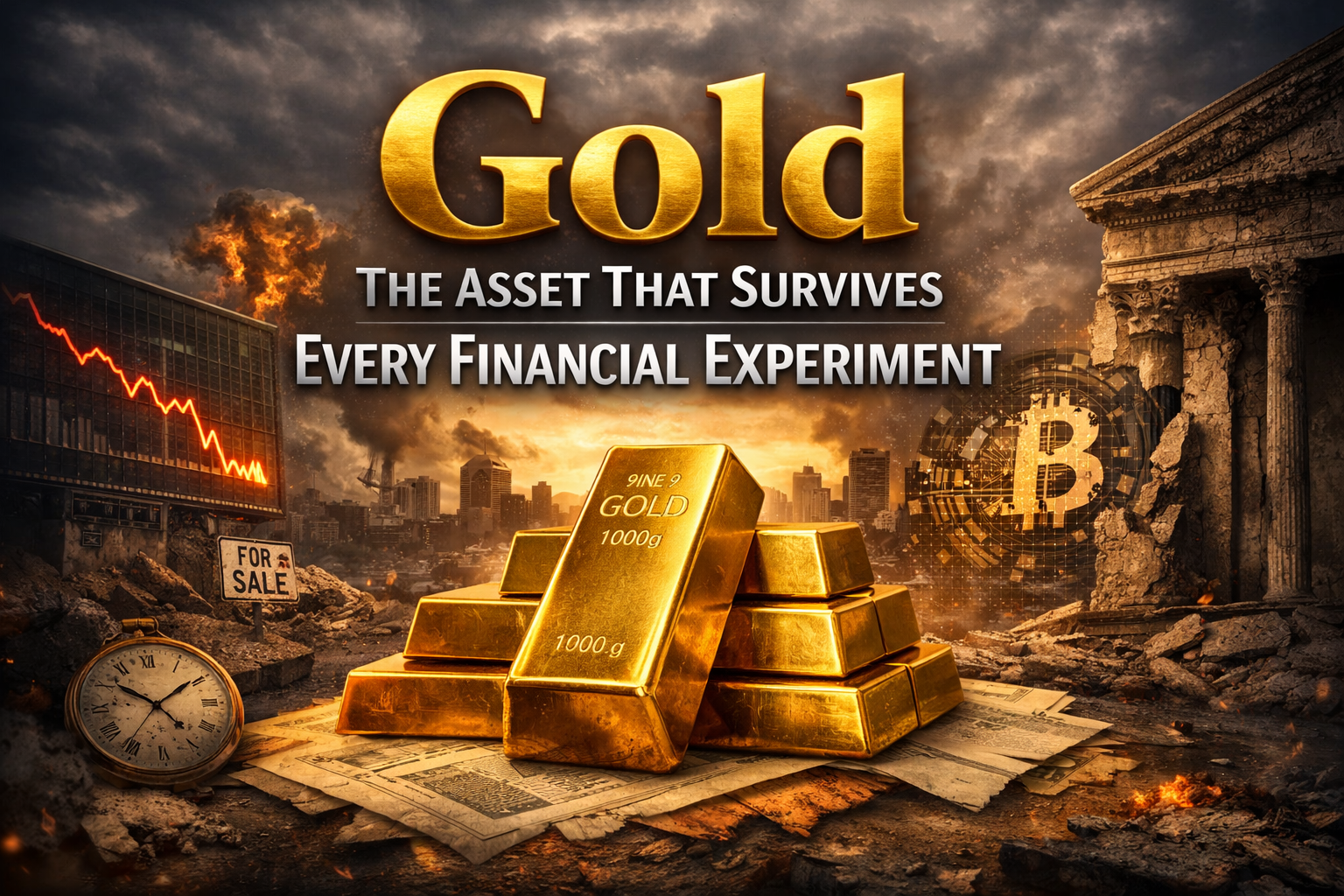
For centuries, gold has occupied a unique position in the global financial system. Empires have risen and fallen, currencies have been created and destroyed, technologies have transformed economies, yet gold has consistently preserved its relevance and value. In a world where investors are constantly comparing equities, real estate, mutual funds, and cryptocurrencies, gold continues to stand apart as a fundamentally resilient asset.
Between 1971, when the gold standard was abandoned, and 2024, gold prices have risen from approximately USD 35 per ounce to over USD 2,000 per ounce, delivering long-term compounded returns of around 8 percent annually in dollar terms. This performance has been achieved without reliance on corporate earnings, management execution, or technological adoption cycles.
This article explains why investing in gold remains a stronger and more reliable option compared to share markets, property, mutual funds, and digital assets, particularly in times of economic, political, and systemic uncertainty.
Gold Is Immune to Company Specific Risk and Market Sentiment

Equity markets are inherently driven by sentiment, narratives, and company level developments. A single earnings miss, regulatory action, leadership change, or geopolitical headline can erase 10 to 30 percent of a company’s market capitalization in a matter of days. During major market corrections, benchmark indices themselves can decline 40 to 55 percent, as witnessed during the 2000 dotcom crash, the 2008 global financial crisis, and the 2020 pandemic selloff.
Gold, in contrast, does not depend on quarterly results, management decisions, balance sheets, or corporate governance. Its value is derived from universal trust, scarcity, and monetary history. During the 2008 financial crisis, while global equity markets fell over 50 percent, gold prices rose by more than 25 percent between 2007 and 2011. In the COVID 19 crash of 2020, gold reached record highs within months while equities remained volatile.
This repeated pattern demonstrates gold’s role as a sentiment neutral asset in an otherwise emotion driven market environment.
Gold Has No Counterparty Risk
One of the most underappreciated advantages of gold is the absence of counterparty risk. Stocks depend on corporate solvency. Mutual funds depend on fund managers, custodians, and market liquidity. Real estate depends on developers, tenants, legal systems, and credit availability. Cryptocurrencies depend on technology infrastructure, exchanges, and regulatory permissions.
Physical gold and sovereign backed gold instruments do not rely on any institution’s promise to pay. According to the World Gold Council, over 90 percent of gold ever mined is still in existence today, retaining intrinsic value across generations. This permanence makes gold uniquely resilient during systemic stress when trust in financial intermediaries weakens.
Limited Supply and Irreplaceable Scarcity
Gold is finitely scarce. Global gold production grows at a constrained rate of approximately 1.5 percent per year. Annual mine production averages around 3,500 tonnes, while global demand consistently ranges between 4,200 and 4,500 tonnes, with the gap met through recycling.
All the gold ever mined in human history amounts to roughly 205,000 tonnes. If melted together, it would form a cube measuring approximately twenty two meters on each side. No technological breakthrough can materially accelerate gold supply, unlike fiat currencies which have expanded by over 300 percent globally since 2008.
This structural scarcity is why gold has historically acted as an inflation hedge. Over the last 50 years, gold has outpaced average global inflation and preserved purchasing power during high inflation decades such as the 1970s and the post 2020 monetary expansion cycle.
Gold Has Never Lost Its Monetary Relevance
Central banks continue to treat gold as a strategic reserve asset. As of 2024, central banks collectively hold over 35,000 tonnes of gold, accounting for nearly 17 percent of all gold ever mined. In the last three consecutive years, central bank gold purchases exceeded 1,000 tonnes annually, the highest level in recorded history.
Countries such as China, India, Turkey, and Russia have increased gold reserves to reduce dependency on reserve currencies and hedge geopolitical risk. This institutional behaviour reinforces gold’s enduring role in the global monetary system.
Gold Versus Share Markets
Equities can generate high returns during expansionary cycles, but they are accompanied by extreme volatility. Over the last 30 years, global equity markets have experienced multiple drawdowns exceeding 30 percent. Recovery periods have often taken five to seven years for investors who entered near market peaks.
Gold, while delivering lower peak returns than equities in bull markets, provides stability during downturns. Portfolio studies consistently show that allocating 5 to 15 percent to gold reduces volatility and improves risk adjusted returns over long investment horizons.
Gold’s correlation with equities tends to turn negative during periods of crisis, making it an effective portfolio stabiliser rather than a speculative instrument.
Gold Versus Real Estate
Real estate is capital intensive and illiquid. Residential property price cycles often stagnate for long periods. In multiple global markets, real estate prices remained flat or declined in real terms for 7 to 10 years following the 2008 crisis.
Gold offers near instant liquidity, global pricing transparency, and zero maintenance costs. It does not suffer from regulatory bottlenecks, tenant risk, or leverage exposure. Transaction costs for gold are significantly lower compared to stamp duties, registration fees, and taxation associated with property investments.
Gold Versus Mutual Funds
Mutual funds are market linked products. Their performance depends on market cycles, fund manager decisions, expense ratios, and timing. Over a 10 year period, a significant percentage of actively managed equity funds fail to outperform their benchmarks.
Gold investments, whether through physical gold, exchange traded funds, or sovereign gold bonds, offer transparent pricing and direct exposure to the underlying asset. Sovereign gold bonds in India additionally provide fixed annual interest while tracking gold prices, enhancing overall returns.
Gold Versus Cryptocurrencies
Cryptocurrencies remain highly volatile. Bitcoin, for example, has witnessed multiple drawdowns of over 70 percent within short timeframes. Regulatory uncertainty, exchange failures, and security breaches continue to pose systemic risks.
Gold does not rely on adoption narratives or technological infrastructure. It does not face existential regulatory threats. Its role as a store of value has been validated across more than 5,000 years of economic history.
New Age Gold Investment and Trading Options
Modern investors now have multiple avenues to invest in gold. Gold exchange traded funds manage assets worth over USD 200 billion globally. Digital gold platforms and sovereign gold bonds have expanded participation among younger investors.
In India, investment demand for gold has grown steadily, with financial gold now accounting for a rising share of total gold demand compared to purely ornamental use. This transition reflects gold’s evolution from a traditional asset to a strategic financial instrument.
Gold’s strength lies in its consistency. It does not promise extraordinary returns, yet it has delivered steady long-term appreciation while protecting wealth during periods of crisis. It requires no belief in management quality, no faith in technology, and no reliance on economic cycles.
In a world marked by rising debt, currency debasement, geopolitical tensions, and financial complexity, gold remains one of the few assets that serves as true financial insurance.
While equities, real estate, mutual funds, and digital assets each have their place in a diversified portfolio, gold stands apart as the ultimate hedge and the most time tested store of value.
History has shown repeatedly that gold never loses its shine. It simply waits for uncertainty to remind investors of its importance.