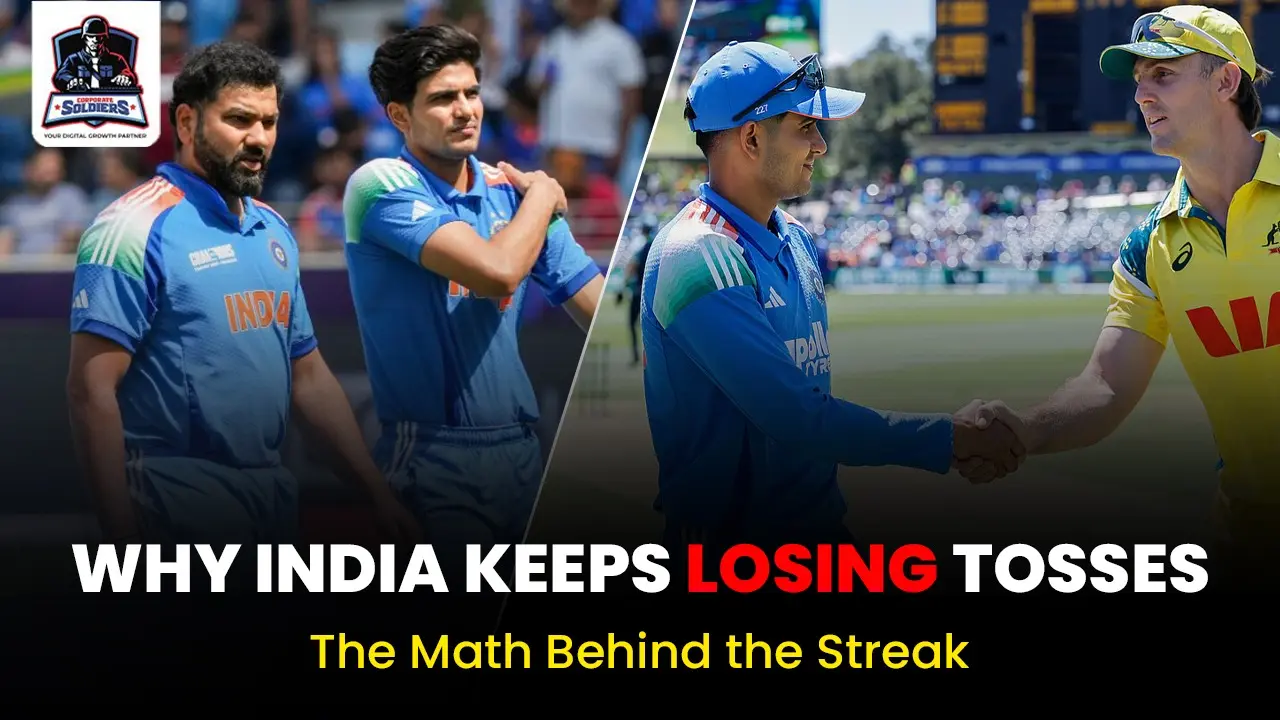
Every few years, cricket throws up a statistic that feels almost unreal. Today, that statistic belongs to India: twenty consecutive toss losses in One Day Internationals. Tosses are supposed to be the purest form of randomness in cricket, a fifty–fifty split with no psychological, tactical or skill-based interference. Yet here we are, with the world’s most-watched cricket team stuck in a losing streak long enough to break global records.
| Rank | Team | Format | Known consecutive toss-loss streak | Notes |
| 1 | India | ODI | 20 | Confirmed current world record for most consecutive toss losses in ODIs. |
| 2 | Netherlands | ODI | 11 | Previously held record before India went past it. |
| 3 | Zimbabwe | ODI | 9 | Listed among highest ODI toss-loss streaks. |
| 4 | Bangladesh | ODI | 9 | Tied with Zimbabwe on some lists. |
| 5 | Sri Lanka | ODI | 8 | Also appears in “most ODI toss losses” streak lists. |
India’s run is now the longest toss-losing streak in ODI history. Netherlands once held the record with eleven, followed by Zimbabwe and Bangladesh hovering around nine. India has almost doubled those numbers. At face value, this looks like terrible luck. But beneath the surface lies a deeper story that mixes probability theory, cognitive bias, long-run randomness, and the inevitable force known as regression to the mean.
To understand why this happened and how long such streaks can continue, we need to step out of cricket for a moment and step into mathematics.
The law of moving averages
Many gamblers mistakenly believe that if an outcome appears too many times in a row, the opposite is due. Probability, however, does not work that way. A coin doesn’t grow tired of landing on tails. It doesn’t become more generous over time. Each event is independent. The probability stays fifty percent, toss after toss.
But what does shift is the moving average: the rolling window of outcomes across a sequence. Across thousands of trials, long losing streaks are not just possible but expected. In fact, mathematicians have proven that the expected longest streak in a sequence of random binary events grows as the number of trials increases.
If you flip a coin a hundred times, the longest losing streak is often between six and eight. If you flip it five hundred times, streaks of ten or more are not surprising at all. Olympic shooters, casino players and even stock market analysts face the same phenomenon. The illusion of patterns in randomness is a cousin of something called the law of large numbers.
The law of large numbers and why India is not cursed
The law of large numbers states that as the number of events increases, the average outcome approaches the expected probability. For tosses, this means fifty percent heads and fifty percent tails over a large enough sample. But the road to this average is messy. Within the journey, nature allows clusters, streaks, anomalies and bursts that look anything but random.
India’s twenty-toss streak is not a violation of probability. It is the most dramatic expression of randomness itself.
Think of it this way. If every ODI team plays hundreds of matches over decades, with each toss being independent, then extreme clusters become mathematically certain. Someone had to experience a streak of twenty at some point. That someone happened to be India in 2024–25.
The regression-to-the-mean effect
Regression to the mean is the idea that extreme outcomes tend to move back toward average levels over time. If a stock performs extremely well for a few months, the following months often deliver more “normal” results. If a batter has a bad run of form, odds are that he will eventually move closer to his career average.
Tosses behave exactly the same.
After an extreme run of twenty losses, the most likely long-term outcome for India is a return to equilibrium. Over the next fifty ODI tosses, India is still expected to win around half. The streak does not make future wins more likely; it simply sets the foundation for long-term balance.
How streaks affect psychology inside dressing rooms
While tosses are mathematically random, teams are not. Humans behave differently during streaks. A captain losing repeated tosses can appear unlucky. Analysts begin to over-index on conditions they cannot control. Fans start reading patterns that don’t exist. In sport, perception becomes a subtle performance variable.
Researchers in behavioural economics call this the clustering illusion: humans assume patterns in random events because our brains are wired to detect sequences even when none exist.
In cricket, this illusion does two things during a streak:
- It creates noise in decision-making. Teams may over-prepare for defending totals or chasing totals depending on past outcomes they did not choose.
- It shifts emotional energy. Teams feel as though they start the game at a disadvantage before a single ball is bowled.
Even though the toss has no memory, the team does.
How can India break the streak?
The simplest answer: they can’t. Not through effort, not through prediction, not through strategy. Tosses are independent random events. The only way to break the streak is to keep playing matches.
But teams can break the psychological drag of a losing streak in three practical ways.
Reframing the toss
Analysts recommend treating toss outcomes as fixed variables, not random ones. Instead of planning two game plans, teams can design a single adaptable plan that scales depending on conditions. By detaching emotional value from the toss, the team stops feeling as if it is losing before starting.
Micro-preparation
Teams thrive when scenarios are normalised. If India prepares equally for batting first and chasing, regardless of recent toss results, the toss becomes less influential. The Australian team during their golden era used this method: every match simulation started with the assumption that they might lose the toss.
Narrative reset
Sports psychologists often advise players to break patterns through narrative interruption. A captain can switch his phrasing, his pre-match routine or even the ritual step he takes before calling the toss. While this doesn’t change probability, it rewires team perception around the event.
You cannot control randomness, but you can control how you experience randomness.
Why this streak is a reminder of cricket’s deeper beauty
Cricket is a game of skill layered on uncertainty. The toss is the ultimate reminder of that uncertainty. It is the one moment in cricket where nothing can be predicted, engineered or reverse-engineered. In a sport where analytics, algorithms and data models increasingly drive decision-making, the toss humbles everyone equally.
India’s twenty-toss streak is extraordinary, but not supernatural. It is probability expressing itself in the purest way. It is the mathematics of chaos meeting the psychology of elite sport.
And just as it started without warning, it will end without announcement.
Because randomness ends streaks the same way it creates them quietly, unpredictably, and without caring who is standing on either side of the coin.