Introduction
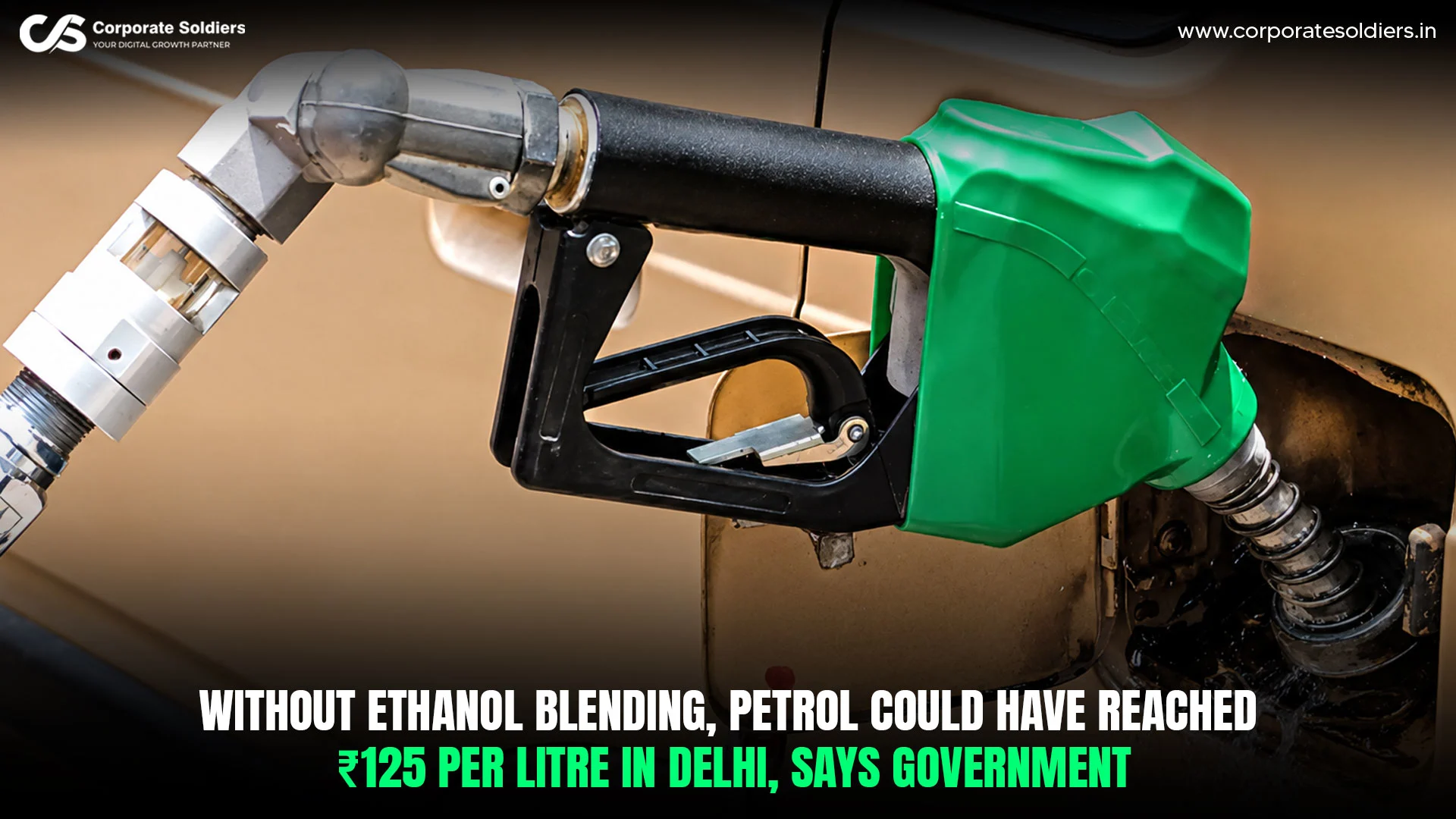
According to the Government of India, the cost of petrol in Delhi might have soared to approximately ₹125 per litre at times of high global crude oil price without the ethanol blending programme adopted by the country. The Ministry of Petroleum and Natural Gas (MoPNG) indicated that ethanol blending served as a buffer between the consumers and the full effects of the crude oil prices when international crude oil prices rose to nearly $135 per barrel.
This is said as a new debate on the idea of expanding ethanol-blended petrol and especially E20 fuel and the greater involvement of biofuels in the Indian energy approach takes place. Although the estimate of the government is based on its own review of the impact of the programme, the assertion has also attracted the interest of the economic, agricultural and energy-security goals of the ethanol blending project in India.
With India aiming to decrease its reliance on imported crude oil and increase the production of renewable fuels domestically, ethanol blending has become one of the most important energy-transition programmes in the country.
Government’s Claim Explained
The Ministry of Petroleum and Natural Gas stated that petrol prices in Delhi could have risen to about ₹125 per litre when global crude oil prices reached around $135 per barrel if ethanol blending had not been part of India’s fuel mix. The ministry claimed that the programme assisted in moderating the fuel prices by substituting a part of imported petrol with locally produced ethanol.
The government has introduced the number as a representation of the cost-saving impact of ethanol replacement at the time when the international oil markets were extremely volatile. Authorities have maintained that each litre of ethanol blended with petrol reduces the amount of imported fossil fuel required, making the country less susceptible to global crude oil price shocks.
Petrol prices in India are also influenced by central and state taxes, meaning retail fuel prices are affected by factors beyond crude oil costs alone.
It should be mentioned that the 125 per litre estimate is a government estimate and not a retail pricing estimate that has been done by an independent auditing firm. Nevertheless, the economic justification is that a part of imported fuel can be substituted with domestically produced ethanol which will lead to lower reliance on imports, and such a rationale aligns with the goals of the Ethanol Blended Petrol (EBP) Programme in India.
What Is Ethanol Blending?
Ethanol blending is the use of ethanol, a renewable biofuel normally made of sugarcane, molasses, maize and other agricultural feeds, with petrol and then sold to consumers.
The ratio of blend is stated to be:
- E10: 10% ethanol and 90% petrol
- E20: 20% ethanol and 80% petrol
- Higher blends: Greater blends of ethanol in specifically designed vehicles.
The Ethanol Blended Petrol Programme was initiated by India to help decrease crude oil imports, enable farmers and reduce emissions. The programme has grown tremendously in the last ten years. Official data indicate that the blending rates increased from less than 1.5% in 2013-14 to around 20% in 2025-26, allowing India to achieve its E20 target ahead of schedule.
The programme is carried out by means of the public-sector oil marketing companies, such as Indian Oil Corporation (IOC), Bharat Petroleum Corporation Limited (BPCL) and Hindustan Petroleum Corporation Limited (HPCL).
Why Ethanol Blending Helps Reduce Fuel Costs
Lower Dependence on Imported Crude
India has a high percentage of importing its crude oil needs. At times when world crude prices shot high, the cost of fuel in the country is under upward pressure.
Through the mixing of ethanol and petrol, some of the fuel being sold at the retail outlets is domestic agricultural feeds and not foreign petroleum. This decreases the amount of crude oil demanded and decreases the foreign exchange outlays.
Diversification of Fuel Supply
Ethanol offers a new fuel source in addition to the traditional petroleum products. This diversification has the potential to enhance resilience to global supply shocks and commodity-price volatility.
Greater Energy Security
Government sources always refer to ethanol blending as an energy-security tool. Increasing the proportion of fuel derived domestically in the transport industry will enable India to minimize the geopolitical risks and instability in the world energy markets.
Economic Benefits Highlighted by the Government
The government has pointed out a number of economic benefits of the ethanol blending programme.
Based on the data published by the Ministry of Petroleum and Natural Gas and PIB:
- Since the expansion of the programme, foreign exchange savings have surpassed ₹1.9 lakh crore.
- Over 310 lakh metric tonnes of crude oil have been replaced by ethanol.
- The purchase of ethanol and the associated payments made to farmers have been in excess of ₹1.6 lakh crore.
- There has been substantial investment in the capacity of production of ethanol in the country.
The official records show that the capacity of ethanol production has grown to approximately 2,000 crore litres in 2026 as compared to 421 crore litres in 2014. The same period has also seen a sharp increase in the ethanol purchases by oil marketing companies.
Benefits for Farmers
Among the core policy goals of the programme is to generate more income to farmers.
Ethanol feedstocks are:
- Sugarcane juice
- B-heavy molasses
- C-heavy molasses
- Maize
- Damaged food grains
- Surplus agricultural produce
Government officials say this provides predictable demand to agricultural production and it sustains rural income.
Environmental Impact
Ethanol is a renewable fuel since it is made out of biomass, instead of fossil resources.
The ethanol blending programme has also helped in the cutting down of over 900 lakh metric tonnes of carbon dioxide emissions, as estimated by the government since its expansion.
The potential environmental benefits are:
- Reduced lifecycle greenhouse gas emissions than with conventional petrol.
- Reduced reliance on fossil fuels
- Further climate and energy-transition support of India.
Nevertheless, analysts tend to observe that the environmental results will be based on the selection of feedstock, farming, water consumption and effectiveness. Consequently, the environmental impact of a production system may be different depending on the production system.
Challenges of Ethanol Blending
Although ethanol blending has a number of policy benefits, there are a number of challenges.
Feedstock Availability
To maintain the elevated blending rates, it is essential to have dependable ethanol feed supplies. The problem of fuel production and the use of fuel versus agricultural needs is a continuous policy debate.
Water Consumption
Sugarcane being one of the key ethanol inputs in India is a water-intensive crop. There has been a growing trend among policymakers to diversify to grain-based ethanol, especially maize, to diversify feedstock. In recent years, the government has also adjusted ethanol feedstock policies at times to balance fuel production with sugar availability, highlighting the need to manage food and fuel priorities simultaneously.
Vehicle Compatibility
Some vehicle owners have been raised with concerns of compatibility and fuel economy with the E20 following the replacement of E10.
Government and motor companies have claimed that E20 compatible cars have been extensively tested and that no instances of engine failures have been reported as a direct result of E20 use.
Most newer vehicles are designed to operate on E20 fuel, while owners of older vehicles are advised to check manufacturer guidance regarding long-term compatibility.
Meanwhile, Union Road Transport and Highways Minister Nitin Gadkari has recently informed Parliament that E20 petrol could decrease fuel efficiency by about 2-6 percent, depending on the type and age of the vehicle. This is partly because ethanol contains less energy per litre than conventional petrol, which can slightly reduce fuel economy.
Infrastructure Requirements
Higher ethanol blending levels require investments in:
- Storage facilities
- Blending infrastructure
- Transportation networks
- Production plants
Growth of the programme has thus been supported with a lot of infrastructure development within the fuel supply chain.
Food-versus-Fuel Debate
Biofuel programmes around the world regularly lead to apprehension regarding rivalry in utilisation of agricultural products in food and fuel.
India has tried to mitigate these fears by having a diversified feedstock policy and by utilizing the excess agricultural production where feasible. However, the problem still serves as a significant point of concern in biofuel policy deliberations in the long-term.
India’s Ethanol Blending Roadmap
The strategy of ethanol in India is based on the National Policy on Biofuels and Ethanol Blended Petrol Programme.
Key milestones include:
- Less than 1.5% blending in 2013-14.
- Rapid growth following policy reforms that were initiated in 2014.
- Introduction of E20 petrol nationwide.
- Achievement of the 20% blending target ahead of the original timeline.
The government has made it clear that no decision has been made so far to increase the nationwide blending level above 20%. The next step to increase blends would involve evaluation of the science, technical tests and consultations with the stakeholders.
Consumer Impact
To consumers the argument by the government is simple: the blending of ethanol will help them avoid international spikes of the price of crude oil and also lead to fuel-price stability.
The effects on potential consumers are:
Benefits
- Reduced dependence on imported oil
- Improved energy security
- Possible alleviation of fuel-price strains in crude oil shocks
Considerations
- Minor drop in fuel economy of some vehicles on E20.
- Requirement of compatibility awareness with owners of older vehicles.
- Further modification of vehicle technology to increase ethanol blends.
The government has also mentioned that the usage of E20 petrol is not a viable reason to deny vehicle insurance claims.
Industry Perspective
Industrially, blending of ethanol has formed a new eco-system between agricultural production, bio-fuel production and distribution of petroleum.
To the oil marketing companies, ethanol is an added source of domestic fuel and can be used to supplement the blending requirements and minimise reliance on imported hydrocarbons. To the ethanol producers and agricultural stakeholders, the programme has provided a new market and investment opportunity.
The project is also being seen as a more general strategy of India to enhance energy security, as well as contribute to domestic production and rural development.
Outlook for India’s Fuel Sector
The statement from the Ministry of Petroleum and Natural Gas underlines the central role of biofuels in India’s broader energy policy framework. By leveraging domestic agricultural output to meet energy demand, the ethanol blending programme serves as a dual-purpose mechanism designed to limit foreign exchange exposure while supporting domestic agricultural incomes.
As India approaches full nationwide implementation of E20 standards and explores flex-fuel vehicle integration, policy focus will continue to balance retail fuel affordability, energy independence, and environmental targets.