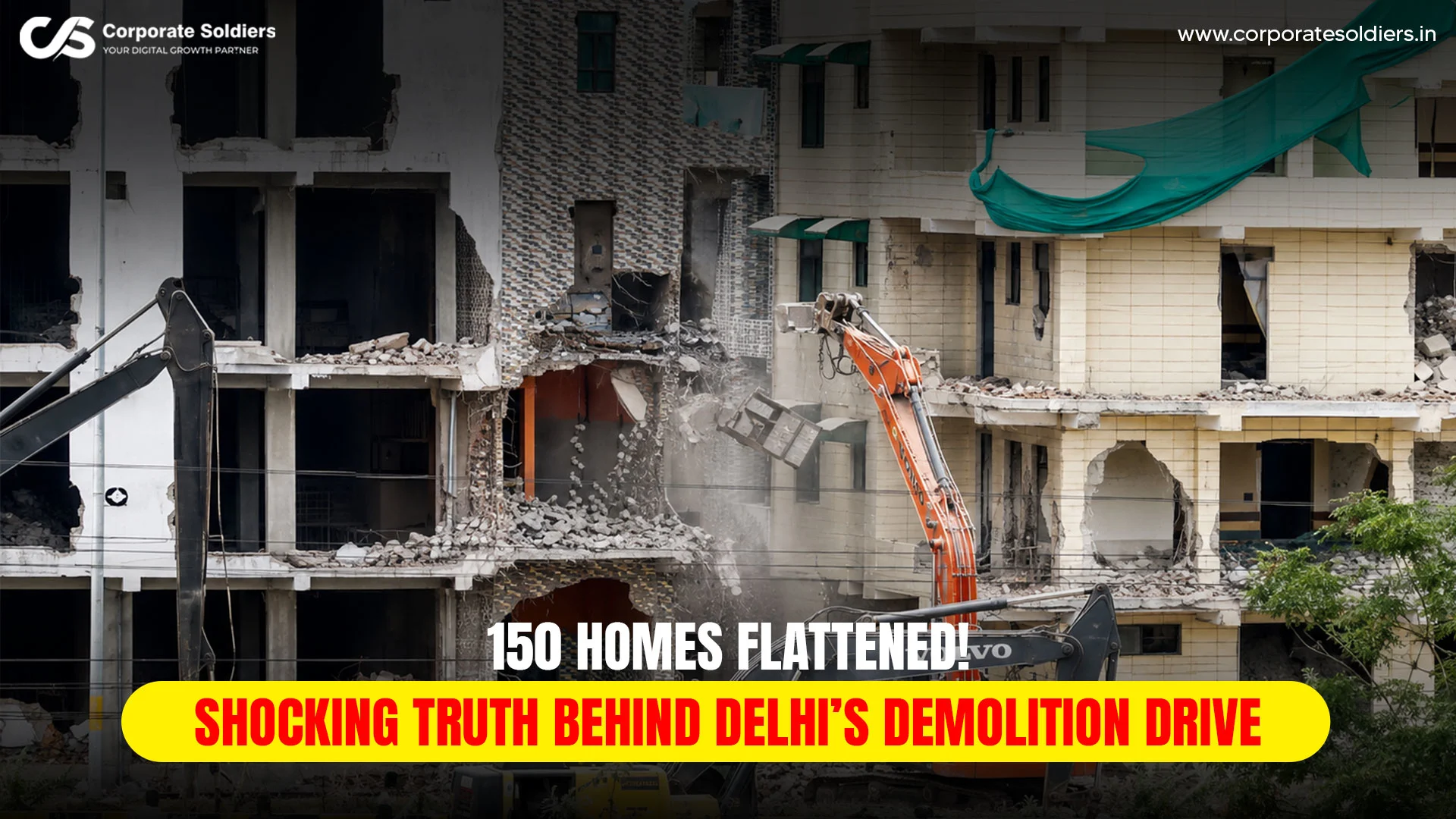
The recent anti-encroachment drive on a huge scale in the Shalimar Bagh in Delhi has highlighted the issues of land management in the cities and development of infrastructure. Police on May 31 tore down approximately 150 residential buildings as a part of a road-widening initiative in the northwestern section of the national capital. The evacuation was done following the expiry of a deadline within which people were supposed to clear the impacted properties as provided by the court.
The demolition created a lot of publicity considering the magnitude of the demolition, the many years of settlement in the area, and the anxieties that the residents had, having to abandon those homes which had been inhabited by certain families since their childhood.
What Happened in Shalimar Bagh?
This demolition drive was carried out in Haiderpur in Shalimar Bagh in northwest Delhi. The operation started early in the morning on May 31, with intensive security measures in the area and a large deployment of police and paramilitary forces. Senior police officials also monitored the process to maintain law and order.
Authorities state that about 150 houses were demolished in a road widening project. Police officers were reported to have started planning the night before and barricading operations started before dawn and the demolition work started in the early morning hours.
The affected buildings fell on land that was to be used in widening a road which the authorities claimed was to be done to widen the already existing road and enhance connectivity in the region.
Why Were the Buildings Demolished?
The authorities cited the demolition to be done to clear encroachments which hindered a planned road-widening project. The move was preceded by a legal procedure which involved public notices, administrative orders and court hearings.
District Magistrate Shailendra Singh said that the land was acquired by the Delhi government in 1980 and compensation was paid to the affected occupants of the land at that time. Officials indicated that a survey carried out in January 2026 showed that there were 143 illegal permanent constructions in the 30-metre right of way that the road was supposed to be built.
In January, the district administration put out a notice with objections and in March, issued a demolition order. In April, residents had appealed against the move at the Delhi High Court. Nevertheless, the court authorized the authorities to continue with the project of expanding the road and ordered people to leave the buildings by May 30. After that deadline was reached the demolition started.
The authorities insisted that the move would only involve about 10.5 metres of the encroached land above the current roadway and the aim was to save as many buildings as possible throughout the expansion.
Legal Timeline Leading to Demolition (Supreme Court Proceedings)
The legal proceedings escalated following the Delhi High Court’s order in April 2026. A review petition to the decision was dismissed May 18, 2026. This was in turn petitioned to the Supreme Court wherein on May 29, 2026, the Special Leave Petition (SLP) was denied. All the court redresses had been exhausted and as such, the demolition drive was carried out on May 31, 2026 when the compliance deadline elapsed.
The Scale of the Operation
The drive was part of broader anti-encroachment operations carried out in Delhi over the past few months. Nearly 150 buildings were marked for demolition in this action.
Security and Administrative Deployment
The neighborhood was put under high-security with police and paramilitary forces being deployed throughout the area. The operation was overseen by senior officers, such as the top officials of the district police. Authorities implemented extensive security arrangements to prevent disruptions and maintain order in the area.
Road-Widening Objective
The authorities justified that the current road was taking up around 19.5 metres of the allocated corridor with the rest of the encroached area being needed to bring the designed 30-metre wide road. The project will be aimed at enhancing the road infrastructure and traffic in the region.
Why Authorities Considered the Project Necessary
The road-widening project in Shalimar Bagh was described by authorities as a critical infrastructure requirement aimed at improving mobility and public safety in the region. Officials said the stretch forms an important traffic corridor connecting Shalimar Bagh with Outer Ring Road, Azadpur, and several adjoining residential neighbourhoods.
According to the administration, the expansion is also intended to improve emergency access for ambulances, fire services, and other essential response vehicles, which often face delays due to congestion in the existing narrow stretch.
Authorities further maintained that the project forms part of broader urban mobility planning and was essential in easing long-term traffic pressure in north-west Delhi.
Impact on Residents
The demolition directly affected families living in the structures. Some of its residents indicated that they had been expecting the risk of demolition but were not sure when it would happen and how this would impact future housing plans.
Most of the families claimed that they had been in the locality for decades. The residents said that they had land registration documents as far back as the 1970s or earlier and it was frustrating to be evicted after paying taxes and utility bills.
Housing and Relocation Concerns
Homeowners whose houses were destroyed were complaining that they were faced with the financial strain of seeking alternative settlement. They said that they would now be forced to move into rented houses, some even pointed out that they could go back to their home villages because of the loss of homes and ways of life.
A resident informed Hindustan Times that the compensation and rehabilitation schemes provided by authorities were not easy to get due to the eligibility requirements. Authorities had told them about a 3 lakh cash scheme or accommodation scheme in Ghevra according to the affected residents but some families claimed that moving to the area was not feasible due to distance and other factors.
There were also reports of power interruption by some residents during the operation which further contributed to the difficulties that were experienced on the day of the demolition.
Residents’ Legal Arguments
In the court proceedings, the residents claimed that the purchasing process was not completely solved and that the compensation was still pending in a number of cases.
They also argued that most families had been staying in the region for decades and they had old documents which included property papers and utility connections.
The court, however, did not subscribe to these arguments and the authorities could continue with the road-widening project after the deadline specified.
Compensation and Rehabilitation Measures
It was through the demolition that the government had announced a rehabilitation package to the residents who had been affected. According to the official guidelines, qualified families were granted a one time ex-gratia of ₹3 lakh.
Besides, it was also proposed to temporarily house at Savda Ghevra up to 11 months those households which had no other options of accommodation.
But residents expressed their worries on the problem of accessibility, eligibility requirements and practicality of the move to remote rehabilitation locations.
Administration’s Stand
District Magistrate Shailendra Singh argued that the land was obtained by the government decades ago and due process was observed prior to the demolition being done. The occupants who were affected were issued with notices and were given an avenue to make objections and challenge the move in court as per the officials.
The administration claimed that they had made numerous attempts to clear the site in the course of years but their previous attempts were not exhaustive. According to the authorities, the new operation was necessary in order to eliminate encroachments, enhance infrastructure, and enable road widening.
The authorities further pointed out that the demolition was done in compliance with court-sanctioned procedures and legal guidelines in regard to the road-widening project.
Delhi High Court’s Observations
The Delhi High Court, while hearing petitions related to the demolition, observed that public infrastructure projects cannot be indefinitely stalled due to private occupation of public land.
The court emphasized that such occupation must yield to larger public interest when land is required for essential public purposes such as road expansion.
The court also permitted the authorities to proceed with the demolition after the expiry of the compliance deadline, reinforcing the legal backing for the anti-encroachment action.
The Larger Urban Development Challenge
Demolition of the Shalimar Bagh underscores a common problem with most Indian cities in terms of striking a balance between infrastructure creation and the fact on the ground of long-established settlements and encroachments.
City planners are usually required to expand roads, enhance accessibility by people, and to make master plans that will facilitate increased populations. Simultaneously, the people that reside in regions where such projects are conducted might go through displacement, financial difficulties, and uncertainty about the rehabilitation.
In the Shalimar Bagh case, the officials justified the action by stating that it was a necessary measure to reclaim the land to be used by the public infrastructure, but affected residents doubted the sufficiency of compensation and the consequences of the action on the families which had resided in the area for decades.
The episode highlights the difficulties in implementing the rules of urban planning and responding to the social impact of large-scale demolition and redevelopment projects.
Final Thoughts
The demolition of almost 150 buildings in the Shalimar Bagh of Delhi is a major step in the ongoing struggle in the city to deal with encroachments and the development of vital infrastructure. The operation, which occurred after a court-approved legal process, public notification and a court decision, was intended to enable the road-widening project on land that authorities say was acquired by the government decades earlier.
Although the officials have justified the move as an act that is within the law and a requirement to enhance urbanization, people who have been affected by the demolition have questioned the issue of displacement, compensation, and loss of homes that people have lived in over the years.
With Delhi still struggling with land use, infrastructure development, and population, the demolition of the Shalimar Bagh is a reminder of the challenging balancing act between urban control, goals of development to the people, and the welfare of the city dwellers.