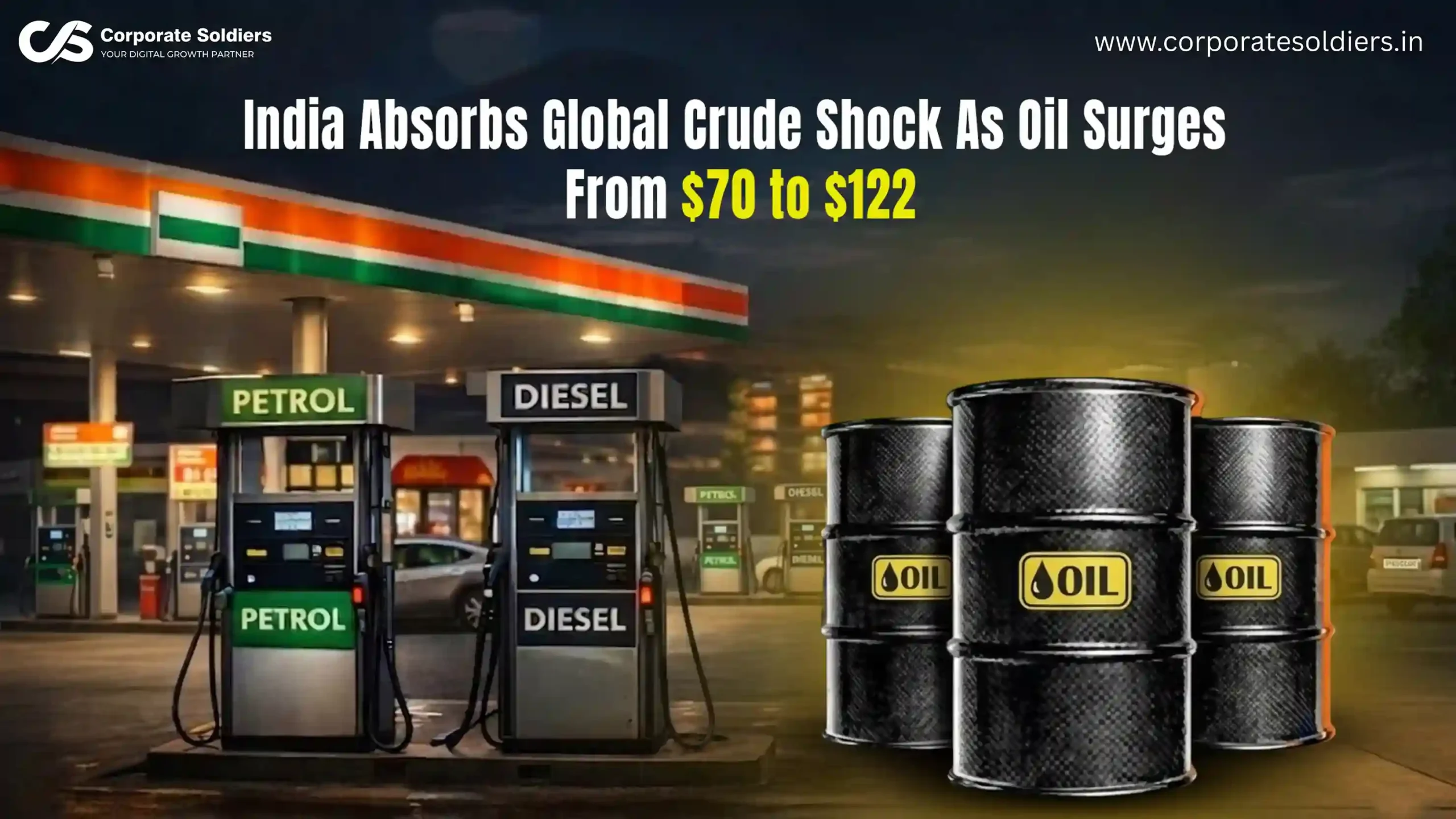
International crude spikes trigger global fuel inflation, while India prioritizes consumer insulation through fiscal absorption, tax adjustments, and export duty measures.
Research-Based Introduction
Crude oil markets have experienced a sharp upward movement over the past month, with prices rising from approximately $70 per barrel to around $122 per barrel. This sharp rise has caused a rise in fuel retail prices in the large global economies, which has resulted in high inflationary pressure on transportation and energy costs.
Based on the given policy discourse, this boom has pinned governments around the globe in a tough situation whereby they can either directly make a rise in the consumer price or absorb the volatility through fiscal measures. India has, however, adopted a different strategy that seeks to cushion local consumers against the direct effect of world oil price shocks.
Global Impact of the Crude Oil Surge
The sudden rise in the price of crude oil has been translated to high increases in the price of petrol and diesel in various parts of the world.
- Southeast Asia has been experiencing a fuel price hike by around 30% to 50%
- North America has recorded a fuel price increase of approximately 30%
- In Europe, the growth recorded is almost 20%.
- The steepest increase has been experienced in African nations by about 50%
The imbalanced, yet widespread, effect of global energy market volatility is reflected in these figures, with developing regions of the world like Africa and Southeast Asia experiencing a relatively higher inflationary transmission impact. The standardized driver over the same territories is the sudden increase in the market price of the crude oil, which has put the pricing systems of the national energy in strain.
India’s Policy Choice Amid Global Volatility
In this international context, India had two options of policy routes: either to directly transfer the burden of the increased prices to the consumers in terms of high petrol and diesel prices or to soak up the financial burden on the government and fiscal safeguards.
According to the given story, the Government of India followed the latter strategy and decided to protect the citizens against direct price growth. It is stated that the decision is in line with the overall approach that the government has taken in the last four years since the start of the Russia-Ukraine conflict, where the world energy markets have been unstable.
The policy position is an indication of the ongoing prioritization of consumer price stability as opposed to short-term fiscal balancing. It is said that the government has been under a heavy financial strain to ensure that it does not pass the foreign crude oil volatility to local fuel prices directly.
Fiscal Effect and Strain in the oil sector
The insulation decision for domestic consumers has led to a significant fiscal implication. The given statistics show that the government has suffered a significant blow to the taxation revenues to control the price gap between international crude prices and domestic fuel prices.
Oil marketing companies are currently facing estimated losses of approximately ₹24 per litre on petrol and around ₹30 per litre on diesel. These losses indicate the extent of under-recovery in retail fuel pricing relative to elevated international input costs.
This policy framework thus transfers some of the economic cost away to the consumer and onto the state-supported fiscal absorption/upstream/downstream changes in the oil distribution ecosystem.
Export Tax Mechanism and Market Stabilisation
This has been done through the introduction of an export tax on petroleum products as a response to high international fuel prices, where any refinery exporting to foreign nations will have to pay an export tax. The justification is to maintain stability in domestic supply and respond to arbitrage pressures created by elevated global prices. The policy aims to balance domestic demand with international market conditions while supporting fiscal management amid revenue pressures.
Broader Geopolitical Context
The policy reaction fits into a wider geopolitical and economic framework that has been affected by constant unrest that started four years ago with the outbreak of the Russia-Ukraine conflict. This extended shift of volatility has served to repeat the cycles of volatility in the world energy marketplaces, and these cycles have impacted pricing structures in both the developed and the emerging economies.
In this context, the strategy of India is placed within a more extended approach to dealing with external shocks by domestic price stability mechanisms instead of complete market pass-through.
Conclusion
The recent escalation of crude oil prices in the international market to as high as $122 per barrel has worsened fuel inflation across the world, with some regions of Europe experiencing as much as 20 percent and other regions of Africa and Southeast Asia as high as 50 percent. It is upon this background that India has undertaken the policy of countering the shock internally as opposed to throwing the complete burden on the consumers.
The strategy has led to a substantial fiscal burden and a decrease in revenue from taxation, and the oil companies have witnessed under-recoveries between 24 and 30 per liter of petrol and diesel, respectively. At the same time, the introduction of export duties has been done in order to stabilize the outside price pressure and home supply.
The original commentary also expresses gratitude to Hon’ble Prime Minister Narendra Modi Ji and Hon’ble Finance Minister Nirmala Sitharaman Ji for what it describes as a timely, bold, and visionary decision.
This analysis is based on the original commentary that shows a direct appreciation of the honorable prime minister Narendra Modi and finance minister Nirmala Sitharaman in what it describes as a timely and policy-driven intervention.
On the whole, this case is an organized effort of India to focus on consumer insulation during an era of long-term energy volatilities in the world, as it manages trade-offs between fiscal stability, market volatility, and geopolitical uncertainty.