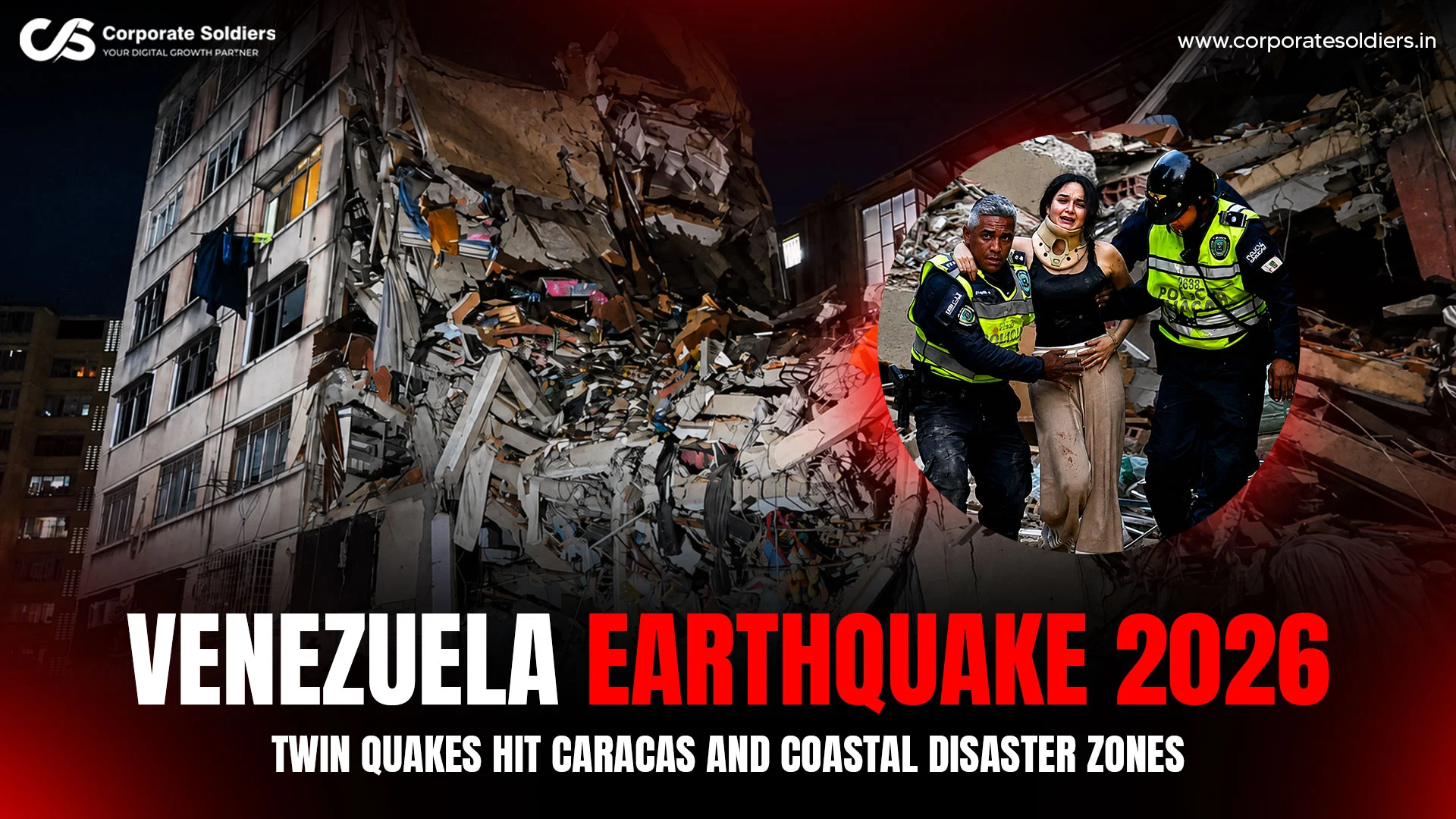
It was on the evening of Wednesday, June 24, 2026, that two massive, back-to-back earthquakes hit Venezuela which have since devastated a large part of the northern and western part of the country. Coming on a national holiday, the disaster has brought millions of citizens home, flattening high-rise buildings, crippling critical infrastructure and prompting an urgent international search-and-rescue response. The scale of the structural devastation and rising human toll have prompted governments and geologists to term it one of the most catastrophic natural disasters that Venezuela has ever faced in decades and the strongest earthquake to strike northern Venezuela since 1900.
Earthquake Technical Parameters and Geological Context
As the volumes of data released by the United States Geological Survey (USGS) show, the disaster was more than a one-time event, but a two-fold one with two major seismic shocks that occurred within less than a minute of each other.
- The First Earthquake: Struck at 18:04 local time (22:04 GMT / 23:04 BST) with a magnitude of 7.2. It had its epicenter in the state of Yaracuy about 21.9 kilometers west of the coastal town of Morón and about 160 kilometers west of Caracas. The depth of the hypocenter of the USGS was shallow at 21.9 kilometers.
- The Second Earthquake: This occurred 39 seconds after the first one, and was stronger (7.5). Its epicenter was around 28 kilometers southeast of Yumare city. It was even shallower and it had a depth of about 10 kilometers.
Why the Shocks Were So Destructive
This catastrophic degree of destruction resulted from a combination of geological conditions and structural vulnerabilities.
- Shallow Focal Depth: Both the earthquakes were close to the surface of the earth. Shallow earthquakes (below 70 kilometers deep) used in seismology do not give seismic energy time to spread through the crust of the earth before it gets to the surface. This causes much increased violence shaking on the ground directly above the epicenter as opposed to deep-focus events.
- Tectonic Environment: Venezuela has been located in the complicated boundary zone where a third plate, the Caribbean and the South American slide against each other. This fault system generated a great deal of energy due to the high rate of release of built up strain along this fault system. Seismologists also described the sequence as a seismic doublet, in which the first earthquake did not release all accumulated tectonic strain. Instead, it transferred stress to a neighbouring fault segment, triggering the stronger second rupture within seconds.
- Holiday Timing: The battle of Carabobo national holiday was on the day the disaster happened. The schools and offices being closed meant that more than usual families were packed in residential buildings rather than outdoors and hence the number of individuals in the building was so high when it collapsed.
- Weaknesses in Building Code: The violent shaking showed the glaring structural weaknesses of the local infrastructure. Civil engineers emphasize that the key factors which directly led to the overall failure of the old and new high-rise concrete buildings were quality and the lack of seismic reinforcement in the buildings.
Casualties and Regional Impact
The number of official confirmed casualties swelled as rescue workers worked on. The Acting President Delcy Rodriguez first claimed that 32 people died and approximately 700 people were injured. Later authorities changed the toll to 188 dead and 971 injured but Health Minister Carlos Alvarado confirmed that at least 235 people had died and over 1,520 people had been hospitalized. Authorities warned that the numbers might keep increasing as the search-and-rescue efforts went on.
Local registries and online missing-persons databases also indicated that between 40,000 and 46,000 people had been reported missing or unaccounted for, with authorities attributing much of the surge to widespread telecommunications outages that left families unable to contact one another.
The tremor was so intense that it was experienced across national boundaries and high-rise buildings were evacuated precautionarily as far as Bogotá, Colombia. In Venezuela, a massive structural destruction, power outages, and collapses of buildings have been documented in various large states and cities:
- Caracas: The capital city has been devastated but in localized areas, especially in the Chacao, Baruta, Los Palos Grandes and Altamira districts.
- La Guaira: The city of La Guaira was on the north coast and suffered the most impact of structural failures with dozens of large buildings being completely destroyed.
- Other Affected States: Large cracks in buildings, structural collapses and infrastructural collapses have been confirmed in the states of Yaracuy, Carabobo, Aragua, Miranda, Trujillo, and Falcón. Governor Víctor Clark confirmed at least 22 hospitalized with injuries and crews were searching for 15 missing adults in Falcón alone.
Widespread Structural Destruction
The constructed environment of the whole of northern Venezuela has been severely affected, with thousands of families homeless or sleeping on the street because of the fear of collapsing buildings.
- High-Rise and Hotel Collapses: The BBC confirmed video footage of the collapse of a 10-story hotel in La Guaira, completely turned into a mountain of rubble. The district mayor of the Baruta district of Caracas testified to the collapse of two multi-story buildings, and three confirmed deaths. In the Chacao district, Mayor Gustavo Duque said that at least one person had died as four buildings had totally fallen down.
- Healthcare infrastructure also came under severe strain. According to the Pan American Health Organization (PAHO), Hospital Domingo Luciani was fully evacuated as a precaution while Hospital Dr. Francisco A. Risquez suffered a partial collapse that forced emergency evacuations. Hospital Victorino Santaella Ruiz and Hospital Magallanes de Catia also carried out partial evacuations following structural damage and ruptured utility lines.
- Critical Infrastructure Failures: Large-scale power grid failures have caused large parts of Caracas and other cities to be completely without power. To help restore communications, SpaceX announced one month of free Starlink satellite internet service across Venezuela and began deploying additional terminals to the worst-affected areas for emergency responders and displaced residents.
- Transportation Systems: The Caracas Metro was completely closed. Moreover, Maiquetía International Airport, the country’s main international gateway, sustained damage that forced authorities to suspend commercial flight operations while structural inspections and safety assessments were carried out.
Eyewitness Accounts and Current Situation on the Ground
The abruptness of the two shocks has thrown urban areas into an anarchical situation. The witnesses report that it was a traumatic experience that they had never experienced before.
The staircases gave way, entire walls collapsed, and debris fell from the ceiling. It was terrible.
Odalis Escalona, a 54-year-old bank employee in Caracas.
On the same note, Heidi Romero, a 42-year-old shopkeeper who was above the second shock in a shopping center in Caracas when the 10-kilometer-deep second shock struck, reported scenes of pure panic with emergency stairs being used to get thousands of terror-stricken people out of the building. María Alejandra, who lives in a neighborhood near one of the buildings that fell down said that it was like a horror movie after the quake, and that people had to literally scramble over heaps of concrete slabs to get out.
A failure in the logistic organization of communication networks has contributed greatly to the distress of families in search of missing relatives. Medical student Juan Ortiz, based in Caracas, said how angry many volunteers were:
I am stunned and confused and feel that I cannot do anything because one of my close friends is dead, another one is under the rubble and 20 or so people who live in the coastal area have disappeared.
Luis Hernandez, a Venezuelan business owner who was talking in exile, emphasized the extreme fear of the diaspora, as the rupture of phone connections has obligated them to live only on pieces of social media information as to whether their sisters and parents are safe.
National and International Response
Government Emergency Measures
Immediately after the event, the acting President Delcy Rodriguez proclaimed a state of emergency throughout the country and gave the command of the national emergency to a military general to control and coordinate the national emergency. Officials in the government, such as the President of the National Assembly Jorge Rodríguez and Interior Minister Diosdado Cabello, reported the preemptive cut of gas to various urban areas to avoid post-earthquake explosions and fires.
Minister Cabello assured that emergency workers are doing everything they can in the area of security and civil support to rescue people out of the rubble. Nevertheless, local officials acknowledge that continuous aftershocks, over 20 different secondary tremors had been reported around Caracas, endanger the collapse of partially weakened buildings, making the use of search teams extremely difficult.
International Mobilization
As the extent of the disaster has become overwhelming, emergency humanitarian aid packages and search-and-rescue resources have been mobilized by several countries:
- United States: The US government has promised to give a 150 million (£113 million) rapid-relief package. According to U.S. Secretary of State Marco Rubio, the aid package includes $100 million for the United Nations Office for the Coordination of Humanitarian Affairs (OCHA) pooled fund and an additional $50 million in direct assistance to humanitarian organizations operating in Venezuela, including the International Medical Corps, World Vision, and Samaritan’s Purse.
The U.S. Southern Command (SOUTHCOM), under the coordination of Marine Corps Maj. Gen. Kevin J. Jarrard, deployed the amphibious transport ship USS Fort Lauderdale, the littoral combat ship USS Billings, C-17 and C-130 transport planes, and Urban Search and Rescue (USAR) teams of Fairfax County, Virginia and Los Angeles, California, to aid the relief efforts. K-9 search-and-rescue teams and emergency medical supplies are also deployed.
The U.S Department of the Treasury also issued a temporary sanctions waiver allowing humanitarian organizations to transfer funds and relief supplies into Venezuela without breaching existing U.S. sanctions. The authorization remains valid until October 23, 2026, facilitating international disaster assistance.
- Regional Assistance: Mexico, El Salvador, and the Dominican Republic have pledged rescue teams, emergency material and technical assistance.
- International Support: Qatar, France, Germany, Netherlands, Spain and Switzerland have also pledged special disaster response teams and staff. Also, China and India have officially declared that they are on standby to provide secondary aid to help Venezuela get back on its feet in the long term. Foreign ministries also confirmed that two Brazilian citizens and one Italian national was among those killed in the disaster, highlighting the earthquake’s impact on foreign nationals living in or visiting Venezuela.
USGS Predictive Risk Modeling
Concurrently with real time field data, the USGS Prompt Assessment of Global Earthquakes for Response (PAGER) system published worrisome mathematical probability modelling on the actual human and financial cost of this disaster.
The USGS modeling is that there is a 44 percent chance that the end result will be more than 10,000 people dead, and a 30 percent chance that the total number of deaths may approach 100,000 people. Seismologists explain that the numbers are automated estimates of the density of the population in the area, the vulnerability of local buildings to seismic forces, and previous statistics, as opposed to the actual field counts. The agency also cautioned about serious and continued secondary risks, such as structural instability, high probability of localized landslides in the mountain communities, and extensive liquefaction of the soil along the coastal corridors.
Historical Comparison
To learn the extent of the gravity of this incident, historians and geologists refer to the catastrophic earthquake in Caracas in 1967. The earthquake that had a magnitude of 6.6 killed 236 people, wounded thousands of people and greatly transformed the architecture of Venezuela.
The event of June 24, 2026 doublet is a much bigger manifestation of physical energy. Due to the 7.5 mainshock being the most powerful single seismic event to ever strike northern Venezuela since 1900, the pre- and post-disaster structural and human cost is set to eclipse any contemporary precedent in the history of the country.
Future Outlook and Recovery Challenges
The immediate focus remains on highly time-sensitive search and rescue operations during the critical first 48 hours after the earthquakes.
Before this calamity, even international humanitarian aid organizations such as Project HOPE have observed that almost 8 million of its citizens, or over a quarter of the entire population, already needed basic humanitarian help since the country was already facing severe economic problems. These already existing systemic problems will be enhanced by the total devastation of water infrastructure, massive power grid outages, shutting down of its main international airport and sending thousands of families without the ability to obtain safe housing. In the future, a long-term, multi-year international financial collaboration and multi-faceted redevelopment of the infrastructure in the destroyed municipalities in northern Venezuela will be necessary.