Weeks the football world had looked forward to an international heavyweight battle in which two of the most compelling sides in the game were to clash. Spain reached the 2026 FIFA World Cup Final as the most dominating possession-based team in the tournament with a flawless and tactically advanced team under the leadership of Luis de la Fuente. Argentina, in turn, were the defending champions and had the burden of trying to keep the largest trophy in football and were also continuing a tradition that had characterized the present day football in Argentina.
It was not a typical goal-fest, a show of attacking fireworks that occurred at New York New Jersey Stadium. Rather it turned out to be a patient, disciplined, enduring fight and ultimately survival battle.
The Spanish struggled, gouged and manipulated for 90 minutes. Argentina was in defense, resistance and also they are relying on their goalkeeper. Then followed a red card during a deep extra-time-drama, a goal by Ferran Torres, and wild scenes at the end of the game.
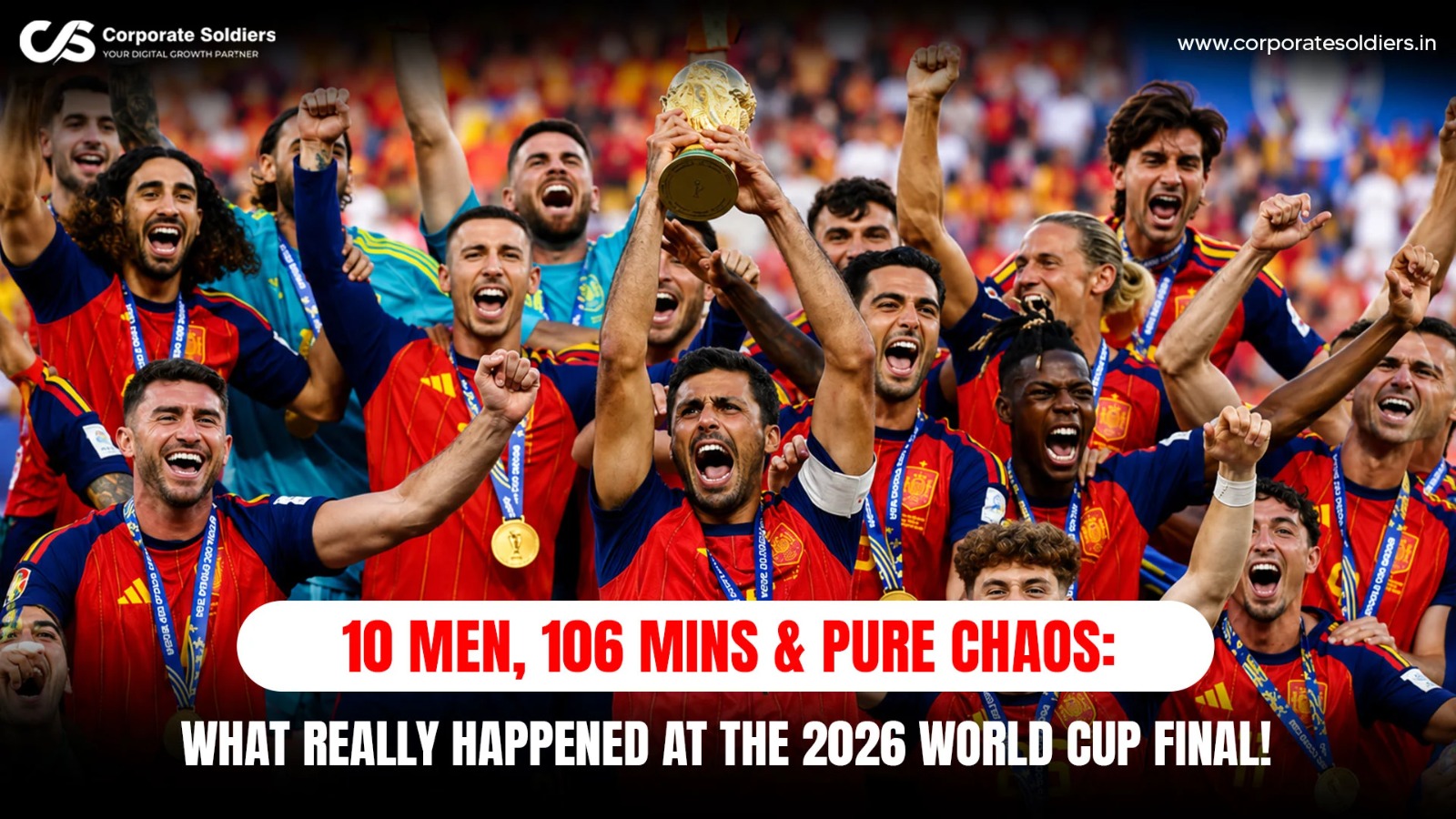
The 1-0 victory of Spain in extra time made the country win the second FIFA world cup title and terminated the reign of Argentina as world champions in one of the most thrilling FIFA world cup final matches in recent history.
The Build-Up: Spanish Dominance vs. An Argentine Wall
From the first whistle the Spaniards gained dominance.
Their midfield distributed powerfully, and pushed Argentina the length of the field, as they always found a way to break through the lines. The tempo was orchestrated by Rodri and the front line pushed Spain higher and higher through the full-backs and the frontline pushed Argentina into defensive situations many times.
The trend was not much altered during normal time.
The possession, territory and the creation of the majority of the attacking situations were dominated by Spain. Argentina was unable to develop any substantial offensive opportunities and long periods of time were spent by them on defending near their own penalty area. Reports in the latter cited that Argentina did not make any first-half shot which showed the control of the game by Spain.
But even with the superiority of Spain territorially the score was even.
This was mainly due to Emiliano Martínez.
The performance of Argentina goalkeeper will be remembered by one of the best ever performances of a goalkeeper in the World Cup Final. Denying Spain with stinging retaliation, with superb positioning and superb composure when it was most needed, he did so time and again.
Martinez was repeatedly expecting crosses, dominating his zone and making a number of vital saves that helped Spain not to turn their dominance to goals. His capability to stay on track when under continuous pressure saved Argentina a lot of time when most teams would have disintegrated.
As the number of shots that Spain fired kept on increasing, Martinez was more involved in the game. Each of the saves confirmed Argentina in their faith and at the same time aggravated Spain even more.
In normal time in the last few moments, it seemed that the goalkeeper was the only one who stood between Spain and the trophy.
The Turning Point (90+3′)
The heroic resistance of Argentina was to be tested to the limit, as the second half stoppage time began. During the 90+3rd minute, when miraculously the score was at 0-0, Enzo Fernandez threw himself in a desperate, late tackle on the 19-year-old Spanish center-back Pau Cubarsi. The challenge was also dangerous as the referee Slavko Vincic had already given him a yellow card in the 82nd minute and had no option but to give him a second warning with a red card.
The strategy turned out to be disastrous in real time and devastating to the men of Lionel Scaloni. With Argentina already exhausted, compelling them to go through the agonies of an extra half an hour with only ten men put the physical advantage in a different perspective altogether. It gave Spain a strong psychological edge immediately as they began to line themselves higher up the pitch to take advantage of the sudden gap in the middle of the park to play what was already a one-sided tactical map into an unremitting assault-versus-defense game.
The Winning Goal (106′)
It was only at 106th minute when the breakthrough came.
It was an objective which indicated the whole philosophy of the tournament of Spain.
The circulation of the patients made the defensive block of Argentina turn towards one side and then Spain promptly changed sides. Nico Williams, who had created havoc on the defenders on several occasions during the evening, had space and made the vital contribution.
Nico Williams intelligently redirected the ball into the path of Ferran Torres inside the penalty area.
It was a clever movement on the part of Torres. Instead of staying between defenders, he wandered into a hole of space that was created by better positioning and continuous movement of the ball by Spain.
It was a professional final.
There was practically no chance with Martinez, in spite of another splendid performance.
It took Argentina more than 100 minutes of beating off Spain attackers but finally its goalkeeper was defeated by a perfectly executed and timed move.
The aspiration instantaneously turned into the marking point of the championship.
It was the perseverance of Spain that paid off.
His creativity of Nico Williams was turned into an assist.
And the coolness of Ferran Torres that eventually prevailed in the FIFA world cup final. Post-match reports indicated that the goal which Torres scored came after a series of Spanish attacks and it eventually led to the end of the resistance by Argentina.
The Final Whistle: Pure Chaos
The New York New Jersey Stadium burst into a riot of uncontained euphoria, and heart-wrenching despair when the referee whistled the last in 120 minutes of bloody combat. The pure emotion of the scene at once leaked on to the stage. Some of the shattered Argentineans dropped to the ground in shock as players of Spain ran on the lawn to congratulate Torres and de la Fuente.
Within a limited amount of time, the situation was quickly escalating along the technical areas as the contemporary competitive ideals got out of control and resulted in a series of rough confrontations between the two teams. With the shoving in the aftermath of the match and the emotional tensions, the referee of the match gave out a direct post-match red card to Argentine midfielder Leandro Paredes who had been showing aggressive behaviour in the melee. But, saner heads prevailed; in a few minutes the Spanish team was assembled in a respectful guard of honour to cheer Lionel Messi and the other normal champions as they approached to collect their runners-up medals.
Tactical Analysis
Structural patience, physical conditioning and deep roster execution were the straight results of the historic victory of Spain. In keeping the ball in the elite positions, La Roja made Argentina to run in circles chasing shadows with their midfield pivots being dragged out until they became fatigued structurally. The area that Yamal and Williams provided pushed the low block of Argentina to the farthest and Rodri could have dominated the midfield through giving out the ball with almost perfection.
Moreover, the high pressing in Spain left Lionel Messi without any outlets as it was all cut off due to the high pressing. At the moment when the numerical superiority came in extra time, the impact of de la Fuente bench proved to be the deciding factor; new legs of Ferran Torres and Pedri absolutely exhausted and gasping the Argentine rearguard. On the contrary, the blueprint of Argentina was totally based on compactness in structure by falling into an ultra-low block that ceded the midfield in the hope of pushing the game into a penalty shootout.
Standout Performers
Ferran Torres
The ultimate supersub. Torres, who entered the pitch in the 61st minute, offered the direct verticality and sharpness which were lacking to the starting line of Spain in the last third. The winning goal, where he stood in the right place, and transformed his only clear opportunity of the game into the most valuable goal of his career, was typical of the instincts of an elite striker.
Emiliano Martínez
Despite his playing on the losing side, Martínez gave a goalkeeping masterclass that will be remembered as one of the most significant individual performances of the final. Martinez made a fantastic set of saves that had kept Argentina in the game and it had taken Spain a long time and extra time to break through.
Rodri
The beat of heart of the new world champions. Rodri produced the performance of the century in midfield control, getting in front of the backline to prevent any counterpasses and passing forwards with an unbelievable efficiency score before being substituted towards the end of extra time.
Nico Williams
Introduced dynamically creative play and burning wide play in the second half. Instead of trying to do a tricky finish, himself, Williams smartly redirected a delivery by Pedro Porro towards Ferran Torres, and it served as the assist to the winning goal.
Match Statistics
| Statistic | Spain | Argentina |
| Final Score | 1 | 0 |
| Possession | Dominant | Limited |
| Shots | Higher total | Significantly fewer |
| Shots on Target | Multiple | Very few |
| Corners | More | Fewer |
| Yellow Cards | Multiple | Multiple |
| Red Cards | 0 | Enzo Fernández, Leandro Paredes |
| Goalscorer | Ferran Torres (106′) | — |
| Venue | New York New Jersey Stadium | New York New Jersey Stadium |
| Attendance | Official FIFA figure pending confirmation | Official FIFA figure pending confirmation |
Historical Significance
This last turn is an indelible mark in the history of world football. This win saw Spain win their second FIFA world cup, the first world cup they won since their golden generation had won it all in South Africa 2010. Through this, the win made Spain the second FIFA world cup champions and their first since 2010, which further cemented their position as one of the top countries in the world of international football.
In the case of Argentina, the loss is a bitter culmination of their hopes of successfully retaining the crown they had won in Qatar 2022. The defeat also officially ends an era as the 39-year-old Lionel Messi is only missing the second world title in what is probably his final world cup appearance.
What This Means for Spain
To Spain, this win is a crowning achievement of the work of manager Luis de la Fuente, who at the age of 65 years makes history as the oldest coach to ever lift the FIFA world cup trophy. It justifies an epic roadmap that is concerned with integrating the traditional tiki-taka tradition in Spain with rough and straightforward wing play. The shocking emergence of a new generation- Pau Cubarsi, Lamine Yamal, and more- and the world-renowned management of such experienced characters as Rodri and Dani Olmo, are the signs that Spanish football will be able to dominate the world in the next few years.
What This Means for Argentina
In the case of Argentina, the last ones are an indication of a natural yet emotional transition phase. Although it does not help to devalue Lionel Messi as arguably the greatest player to have ever graced the field, it plunges La Albiceleste into a rebuilding process. As the old generation of players with extensive international experience is nearing the end of their careers, manager Lionel Scaloni needs to consider incorporating the young players, such as Nico Paz and Giuliano Simeone, into the main team. The end result of this tournament is also very clear and obvious: defensive grit and individual heroism may get you to the biggest stage, but structural depth is required to keep the throne.
Final Thoughts
The FIFA world cup Final 2026 was loaded with it all. It was characterized by a frenzied tactical battle, a historic masterpiece of goalkeeping, a red card that changed history and the dramatic extra-time scenes culminating in an eye-catching match-winning goal. The crude excitement which heated up at the last blast of the whistle merely served to indicate the huge interests at stake in the affair. With the dust now settling in New Jersey, this battle will be officially recorded in the history books as one of the most dramatic, chaotic and memorable finals ever to be seen in the history of the beautiful game.
Match Stats at a Glance
| Category | Details |
| Final Score | Spain 1-0 Argentina (AET) |
| Goalscorer | Ferran Torres |
| Minute | 106′ |
| Red Cards | Enzo Fernández, Leandro Paredes |
| Saves | Emiliano Martínez produced multiple crucial saves |
| Champions | Spain |
| Runners-up | Argentina |
| Competition | FIFA World Cup Final 2026 |
| Venue | New York New Jersey Stadium |
| Match Type | Extra Time Victory |