Introduction
One of the competitive advantages that have gained significance in social media marketing is consistency. Algorithms are now more rewarding for brands and creators that have a regular publishing schedule, engagement with the audience, and development of predictable patterns of content across platforms. But, it has become much more challenging to be consistent when companies have to manage a variety of platforms, types of content, campaigns, and target audiences at the same time.
It is no longer possible to manage social media by occasional updating. This is because brands today are supposed to co-ordinate short-form videos, carousels, and educational content, trend participation, paid campaigns, community engagement, creator collaboration, and platform-specific strategies simultaneously usually on Instagram, LinkedIn, Tik Tok, Facebook, X, and YouTube Shorts.
In the absence of an organized planning system, most businesses end up being beset by such issues:
- Inconsistent posting schedules
- Last-minute content creation
- Weak campaign coordination
- Repetitive messaging
- Creative burnout
- Poor engagement performance
- Inadequate quantifiable strategy.
It is here that a properly-designed Social Media Content Calendar is needed.
A strategic content calendar transforms social media from ad hoc posting into a structured marketing system. It assists teams to plan campaigns ahead, align content to business objectives, streamline production processes, enhance teamwork and maximize performance by using data to make decisions.
No matter what kind of startup, agency, creator, SaaS company, e-commerce brand, or local business, a content calendar offers that operating framework to accomplish the growth of social media marketing quickly and in a sustainable manner.
What Is a Social Media Content Calendar?
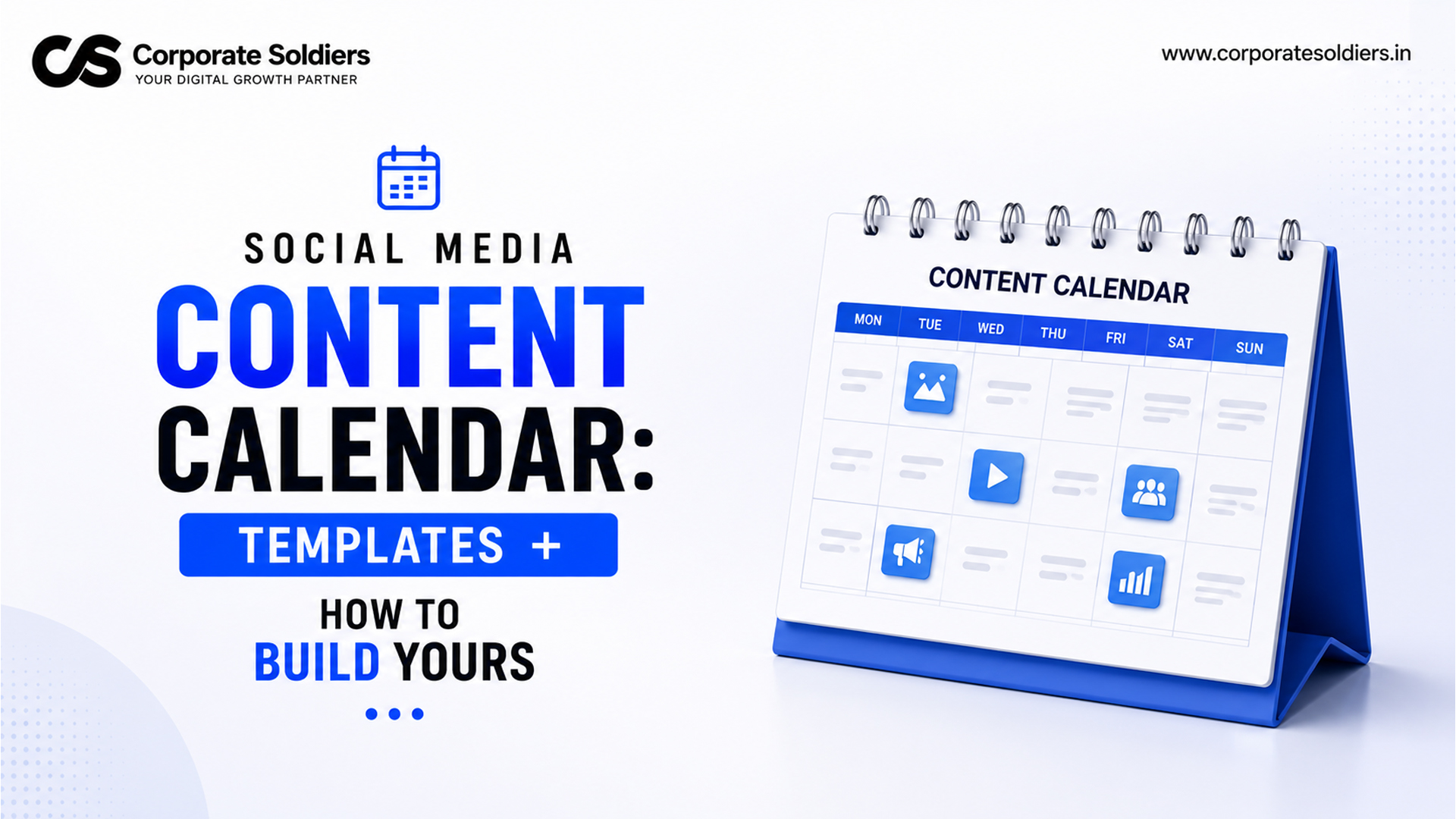
A Social Media Content Calendar is a system of planning that is designed to organize, schedule, manage and optimize content in the social platforms within a specific time frame.
It serves as an operational workflow as well as strategic roadmap to the implementation of social media.
A content calendar will often consist of:
- Publishing dates
- Platforms
- Content topics
- Captions
- Creative assets
- Hashtags
- CTAs
- Approval workflows
- Performance tracking
Why Most Social Media Content Calendars Fail?
Most companies develop their social media content calendars with the best intentions yet cannot stick to them. The issue is in most instances not the shortage of ideas but the lack of an effective system that can be sustained by the teams in the long run.
The most frequent causes of failure of social media content calendars include:
- Setting goals that are beyond the team to achieve.
- Publication periods will be inconsistent because of unrealistic time-frames.
- Lack of clear ownership of content creation, review and publication.
- Without organized approval processes, which lead to delays in production.
- Opposing analytics and going on publishing without optimization.
- Failure to have a content buffer to deal with unanticipated delays or changes of campaigns.
- Trying to rank each of the trending topics rather than pursuing a long-term content strategy.
- Delivering the same content on all platforms, rather than modifying content to platform-related audience behavior.
Effective social media content calendars are based on regular implementations and not mere scheduling. Defined workflow, realistic publication schedules, responsibility, continuous performance review and planning assist teams to be consistent and experience sustainable growth in the long run.
Strategic Planning vs Content Scheduling
Scheduling tools are a confusing concept to many businesses that think of strategic content planning.
Content Scheduling
Scheduling is an automated procedure of posting posts at a specific time using tools.
Strategic Content Planning
Strategic planning involves:
- Defining objectives
- Relevance of content and behavior of the audience.
- Structuring campaigns
- Organizing messaging
- Maintaining brand consistency
- Tracking performance trends
Content is published with the help of a scheduling tool.
The strategy of such content is developed in a content calendar.
Why Content Calendars Matter
The content calendars bring organization to the digital world which is becoming more and more chaotic.
They help businesses:
- Maintain consistency
- Reduce operational inefficiencies
- Improve campaign coordination
- Prevent duplicate content
- Increase strategic clarity
- Scale content production sustainably
Types of Social Media Content Calendars
Weekly Calendar
Best for:
- Small businesses
- Solo creators
- Agile marketing teams
Concentrates on the short term implementation and quick adaptations.
Monthly Calendar
Best for:
- Agencies
- Established brands
- Multi-platform campaigns
Gives greater visibility to the strategy.
Campaign-Based Calendar
Organized around:
- Product launches
- Seasonal promotions
- Events
- Webinars
- Sales campaigns
Platform-Specific Calendar
Isolates the workflows by platform:
- Instagram strategy
- LinkedIn content
- TikTok trends
- YouTube Shorts planning
Can be used with bigger teams that have platform managers.
Benefits of Using a Social Media Content Calendar
Working without a structure causes visibility constrictions and inefficiency of structure. Switching to an organized calendar will have direct benefits to its operations:
- Compounded Consistency: Predictable publishing patterns are rewarded with the help of algorithms. A calendar will help avoid content droughts so that the base level of visibility is steady.
- High Quality Content: Leaving real-time publishing will provide your creative team with the time and space it needs to refine copy, polish visual content and fact-check information.
- Frictionless Work: Pipelines with centralized pipelines clear up the communications. Authors, graphic designers, video editors, and legal stakeholders are aware of what, when and who owns it.
- Removal of Operational Stress: Creative fatigue is found when each day the teams are confronted with a blank canvas. Planning eliminates panic of what to post each day.
- Strategic Campaign Co-ordination: The product launches should be timed accurately in multi-channel. A schedule will make it so that your whitepaper launch coincides with your X thread, YouTube educational video, email campaign, and LinkedIn promotion.
- Data-Driven Optimization: With content in a much better state of organization, based on theme and type, it is far simpler to execute post-mortem audits, as well as isolate on the content pillars that are actually generating revenue.
Core Elements Every Content Calendar Should Include
In order to construct an actionable content planning system, your database or spreadsheet will need to follow ten different fields. Acting not to do these leaves gaps in execution and sign off delays.
- Posting Date and Time: The actual date on the calendar and local time slot the content will be made available.
- Target Platform: The host of the channel (e.g. Instagram, LinkedIn, Tik Tok).
- Content Type / Format: Designates what type of technical resource is needed (e.g., Carousel, Short-form video, Text thread, Long-form article link).
- Caption Copy: Final, approved editorial copy, with any local spacing and formatting.
- Visual Assets / Links: Direct access to cloud folders of high-resolution images, video files or raw creative templates.
- Hashtags & Tagging Profiles: Selective, contextually-based keyword tags and creator handles to be used in collaboration or attribution.
- Call-to-Action (CTA): The call-to-action that is explicit (e.g., “link in bio,” “download the report,” comment below).
- Publishing Method: Indicates that the post will be automatically published with the help of a scheduling tool or that it will have to be posted manually (native interactive platform stickers).
- Approval Status: Ideas about workflow (e.g., Ideation, In Production, Under Review, Approved, Scheduled).
- Performance Metrics: A specified area to record retro-active performance information (Clicks, Impressions, Engagement) in order to make subsequent iterations.
How to Build a Social Media Content Calendar Step-by-Step
To create a strong system, it is necessary to lay the groundwork. This 10 step framework will help you create a working calendar.
- Define Business Goals
The social measures should be connected with corporate targets. Choose your overall operation priority in the quarter, be it brand awareness, pipeline lead generation, direct e-commerce sales or talent acquisition.
- Identify the Target Audience
Make a mapping of your content with actual user personas. Identify the location of your target demographic and their time on-line, their frequent pain points, and the type of forms they use to consume information throughout the work week or in the evening.
- Choose Platforms Strategically
Do not thin the resources on all the new platforms. Select two or three channels upon which you have the concentration of your audience and perfect those before going out.
- Create Content Pillars
Define three to five focus areas as a brand that you can speak on, and be authentic. These are foundations upon which your strategy is anchored and that you have a cohesive identity in your feed.
- Plan Posting Frequency
Decide on a sustainable publication rate, depending on the resources at hand. It is much more prudent to have two posts every week that are of good value than to be posting two times a day throughout the week and then disappear after a month.
- Organize Content Themes
Arrange your content pillars on a typical weekly/monthly grid. E.g., on a Monday, a breakdown of education, on Wednesday, an industry revelation, on Friday, a spotlight of the community.
- Assign Clear Operational Responsibilities
establish ownership within your team. Define the owner of the original research, copywriter, designer of the creative materials and the ultimate editorial approval.
- Content Ownership Matrix
Although it is crucial to define responsibilities, a content ownership matrix can also be applied by many marketing teams to make it clear who is in charge of every step in the content production process. This is because attributing ownership can minimize confusion, achieve better accountability, and a seamless transition between planning and publication of each task.
A typical content ownership matrix may look like this:
| Stage | Owner |
| Topic Research | Marketing Manager |
| Copywriting | Content Writer |
| Design | Graphic Designer |
| Review and Editing | Editor |
| Final Approval | Marketing Lead |
| Publishing and Distribution | Social Media Manager |
The ownership matrix can be customized based on team size and organizational structure. Clearly assigning responsibilities minimizes production delays, streamlines collaboration, and helps teams follow the content calendar more consistently over the long term.
- Content Approval Workflow
Responsibility assignment is not the only element of a relevant content production process. Businesses should also have a well-defined approval process in place to ensure that all of their content assets move through all stages of production on a regular basis prior to publication.
An average social media content approval process is based on the following steps:
Idea
↓
Draft
↓
Design
↓
Review
↓
Approval
↓
Scheduled
↓
Published
↓
Performance Review
Adherence to a predetermined workflow aids teams to minimize production time delays, enhance coordination, brand consistency, and publishing mistakes. It is also used to make sure that all posts have been checked in terms of quality, accuracy and content relevancy to the goals of the campaign before they become live.
With the increasing content operations, an organized approval mechanism is necessary in order to have an efficient management of various platforms, campaigns, and stakeholders.
- Schedule Publishing Dates
Plug in two to four weeks ahead of time. Fill your production software or spreadsheets with copy and innovative, and import approved assets into your content scheduling engine.
- Content Workflow Timeline
An established weekly workflow is important to keep teams on track, keep them accountable, and release content regularly. Instead of undertaking all the activities at once, effective social media teams allocate particular activities to be performed on particular days of the week. This hierarchical method decreases the number of bottlenecks, enhances cooperation, and maintains the schedule of production.
A typical weekly content workflow may look like this:
| Day | Activity |
| Monday | Content planning, research, and topic approval |
| Tuesday | Copywriting and caption creation |
| Wednesday | Graphic design and video production |
| Thursday | Content review, editing, and final approval |
| Friday | Scheduling posts across platforms |
| Saturday | Community engagement and audience interaction |
| Sunday | Analytics review and performance reporting |
- Build a Content Buffer
Effective social media teams will not leave gaps in their publication, and will have a back-up of ready-to-publish content that is approved. They do not have to make all the posts prior to their release, but rather have a content buffer, which helps them maintain a steady flow of publishing even when they face some unforeseen difficulties.
Most companies have two to four weeks of planned content beforehand to give it more flexibility and to lessen the strain of production.
A content buffer assists groups to deal with:
Planned time off and holidays.
Unexpected emergencies
Employee absences
Bothersome campaign delays or approval hold-ups.
The possibility to react to certain tendencies without interfering with the current publishing plan.
Having a content buffer allows companies to be more stable, less stressed in the last minute, and more responsive to changing priorities and keep their content calendar on social media in check.
- Track Performance Metrics
Establish monthly milestones to review your performance. Go beyond vanity metrics (likes) and focus particularly on deep engagement metrics, including shares, saves and outbound link click-through rates.
- Optimize on the basis of Analytics
Adjust your approach based on your findings of the audit. In case your learning carousels are proven to be 40% more effective than long-form text posts, strategically redistribute your creative assets to lean into the winning.
Content Pillars That Improve Consistency
Content pillars are thematic groupings that guarantee your brand generates a healthy blend of worth, diversion, and trade proposals. The healthy calendar organizes its distribution under six pillars:
- Educational Content: Resolves real-life issues of your audience. This covers step-by-step tutorials, industry guides, data deep-dive, and quick tips which can be taken into action.
- Promotional Content: It is directly commercial conversion. Characteristic product changes, case-studies, client endorses and exclusive time cut deals.
- Human Content: People connect with people. This pillar includes spotlights of employees, milestones of company culture, posts of appreciation by users and interactive question prompts.
- Behind-the-Scenes (BTS) Content: Lifts the veil on what you do. Demonstrates the production of raw products, uncensored work footage or the iterative line of design in the real world.
- User-Generated Content (UGC): Peddles and rewards photos, videos and reviews that are created by your real customer base, and develops immediate social credibility.
- Trend-Based Content: Can tap into real-time cultural trends, trending forms of audio or breaking industry news as a way to inject your brand into bigger conversations.
The 70-20-10 Social Content Mix
The ability to build an effective social media content calendar is not just a choice of what to post but also a need to have a sustainable balance in terms of value consistency, content repurposing, and experimentation. The 70-20-10 model is also employed by many mature marketing teams who do not want to experience creative burnout and maintain their social media strategy fresh and effective.
70% Core Content
Most of your publishing content ought to be based on high-value content that serves your brand and audience on a regular basis.
Examples include:
- Educational posts
- Evergreen content
- Industry insights
- Brand expertise
- Customer success stories
- How-to guides
Long term trust, authority and engagement to the audience is built on core content.
20% Repurposed Content
Instead of writing out each post individually, teams that are successful will often reuse previously existing content and convert it into the new format.
Examples include:
- Reels created from webinars
- Posts that are carousel posts on the basis of blog articles.
- Copy graphics of podcasts or interviews.
- Snippets of full-length content.
- Newsletter items in the form of social posts.
Repurposing is also a means of extending the usefulness of the current content and cutting down the time spent in production.
10% Experimental Content
The calendar should be allocated to test new ideas, formats, and platform features as a smaller portion.
Examples include:
- Trending topics
- AI-generated creative concepts
- New platform features
- Polls and quizzes Interactive.
- Emerging content formats
Trying out new things can assist the business in finding new opportunities without interfering with their content strategy.
Such a balanced content mix of 70-20-10 assists teams in avoiding creative burnout, utilizing resources more effectively, and creating an established social media publishing system in the long term.
Cross-Industry Pillar Matrix
| Industry / Entity | Primary Focus Pillar | Secondary Focus Pillar | Example Post Concept |
| Personal Brand | Educational | Community | A carousel breaking down personal career mistakes and lessons learned over ten years. |
| Marketing Agency | Educational | Promotional | A data-backed case study demonstrating how a client scaled their organic search traffic. |
| E-Commerce Brand | Promotional | User-Generated | A high-energy TikTok video showing a real customer unboxing and trying out a new product line. |
| SaaS Company | Educational | Product/Promo | A short walkthrough video showing how to use a newly launched automated feature to save time. |
| Local Business | Community | Behind-the-Scenes | A video tour introducing the kitchen staff and showcasing how morning pastries are prepped from scratch. |
Best Content Calendar Templates to Use
To jumpstart your organization, adopt and modify these structured layout frameworks within your spreadsheet, database, or project management software.
- The Weekly Multi-Platform Sprint Grid
Ideal for agile teams looking at granular cross-channel distribution for a single week.
| Day / Time | Platform | Content Pillar | Creative Asset Required | Caption Summary / CTA | Status |
| Mon / 09:00 | Educational | 1080×1080 PDF Carousel | 5 steps to optimize server infrastructure / CTA: Link to full article | Approved | |
| Tue / 12:00 | TikTok | Trend-Based | 9:16 Short-form Video | Explaining the new data privacy laws using trending audio / CTA: Drop thoughts below | In Production |
| Wed / 15:00 | Community | 4:5 Static Team Photo | Meet our new lead systems architect / CTA: Welcome them in comments | Ideation | |
| Thu / 09:00 | X (Twitter) | Educational | Text-only thread | 10 tactical writing tips for clear copy / CTA: Subscribe to newsletter | Under Review |
- The Short-Form Video (Reels/TikTok) Production Tracker
Streamlined to create mobile video pipelines, giving preference to script states and audio source.
- Title of the topic: What is Automation of Your Inbox Workflow
- Recommended Platform: Instagram Reels and YouTube Shorts
- When hooked first (First 3 Seconds): You are wasting 4 hours a week to do this manually.
- Soundcloud: [Audio Link URL Hyperlink]
- Visual Direction: Direct-to-camera speaking shot cut to a screen-recorded video of a screen share which shows software set up steps
- Script Body: [Insert explicit transcript of voiceover]
- Call to Action: Comment WORKSPACE to be sent the automated template in DM
- Status: Needs Recording
- The Macro Campaign Launch Track
Specially created to handle high-priority product releases or seasonal.
- Campaigned Objective: The introduction of V2 Enterprise Platform.
- Pre-Launch Phase (T-Minus 7 Days): Pay attention to curiosity hooks, teaser assets in all core channels.
- Launch Day Phase (Day 0): High-impact product video, explicit founder statement, email newsletter alignment, and direct product feature breakdowns.
- Post-Launch Stage (T-Plus 7 Days): Case studies, testimonials of the early adopters, responses to commonly posed questions and direct responses to objections.
- Monthly Social Media Content Calendar Template
A monthly content calendar gives a macro overview of what is going to be published in various places. It assists companies to balance content types, be consistent, and align campaigns without overloading their teams.
Below is an example of a simple monthly social media content calendar:
| Week | Tiktok | |||
| Week 1 | Carousel | Industry Insight | Reel | Newsletter |
| Week 2 | Behind-the-Scenes Post | Case Study | Trend Video | — |
| Week 3 | Customer Story | Educational Post | Tutorial | Product Update |
| Week 4 | Product Highlight | Company News | FAQ Video | Newsletter |
This example illustrates the ability to spread various content formats across the month and be varied across the platforms. Depending on their objectives, preferences of their audience and their resources, businesses have the ability to change their publishing frequency, platforms and the types of content they publish. A monthly plan will help to organize the campaigns and keep the process constant and understand gaps in the content prior to publication.
- Platform-Specific Planning Strategies
One of the pitfalls is to think of social media as one. The user behaviors, cultural norms and preferences of each network are unique and determine how you should plan your content.
Instagram
- Strategic Cadence: 3-5 posts to feed every week (a combination of Reels and carousels), and interactive Stories every day.
- Format: Beautifully designed, useful carousel and very entertaining or educational short-length videos.
- Audience Psychology: The audience seeks aesthetic sensations, practical learning insights and identity with the culture.
- Planning Schedule: 2-4 posts/week.
- Format Focus: Deep reads that are text-only, industry coverage and clean PDF file carousels.
- Audience Psychology: Career, networking, sourcing of solutions in business to business, and commentary on corporate business at high level.
TikTok
- Strategic Cadence: 1-2 videos on a daily basis.
- Format Focus: 9:16 vertical videos of high-energy and unpolished that take advantage of the current trends in audio and quick editing cuts.
- Audience Psychology: Real-time entertainment, real human interaction, and uncritical transparency, as well as discovery of subcultures.
X (Twitter)
- Strategic Cadence: Once- 3 times a day (with community responses).
- Format Focus: value-first text threads, brief and immediate industry notes, and commentary on the community.
- Audience Psychology: Live news, direct connection to thought leaders, information transfer in a form of a summary and a group discussion.
YouTube Shorts
- Cadence: 3–5 videos every week
- Format Focus: Green or high impact vertical videos with clear visual pacing and crisp audio.
- Audience Psychology: Discovery knowledge of high intent, rewarding loop of viewing and rapid entertainment solution.
Platform Content Mix
Every social media platform serves a different audience and purpose, so businesses should avoid publishing identical content everywhere. Instead, each platform should maintain a balanced mix of content types based on user behavior and platform expectations.
A practical content mix may look like this:
| Platform | Recommended Content Mix |
| 40% Educational, 30% Community, 20% Promotional, 10% Trend-Based Content | |
| 50% Thought Leadership, 30% Educational, 20% Company Updates | |
| TikTok | 50% Trend-Based Content, 30% Educational, 20% Behind-the-Scenes Content |
These percentages are general planning guidelines but not rules. The content mix can be tailored by businesses, depending on the engagement by the audience and the business goal, as well as the analytics of the platform. It is advisable to maintain a balanced combination to ensure that there is no over-advertisement and to boost growth of the audience in the long term.
How to Batch Content Efficiently
Content Batching Workflows
Batching refers to the creation of several content when there is a concentrated production.
Benefits include:
- Reduced mental switching
- Faster production
- Better consistency
Weekly Planning Systems
Example workflow:
- Monday → Strategy
- Tuesday → Writing
- Wednesday → Design
- Thursday → Video production
- Friday → Scheduling
Caption Batching
It is better to write captions in a large amount:
- Messaging consistency
- Tone alignment
- Productivity
Visual Production Planning
Groupings of design assets should be by:
- Campaign
- Theme
- Platform
- Format
Recording Multiple Videos Together
Brands and creators save time in that they:
- Recording a number of reels at the same time.
- Changing outfits between clips
- Using reused arrangements and illumination.
This goes a long way in enhancing efficiency in production.
Tools for Managing Social Media Calendars
The choice of the appropriate software stack is solely based on the size of your organization as well as the complexity of your media workflows.
- Project Frameworks/Databases: Notion, Airtable, and Asana are tools that provide flexible structures of databases. They are great when it comes to cross-team work, approval states and multi-stage, as well as archiving detailed copy and media backlogs.
- Automation Engine Scheduling: Special schedulers allow you to directly connect several social accounts. They deal with automated cross platform delivery and offer inbuilt links to encircle your URLs with wrap tracking codes.
- Creative Asset Hubs: Tools such as Canva and Adobe Creative Cloud ecosystem have your visual templates stored so that your design implementation is fully consistent even between team members.
- AI Productivity Layer: Sophisticated calendar systems leverage in-built AI services to aid brainstorming of initial ideas, converting platform core scripts into platform-specific caption variants, and analyzing activity data on the audience to suggest the best time to post.
Common Social Media Calendar Mistakes
Even formal teams get into habitual optimization pitfalls. These are some of the errors to avoid during execution in order to ensure that your engagement continues to increase:
- Rigid Overplanning Without Flexibility: Building calendars months in advance leaves zero room to pivot when sudden market shifts or breaking industry news occurs. Keep a firm structure, but leave empty slots for timely reactive posts.
- Posting Identical Content Everywhere (Lazy Cross-Posting): It is unprofessional to post an uncropped video with TikTok-specific text fonts right on LinkedIn and expect people to view it as an image. Make sure you have customized your formatting, hooks and aspect ratios to each platform.
- Failing to consider Downstream Data Reviews: The way to think about your calendar is that it is a one-way publishing conveyor belt, and you never look at the monthly analytics, and thus recycle patterns of low-performing content. Allow facts to inform what is kept on the timetable.
- Weak or Confusing Call-to-Action Strategies: Without telling the user on what to do next you are freezing your conversion funnel. Each post must have a definite, and aimed follow-up.
How AI Is Changing Content Planning
Social media management is being transformed by AI as a manual process previously slow and tedious, but now being automated and based on data.
- Automated Content Repurposing: AI can immediately decompose a single top-performing long-form content, like a comprehensive company whitepaper or a 30-minute YouTube clip, and break it down into ten platform-friendly LinkedIn snippets, X text snippets or short-form video snippets.
- Data-Driven Predictive Analytics: Contemporary algorithms stop at the simple historical matrices of schedules and scan real-time platform patterns of engagement, and make a specific piece of media statistically likely to achieve traction.
- Dynamic Trend Forecasting: ML technology analyzes worldwide key velocity and increasing audio frequency, and informs creative teams about new trend opportunities hours before they flood competitive brand feeds.
Measuring Content Calendar Performance
A content calendar must be a planning system, as well as a performance measurement system.
Engagement Rate
Measures:
- Likes
- Comments
- Shares
- Saves
Indicates audience resonance
Reach
Brings an understanding of the number of people viewing your work.
Applicable in assessing the increase in visibility.
Saves and Shares
Powerful signals of the content value and relevancy of the audience.
Website Traffic
Follows contributions of social media to:
- Site visits
- Landing page engagement
- Funnel entry
Lead Generation
Important for:
- B2B brands
- Agencies
- SaaS companies
- Service businesses
Follower Growth
Measures growth trends of the audience with time.
Conversion Metrics
Tracks:
- Purchases
- Sign-ups
- Inquiries
- Downloads
Finally, it is business results that are more important than vanity measures.
Metrics Worth Tracking
Tracking the appropriate performance indicators enables the companies to assess not only the way their content performs but also the effectiveness of the workflow in their social media. Rather than simply monitoring vanity metrics, teams need to monitor a balanced set of marketing, business and production metrics.
A practical performance tracking framework includes:
| Category | Metrics to Track |
| Traffic | Website visits, Link clicks |
| Engagement | Saves, Shares, Comments |
| Growth | Followers, Reach, Impressions |
| Business | Leads, Sales, Email signups |
| Production | Publishing consistency, Missed deadlines, Approval turnaround time |
Regular monitoring of these metrics can assist businesses to see which content is doing well, enhance campaign strategies, streamline production processes, and data-driven decisions to use in future social media calendars.
Monthly Calendar Review Process
Social media content calendars should be audited on a monthly basis to find out what is working, what requires improvement and how the future content can be optimized. Frequent reviews enable companies to make wise decisions rather than making guesses.
A weekly calendar check-in should have:
- Examining the most successful posts and finding out why they were successful.
- Performing a post analysis of the posts with the lowest performing results to identify areas of improvement.
- Tracking engagement behaviors, such as likes and comments, shares, saves, and click-throughs.
- Measures of growth based on follower growth, reach, and impressions.
- Determining the consistency of publishing and determining missed deadlines or workflow bottlenecks.
- Quantifying campaign ROI through reviewing leads, conversions and other business results.
- Determining ways of reusing existing content that is doing well to create new content in other formats.
Monthly assessments enable businesses to keep their content strategy in constant flux, enhance production effectiveness, and create a social media calendar to achieve better long term performance.
Realistic Social Media Workflow for Small Teams
Startups and small business enterprises are usually resource-constrained.
Efficiency becomes critical.
Lean Content Production
Focus on:
- High-impact platforms
- Repurposable content
- Simple production systems
Avoid unnecessary complexity.
Repurposing Content
A single idea of content can be:
- A blog
- LinkedIn post
- Instagram carousel
- Short-form video
- X thread
- Email newsletter
Repurposing maximizes ROI.
Content Repurposing Matrix
Repurposing content becomes far less challenging when there is a systemic process of transforming a single asset into various format-specific deliverables in business. By modifying existing content to suit new audiences and channels, teams will be able to gain the maximum value of their content and avoid producing new content every day.
| Original Content | Repurpose Into |
| Blog article | LinkedIn carousel |
| Webinar | Short-form Reels or TikTok videos |
| Podcast episode | Quote graphics and audiograms |
| Case Study | X (Twitter) thread or LinkedIn post |
| Whitepaper | Educational carousel or infographic |
Forecasting repurposing opportunities helps businesses to decrease workload in production, offer a steady stream of publishing, and increase the longevity of performing content. Such a formalized repurposing system also makes sure that valuable information can be accessible to those who use alternative platforms and content delivery systems.
Prioritization Methods
Prioritize:
- Revenue-driving content
- High-engagement formats
- Evergreen educational content
Time-Saving Systems
Small teams are advantageous in that they:
- Batch production
- Template-based design
- Reusable frameworks
- AI-assisted drafting
Sustainable Consistency
A realistic calendar is superior to an over ambitious calendar.
Stability is a better measure in the long-term than intensity in the short-term.
Common Mistakes to Avoid
Even a well-planned social media content calendar can fail if common execution mistakes are overlooked. Long-term success depends not only on creating a plan but also on following consistent workflows, monitoring performance, and adapting based on results.
Some of the most common mistakes include:
- Posting identical content across every platform without adapting it to platform-specific audiences and formats.
- Ignoring audience insights and creating content based on assumptions rather than performance data.
- Posting too frequently without having the resources to maintain content quality and consistency.
- Operating without a defined approval process, resulting in delays, inconsistent messaging, or publishing errors.
- Failing to review analytics regularly and missing opportunities to improve future content.
- Creating content without clear business goals or measurable objectives.
- Chasing every trend instead of balancing trending topics with evergreen content.
- Neglecting evergreen content that can generate consistent long-term engagement and traffic.
- Maintaining inconsistent branding through varying messaging, visuals, or tone across different platforms.
Avoiding these mistakes helps businesses build a sustainable social media workflow, improve content quality, and maintain a content calendar that supports long-term growth and consistent audience engagement.
Conclusion
A social media content calendar is not just a mere organization tracking sheet but a vital structure of operation that turns haphazard everyday posting of social media to an operational system that is repeatable and scalable. You can prepare your business for long-term growth by giving up on reactive and real-time creation and transitioning to an organized structure of content pillars, asset batching, and data-driven reviews.
The guesswork around what to post next stops. Develop your base database architecture, establish your essential thematic pillars, batch your future production cycle and use data to drive your creative pipeline.
A successful social media content calendar is not measured by how many posts are planned, but by how consistently those plans are executed. Brands that focus on realistic publishing schedules, platform-specific strategies, clear workflows, and continuous optimization are better positioned to build sustainable content systems that drive long-term engagement, stronger brand visibility, and meaningful business growth.
Frequently Asked Question (FAQ)
- What is a social media content calendar?
A social media content calendar is a detailed map showing how you plan to post on social media in the future, arranged by specific publishing dates, platform nodes to use, links to assets to be included, copywriting templates and campaign structure tags.
- How often should businesses post on social media?
The frequency of posting depends on your resources and channels to be used. To start with, you should target 3-4 LinkedIn and Instagram sessions and 1–2 short-form video posts daily on platforms like TikTok. Focus on good quality and regular delivery rather than the quantity of daily delivery.
- Which tool is best for content scheduling?
The most appropriate option will be based on the size of your team. To have a clear project management and asset reviews use Notion or Airtable. Cross-platform scheduling engines are the best options when it comes to small-to-medium teams in order to publish automatically.
- How far ahead should content be planned?
The ideal time frame to plan is 2-4 weeks before. This buffer will ensure that your team has ample time to batch generate creative resources and do copywriting, but also that your calendar is flexible enough to adapt to any emergency changes in the industry or to real-time brand news.
- How often should a social media content calendar be reviewed?
A social media content calendar should be reviewed regularly to ensure it remains aligned with business goals and audience needs. Weekly reviews help teams manage workflows, monitor publishing schedules, and resolve production bottlenecks. Monthly reviews focus on evaluating content performance, engagement trends, and campaign results. Quarterly reviews provide an opportunity to refine the overall social media strategy, identify new content opportunities, and adjust plans based on audience behavior and evolving business objectives.
- Can small businesses use content calendars effectively?
Yes. Actually, lean teams require the use of calendars more in order to make the most of their time. The organized calendar along with batching of the content can save the small teams of hours each week and avoid creative burnout and keep their brand on track.
- What should a content calendar include?
The targeted information on a strategic calendar must include the target posting date and time, channel on the platform, pillar of core content, final copy of the caption, links to production assets, call-to-action goals, workflow approval labels, and essential performance indicators.