Imagine paying ₹1 crore just to watch a football match.
Not for a luxury suite.
Not for lifetime access.
Not for an investment.
Just one seat.
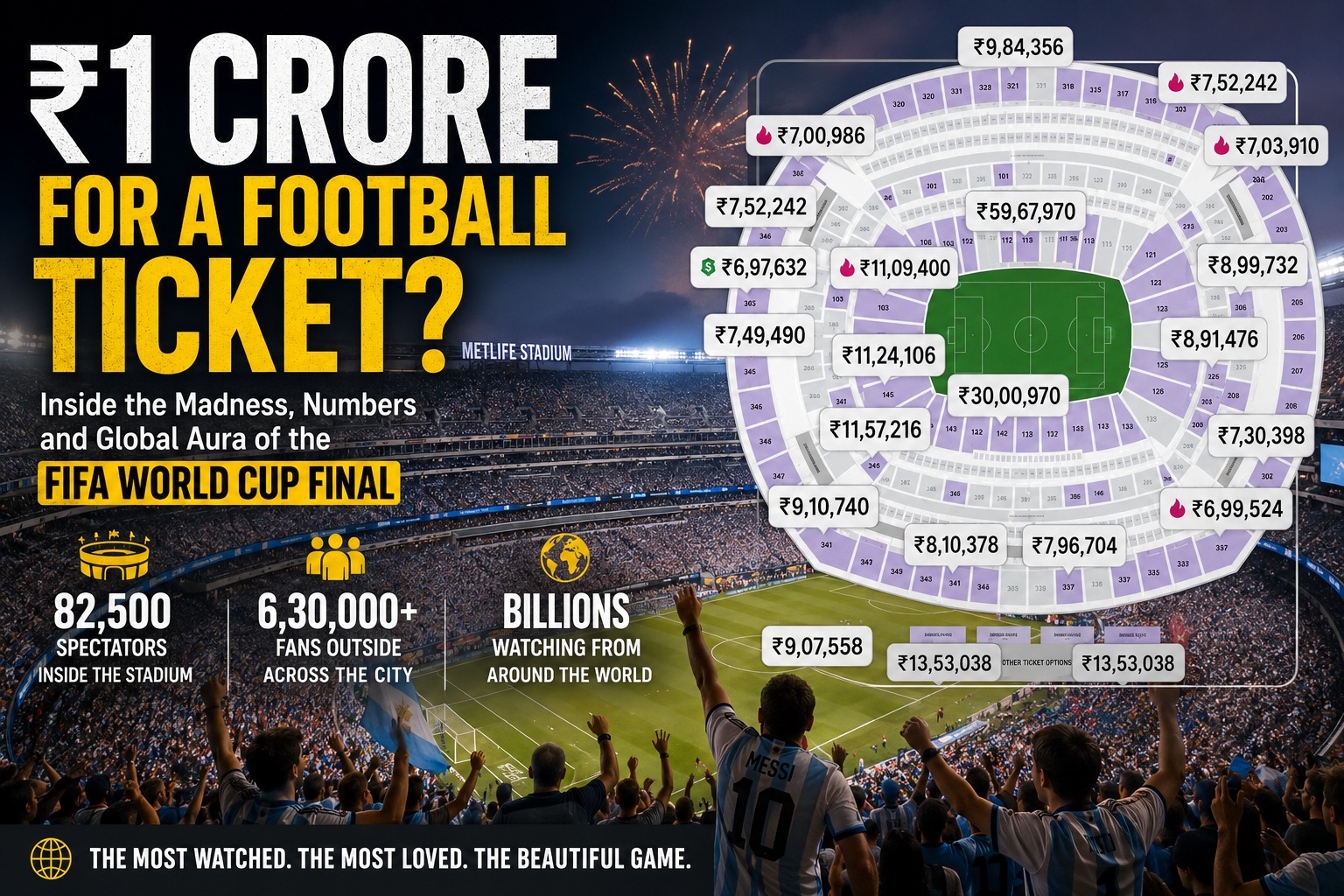
That’s the reality that stunned millions after screenshots of resale ticket prices for the 2026 FIFA World Cup Final between Spain and Argentina at MetLife Stadium went viral on social media. Several resale platforms listed premium seats anywhere between ₹7 lakh and nearly ₹1 crore, sparking discussions around the economics of the world’s biggest sporting event.
While these prices reflected the resale market rather than FIFA’s official ticket pricing, they highlighted one undeniable truth.
Nothing on Earth attracts sporting passion quite like the FIFA World Cup Final.
More Than 82,500 Inside. Over 6.3 Lakh Outside.
On July 19, MetLife Stadium welcomed approximately 82,500 spectators, all hoping to witness football history.
But the real spectacle wasn’t limited to those inside the stadium.
According to local estimates, more than 630,000 fans gathered across New York City and nearby New Jersey, filling fan parks, sports bars, Times Square, public viewing zones, restaurants, and iconic landmarks. Streets turned into seas of jerseys representing countries from every continent.
For one weekend, football wasn’t just being played.
It had taken over an entire city.
Hotels reported exceptionally high occupancy, restaurants operated at full capacity, local transport networks saw massive footfall, and merchandise stores witnessed unprecedented demand. The World Cup Final became an economic festival extending far beyond the ninety minutes played on the pitch.
The Viral ₹7,500 Crore Claim
Alongside the ticket screenshots, another figure began circulating online.
If all 82,500 spectators paid an average of ₹9 lakh each, the total ticket revenue would exceed ₹7,500 crore.
The calculation certainly grabs attention.
However, there’s an important distinction.
The prices visible in the viral screenshots were resale listings, not official FIFA ticket prices. Many fans secured tickets through FIFA’s official ballot at significantly lower rates.
This means the ₹7,500 crore estimate should not be interpreted as FIFA’s actual ticket revenue.
Yet, the calculation still demonstrates something remarkable.
There are enough football fans across the world willing to pay extraordinary sums simply to witness the biggest match in the sport.
Football’s Economy Is Bigger Than Ticket Sales
The financial impact of the FIFA World Cup cannot be measured by ticket prices alone.
Every edition creates billions of dollars in economic activity through broadcasting rights, sponsorships, tourism, hospitality, merchandising, transportation, advertising, and local business spending.
For host cities, the World Cup represents one of the largest sporting-driven economic opportunities in the world.
For brands, it offers unmatched global visibility.
For fans, it delivers memories that last a lifetime.
Why Are Fans Willing to Pay So Much?
The answer isn’t football.
It’s scarcity.
The World Cup Final happens only once every four years.
Only 82,500 people can experience it from inside the stadium.
Yet billions watch from televisions, mobile phones, and public screenings across the globe.
That combination of limited access and limitless demand creates one of the most valuable live experiences in modern sport.
Fans aren’t simply buying a ticket.
They’re buying a story they’ll tell their children and grandchildren.
They’re buying the chance to say,
I was there.
Football’s Global Aura
Comparisons between football and cricket are inevitable, especially in countries where cricket dominates public attention.
Cricket enjoys immense popularity and commands extraordinary audiences across South Asia and several other nations.
Football, however, operates on a different scale.
It is played professionally in almost every country, followed passionately across every continent, and watched by billions during the FIFA World Cup. From small villages in Africa to packed stadiums in Europe, from South America to Asia, football transcends language, culture, and geography in a way few other sports do.
The scenes from New York during the World Cup Final were another reminder of that reach.
The match wasn’t simply watched.
It was celebrated across an entire city.
The Real Lesson
Beyond the breathtaking goals and unforgettable atmosphere lies an important business lesson.
People don’t pay premium prices for products.
They pay premium prices for experiences.
The FIFA World Cup Final is proof that when a brand creates rarity, emotion, and lifelong memories, value is no longer determined by cost alone.
For millions around the world, the price of the ticket isn’t what matters.
The opportunity to witness history does.
Disclaimer: The ticket prices referenced in this article are based on publicly shared resale marketplace listings and should not be interpreted as FIFA’s official ticket pricing or official ticket revenue figures.