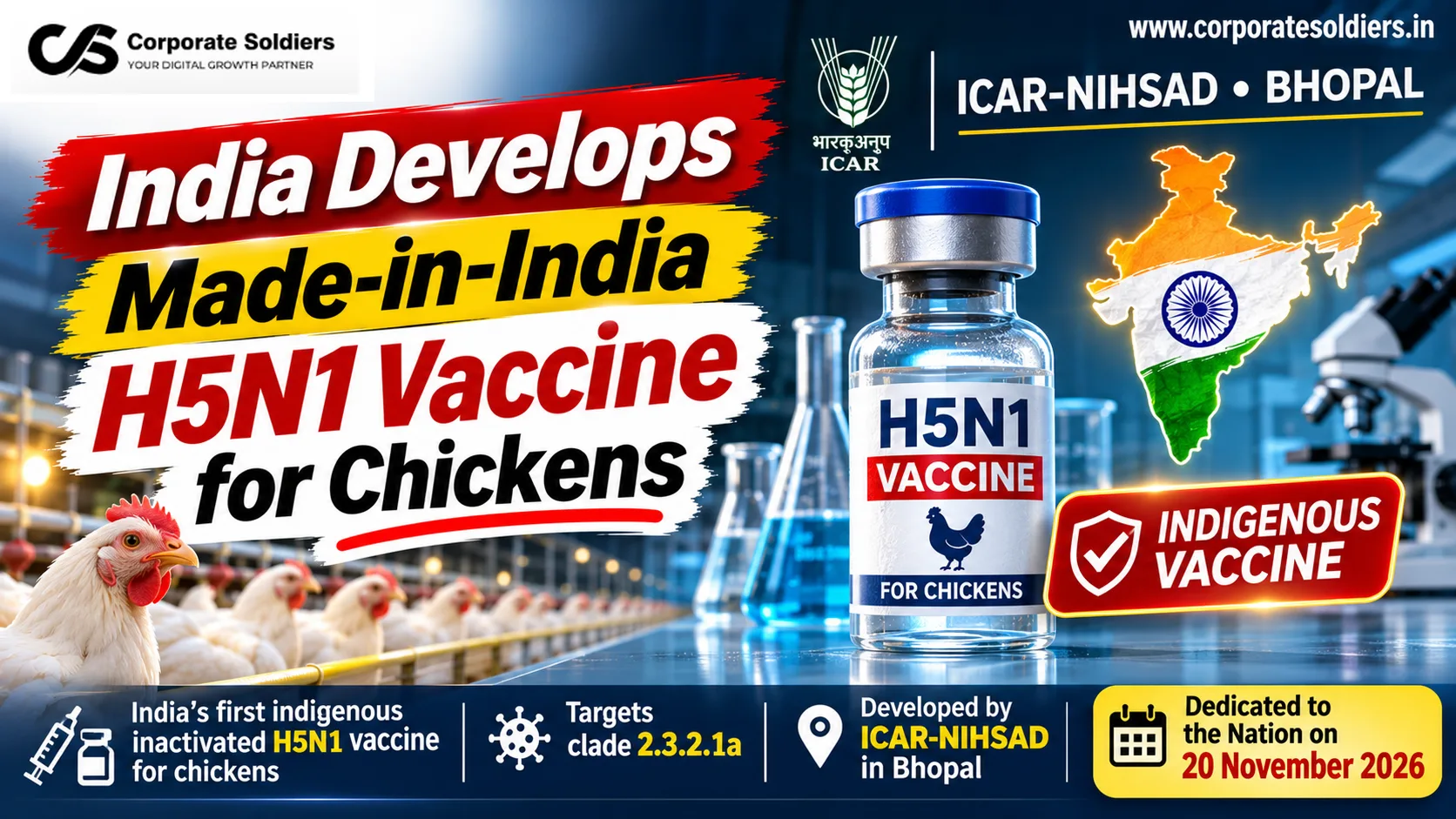
India is set to launch its first indigenous H5N1 vaccine for chickens on November 20, 2026, marking a breakthrough in poultry disease prevention. Developed by ICAR-NIHSAD scientists in Bhopal, the inactivated vaccine targets the H5N1 Clade 2.3.2.1a strain responsible for bird flu outbreaks in Indian poultry.
Union Agriculture and Farmers Welfare Minister Shivraj Singh Chouhan is scheduled to dedicate the vaccine to the nation at ICAR-NIHSAD in Bhopal, Madhya Pradesh.
Why Does India Need an Indigenous Bird Flu Vaccine?
- India first detected avian influenza in 2006 and has since reported over 500 combined H5N1 and H5N8 outbreaks.
- Highly pathogenic bird flu can cause nearly 100% mortality among infected birds.
- Outbreaks lead to financial losses, large-scale culling, and trade restrictions.
- An uncontrolled outbreak could put over 20% of India’s poultry population at risk and reduce GDP growth by up to 1.5%.
- India’s 2006 bird flu outbreak caused estimated direct and indirect losses of ₹2,200–3,000 crore.
- These risks highlight the need for indigenous vaccines to strengthen poultry disease prevention.
How Could the H5N1 Vaccine Help Poultry Farmers?
The indigenous vaccine aims to strengthen protection against the H5N1 strain circulating in Indian poultry.
Its development could strengthen poultry disease control efforts, reduce the economic impact of outbreaks, and improve India’s preparedness against avian influenza.
The Ministry has also reported infections involving mammals and three human cases associated with the targeted H5N1 strain, highlighting the importance of controlling its spread among animals.
However, the vaccine is specifically developed for chickens and should not be confused with a vaccine for humans.
When Will India’s H5N1 Vaccine Be Launched?
The newly developed vaccine is designed to protect chickens against highly pathogenic avian influenza (HPAI), commonly known as bird flu.
It specifically targets H5N1 Clade 2.3.2.1a, a strain responsible for most bird flu outbreaks in Indian poultry.
An inactivated vaccine uses a virus that has been rendered non-infectious to stimulate an immune response. This helps the vaccinated birds develop protection against the targeted virus.
The development is significant because no specific commercial vaccine was previously available in India against H5N1 Clade 2.3.2.1a.
Coming to the point, the bird-flu vaccine is scheduled to be made public. Today, on November 20, 2026, the ICAR-NIHSAD in Bhopal (Madhya Pradesh) is launching the vaccine.
Praised as a significant milestone in science, the commercial availability of this vaccine is still awaited.
Frequently Asked Questions
1. Who developed India’s first indigenous H5N1 vaccine?
Scientists in Bhopal, Madhya Pradesh, at ICAR-NIHSAD developed the inactivated vaccine.
2. Which H5N1 strain does the vaccine target?
This vaccine targets H5N1 Clade 2.3.2.1a, associated with most bird flu outbreaks in Indian chickens.
3. When will India’s indigenous bird flu vaccine launch?
The vaccine is scheduled to be dedicated to the nation on November 20, 2026.
4. Is the H5N1 vaccine designed for humans?
No. The vaccine has been developed specifically for chickens to strengthen poultry disease control.
5. How many bird flu outbreaks has India reported?
India has reported more than 500 combined H5N1 and H5N8 outbreaks since the first detection of avian influenza in 2006.