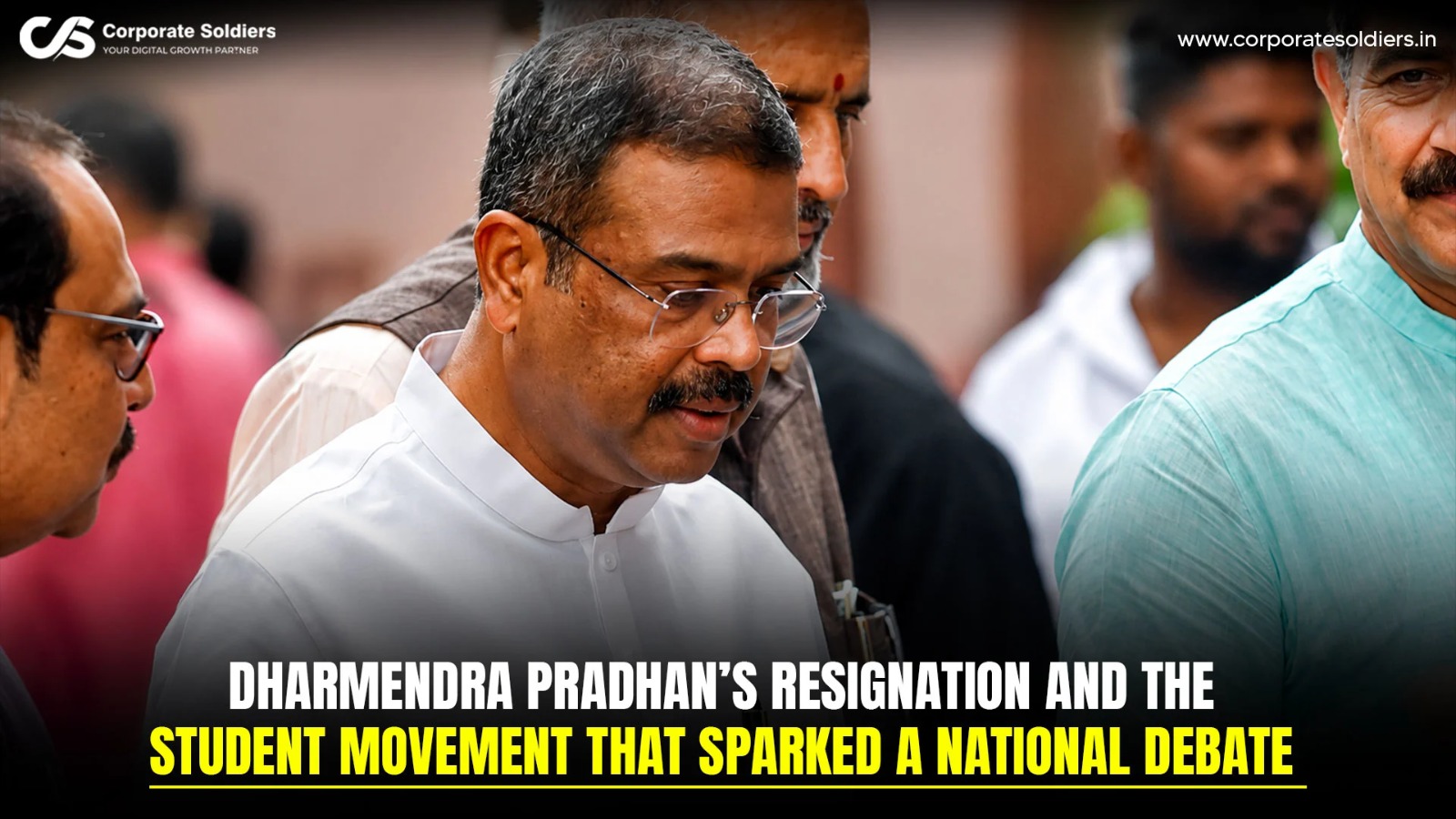
Union Education Minister Dharmendra Pradhan resigned following sustained political pressure and student-led protests over examination-related controversies, turning the issue into one of the most significant debates on educational governance and institutional accountability in recent years. The movement became a national political issue when issues of the integrity of examinations, institutional responsibility, and the perceived inequalities of competitive testing became more widely discussed.
The discussion has transcended the usual political wriggling to become a watershed of contemporary Indian political policy. A crisis that has affected millions of candidates due to the anomalies in national entrance examinations, most prominently the National Eligibility cum Entrance Test (NEET-UG), has put the issue of accountability in personnel, instability in institutions, and administrative structure of national testing agencies in the limelight of parliamentary and popular discussion.
Background: The Unraveling of Public Trust in National Examinations
The unrest stems from a series of high-profile controversies involving national competitive examinations conducted by the National Testing Agency (NTA), leading to growing demands for ministerial accountability and institutional reform. The most vocal part of the popular furor was the behavior of the NEET (UG) examinations where the rumors of question paper leakage, subversion of evaluation procedures, and graft on a mass scale caused extreme panic among both the candidates and their parents.
Nearly 20 lakh students had been in training on high-stakes entry tests which are the main intoxicant to tertiary education and formal sector jobs. To millions of families these standardized tests are the only possible source of social mobility in an economy where much of the work is stuck in the informal sector.
Timeline of Key Developments
- Systemic Failure Uncovered: Cases of question papers being leaked and compromised examination centers are reported during major national entrance exams in most states.
- Re-examinations Ordered: Compulsory re-examinations on nearly 20 lakh candidates due to administration disruptions are only adding to family burdens and mental health challenges.
- Student Mobilization: Student organizations and other interested parties spoke up on the integrity and accountability of examinations, introducing the topic into the broader debate.
- Mounting Calls to Resign: Opposition parties, student organisations and some sections of civil society mount increased calls on the Union Education Minister Dharmendra Pradhan to resign over the issue of examination governance and accountability.
- Resignation of Minister: Dharmendra Pradhan resigned as Union Education Minister amidst increasing pressure of politics and accountability demands on matters relating to examinations.
Why Students Are Protesting: Core Demands and Institutional Grievances
The student movement increased at a high rate since its complaints cut across the traditional social, regional and political boundaries. In contrast to traditional political campaigns, the protests brought together youth, who cut across all demographic lines, and were united by the fact that they were all frustrated by the administrative opaque and the malpractices in examinations.
Key Student Demands and Concerns
- Total Revamp of Testing Organisations: Immediate Structural Reform of the National Testing Agency (NTA) to ensure the security of tamper-proof examination and transparency in its operation.
- Relief to Affected Families: Some student groups and activists have called for support and assistance for families affected by examination-related stress and uncertainty, including those who have suffered severe personal consequences.
- Assured Timescales on Deliveries: The Legal frameworks to guarantee timely redressal of grievances, open-answer key testing and consistent examination timetables.
Calls for Resignation and Ministerial Accountability
With the popular anger over continuous testing inconveniences, the opposition parties and student groups turned their criticism towards the Union Education Minister Dharmendra Pradhan directly and insisted that he resigns on the issue of ministerial responsibility.
Arguments Proponents Raised
- Moral and Administrative Accountability: The fact that several examination cycles had a lot of security breaches, and this was a breakdown in governance, was the argument given by the protesters that needed high level accountability.
- Dismissive Preliminary Reaction: Critics cited initial statements by the ministry that paper leak claims were isolated incidents and this undermined trust in the ministry being ready to deal with systemic weaknesses.
Government and Official Position
Opposition leaders argued that the growing public pressure reflected widespread dissatisfaction with the handling of examination-related controversies and continued to press for ministerial accountability. The government maintained that the Minister should not be held personally responsible for every operational failure and argued that corrective measures and investigations were already underway. The resignation marked a significant political development, with supporters describing it as an act of accountability while critics argued that deeper institutional reforms remained necessary.
Official Response and Government Action
The Union government and legislative bodies responded to the developing crisis and the growing demands for ministerial accountability with a number of measures aimed at restoring confidence in the examination system.
- High-Level Probe and Criminal Investigations: The central investigative authorities as well as the law enforcement agencies were to conduct probes on paper-leak cartels and financial trails that were related to exam malpractices.
- Testing Protocol Review: The Ministry of Education formed expert committees, which inspected the work procedures of the NTA, the standards of encryption of data and the systems of allocation of centers.
- Parliamentary Debates: The scandal sparked off heated exchanges at parliament, with the leaders of the Opposition seeking to have national testing agencies subjected to absolute legislative control.
- Contacts with Delegations: Government representatives continued engagement with student groups and stakeholders as discussions on examination reforms and accountability measures progressed.
Institutional Challenges Exposed by the Crisis
Examination Governance
The scandal has raised the issue of the way that large-scale national exams are given.
It is also one of the most popular competitive examinations in the world with tens of millions of competitors in thousands of centers in India. This large scale presents serious administrative issues which demand well-built monitoring systems and quick-response systems.
Scholars have held that forms of governance are supposed to be dynamic to ensure that they keep up with the increasing complexity.
Accountability Mechanisms
A significant problem that arises out of the debate is that there is no apparent public knowledge on issues of accountability in the examination systems.
Issues that have been brought to the fore in the protests are:
- Who is to blame in case of examination irregularities?
- What are the implications of the failure of institutions?
- What can be done to ensure there is transparency?
These issues have led to calls to have better defined accountability mechanisms.
Institutional Credibility
Schools get legitimacy through the trust of the people.
The harm of controversies relating to examination systems does not stop at administrative issues of the day but may impact the sense of justice in the field of education in general.
Regaining credibility hence comes as an agenda not only to the policymakers, but also to the institutions charged with the responsibility of conducting examinations.
Political Implications
Impact on Parliament
It has become a major topic of debate in parliament.
The controversy has helped to raise questions by the opposition parties on the way the government administered examinations and education policy in general.
The government has in the meantime opined that reforms and investigations need to be left to continue without political interference.
A Test for the Government
The issue of controversy is a governance problem to the Centre since millions of young voters and their families are concerned with education.
The way the government is perceived by people to address issues concerning fairness, transparency and accountability can be the reason behind greater debate on governance and performance of institutions.
Opposition Strategy
In the case of opposition parties, the problem will be a chance to draw attention to the needs of youth, educational possibilities, and social responsibility.
The call of ministerial accountability has thus come to belong to a broader political discourse on the norms of governance and institutional checks and balances.
The Editorial Perspective: Accountability Beyond Individuals
One of the aspects that have been pointed out in the editorial by The Hindu is that the controversy cannot be considered in one perspective of a single minister, or a single examination.
The larger issue is the health of the institutions serving the purposes of the governance of education.
The editorial points out that the call to accountability is understandable in situational terms of general discontent among the people, but it takes more-fundamental institutional change to solve the problem in the long term. Political responsibility is not the only factor that makes examinations credible because of transparent systems, good administration and good protection against future failures.
The bigger problem is to restore the confidence of students who are more demanding on education institutions to operate in a reliable, fair, and accountable manner.
Another aspect highlighted in the editorial is the need to listen to the student issues and consider them as valid stakeholders when it comes to discussing the issue of educational reform and not just as a party in a political debate.
Why This Issue Matters: The Path Ahead
The outcome of resolving this crisis has far reaching consequences on the future of the Indian economy as well as social stability:
- Future of National Standardized Tests: The Ministry of Education faces the challenge of conducting future entrance examinations without administrative lapses and restoring public confidence in the system.
- Student Psychosocial and Psyche: Long legal proceedings, paper cancellations, and unexpected re-tests cause an unimaginable psychological burden among young prospects, and require counseling services on campus and consistent testing dates.
- Public Policy Reform: There has been an increase in urging legislative changes that are specifically aimed at paper leaks and fraudulent testing services that have to be criminalized.
Editorial View: Key Takeaways
The editorial of the Hindu shows that there are a number of basic observations about the crisis:
- Accountability Debate: The controversy intensified discussions about ministerial responsibility, institutional accountability, and the extent to which political leadership should be held accountable for failures within examination systems.
- Reestablishment of Civic Authority: The effective mobilization indicates that civic movements led by the youth, making use of digital platforms and with their unmistakable demands, can create democratic accountability beyond party politics.
- Urgent need to change the structure: Any discussion of accountability must be accompanied by deeper institutional reforms to strengthen the National Testing Agency and examination governance systems.
Final Thoughts
The resignation of Union Education Minister Dharmendra Pradhan has become a significant moment in the debate over educational governance, examination integrity, and institutional accountability in India. To regain the confidence of the people in national entrance exams will have to be done with ruthless candor, and the need to take account of the past lapses, and commitment to uphold high standards of the aspirations of the Indian youth.