Introduction
Protests in the society take center stage in the democratic society, as a channel where citizens voice dissent, demand accountability and policy changes. Meanwhile, governments and law-enforcement agencies have the duty of upholding order in the society and averting violence. The legal dilemma associated with the constitution is usually on how these conflicting imperatives can be balanced without compromising on the fundamental rights.
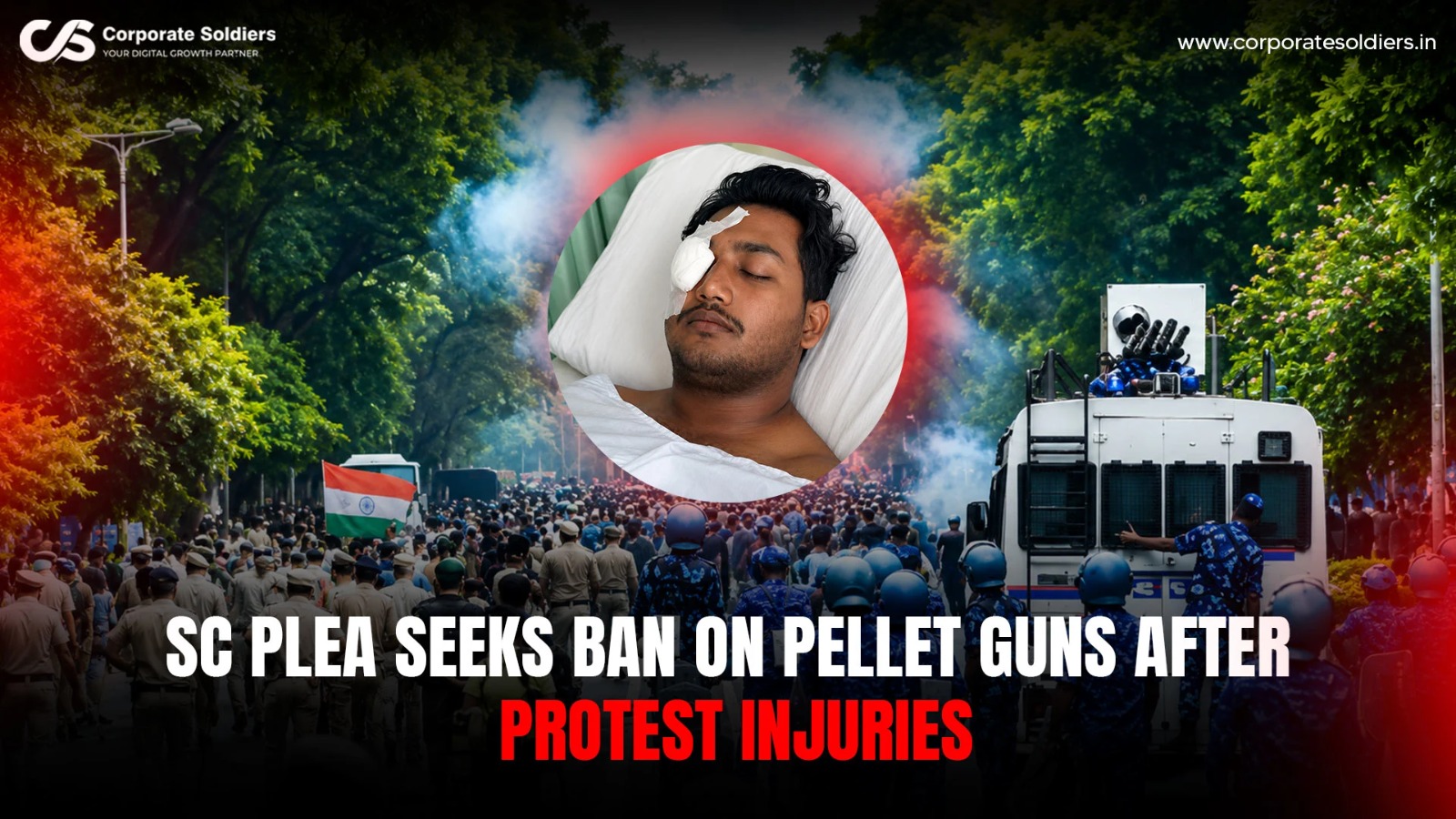
It is against this background that a petition has been presented before the Supreme Court of India that has rekindled the debate on the use of pellet guns and such other kinetic projectiles in controlling the crowd among civilians. The petition is a request to enact a ban on the use of pellet guns by law-enforcement agencies in all cases of public demonstrations nationwide on the grounds that these arms present significant danger of a painful wound and are unconstitutional. The case has acquired national relevance as it poses more general questions concerning the freedom of protest, police responsibility, reasonable use of force, and the future of the crowd-control experience in India.
Delhi Police has denied using pellet guns during the protest, and the allegations form part of the issues currently under judicial consideration.
By the time of publication, the petition is still pending in the Supreme Court and no ultimate court ruling has been made on the merits of the case.
The Trigger: What Happened During the Protest?
The legal issue was brought to light in the aftermath of an incident involving a gathering called Sansad Chalo that took place in New Delhi on July 20, 2026. The protest was organized over allegations of examination paper leaks and recruitment-related concerns.
Claims by petitioners and media reports allege that there were fights between protesters and security staff in the process of carrying out crowd management. Some protesters alleged that they sustained injuries consistent with pellet impacts, including injuries to the face, neck, chest, and eyes that required medical treatment. There are reports that some individuals underwent medical procedures to remove alleged pellet fragments.
The petition is particularly based on the allegations of people who allege to have been hurt in the course of the police reaction. There are reports also that a Rapid Action Force (RAF) inquiry was launched to investigate the allegations of excessive use of force and reports about using pellet-guns.
Meanwhile, the Delhi Police publicly rejected claims that pellet guns were part of its arsenal or were in use during the protest reaction. Claims about the use of pellet-guns by the police in Delhi were described as false and misguided by the authorities.
The veracity of the entire case of the Supreme Court proceedings is pegged on the contradictory narrations of the incident.
The Supreme Court Petition
The petition is under Article 32 of the Constitution in the Supreme Court of India. Reports have indicated that the petitioners are former senior police officer Yashovardhan Azad (in some reports a former IPS officer and former Intelligence Bureau Special Director), Prasant Kumar Singh and Sheikh Irshad Mansoori, who allege that they sustained pellet-related injuries during the July 20 protest.
Some of the advocates of the petitioners are Vrinda Grover, Soutik Banerjee and Devika Tulsiani.
Main Reliefs Sought
The petition seeks:
- Instructions to prohibit or disarm the use of wholly or partially metallic pellet guns and other projectile-action firearms to break up civilian gatherings.
- This appreciation that these weapons cannot be used in civilian crowd-control operations.
- Compensation for individuals who allege they were injured as a result of pellet firing.
- Extensive medical care, rehabilitation and long-term care of the affected individuals.
- Courts involvement to protect constitutional rights of peaceful protest and assembling.
This case is still in the Court and the Court has not yet judged on the merit requests.
Why Pellet Guns Are Controversial
What are Pellet guns?
Crowd control pellet guns are generally shot in a wide spread of small projectiles. They have been internationally classified as less-lethal or less-than-lethal weapons as they are used to minimize the chances of loss of lives in comparison to standard guns.
Less-lethal is not risk-free, though.
Medical Consequences
Pellet impacts have the potential to cause: As demonstrated in medical literature and documented incidents in numerous jurisdictions:
- Vision and eye injuries.
- Facial trauma
- Soft tissue damage
- Penetrating wounds
- Severe cases of permanent disability.
This danger is magnified when projectiles hit exposed areas of the body such as the eyes, head, neck and chest.
Human Rights Concerns
Crowd-control weapons that eject various projectiles randomly have been raised several concerns by human-rights organizations such as Amnesty international and Human rights watch. Opponents claim that these weapons complicate the process of only engaging violent members and leave uninvolved members and innocent people.
In the application of the use of force, the United Nations Basic Principles on the Use of Force and Firearms highlight the necessity, proportionality and minimization of injury in situations where law-enforcement officials employ the use of force. Such guidelines are often used in arguments regarding the use of pellet-guns in the case of a crowd gathering.
Previous Controversies in India
Pellet guns have become a hot topic of debate in India especially in Jammu and Kashmir where their application has resulted in claims of severe body injury such as eye damage and permanent loss of sight. Non-governmental organizations, civil society groups and medical practitioners have severally demanded that such weapons should be tightly regulated or even banned in civil-military situations.
These precedent scandals give valuable background to the current lawsuit.
Constitutional Questions Raised
A number of constitutional principles are at the heart of the debate presented in the petition.
Article 19 and the right to peaceful Assembly
Article 19(1)(a) safeguards the right to freedom of speech and expression and Article 19(1)(b) ensures the right to peaceful and unarmed assembly.
Such rights are not absolute. The Constitution allows reasonable limitations in the interests of the public order, sovereignty and security. However, State imposed restrictions should be legal, proportionate and justified.
Article 21 and Right to Life
Article 21 safeguards life, personal liberty and in the case of the Supreme Court, has been taken to refer to dignity, bodily integrity and safeguarding against arbitrary state action.
The petition claims that the use of crowd-control techniques that are potentially fatal to physiological well-being involve the Article 21 issues since it directly acts upon the physical safety and human dignity.
Article 14 and Equality Before Law
Article 14 demands state action that is not arbitrary and which is founded on rational criteria. Petitioners argue that use of weapons that possibly have indiscriminate consequences could provoke the issue of accidental harm to participants and non-participants.
Principle of Proportionality
In the contemporary constitutional jurisprudence, the concept of proportionality is more often used to conduct the review of state action against the basic rights.
Generally speaking, proportionality requires:
- The goal sought is above board.
- The measure adopted is suitable.
- There are less restrictive options.
- The harm caused is excessive relative to the objective sought.
According to the petition, the use of pellet-guns does not pass this constitutional test.
Least Necessary Force
International policing standards underscore that the use of force must be dependent on the situation and use only the required. The least necessary use of force doctrine is often used when talking about crowd management and protest policing.
State Accountability
Another issue that the case creates concerns the accountability of the government in situations where the crowd-control actions cause alleged injuries. The past has seen the courts consider the issue of compensation, rehabilitation, and the responsibility of institutions, when fundamental rights are alleged to have been violated.
Petitioners’ Key Arguments
Based on reports of the petition, the main arguments are:
- Pellet guns are reportedly inappropriate to disperse crowds of civilians since several projectiles are dispersed in a large area.
- Their usage poses a threat of inflicted harm.
- Even when the peaceful individuals and the onlookers are not involved in illegal activities, they might be exposed to harm.
- The potential consequences of deployment are evidenced by serious injuries especially eye injuries.
- It is alleged by continued use of such weapons to not meet constitutional standards of proportionality, necessity and reasonableness.
It should be noted that these are arguments that the petitioners are advancing. Their validity is yet to be determined by the Supreme Court.
Demands Beyond the Ban
The plea is an appeal that goes beyond a ban on pellet guns.
Compensation
The petitioners seek exemplary compensation for individuals who allege they were injured during the July 20 incident.
Medical Treatment and Rehabilitation
The petition calls upon thorough treatment, on-going medical care and rehabilitation support to the affected persons.
Accountability Mechanisms
Though this petition is mainly centered in the use of pellet guns, there are wider issues concerning the issue of responsibility on the decisions on crowd-control.
Review of Crowd-Control Practices
The lawsuit can promote the judicial review of the current crowd-management policies and operation principles of the use of the force when protests take place.
Why This Case Matters
This is more than just an argument over a particular crowd-control weapon.
Future of Policing
The petition poses some concerns regarding the manner in which law-enforcement agencies ought to react to the presence of large masses of people yet reduce the chances of injuries.
Protest Rights
The case itself involves a direct implication of constitutional safeguards in regard to peaceful assembly and dissent by the people.
Human Rights Standards
The case could be used to further debate the changes to conform domestic policing policies to international human-rights standards.
Judicial Oversight
The case raises the issue of the Supreme Court in examining state action that may be limiting fundamental rights.
Democratic Accountability
The trial indicates wider issues of democracy, transparency, accountability, and the connection between the state and civil rights.
Wider Debate on Crowd-Control Methods
Crowd-management strategies are varied among the law-enforcement agencies of the world.
Alternative Approaches
Measures commonly used are:
- Discussion and bargaining with organizers.
- Public communication systems
- Controlled barricading
- Graduated use of force.
- Water cannons
- Use tear gas or tear smoke under certain conditions.
- Strategic de-escalation techniques
International Best Practices
International ways of policing are focusing more on:
- Advance planning
- Risk assessment
- De-escalation
- Aggressive action against violent players
- Reduction of violence towards non-violent participants.
The debate that is going on addresses the issue of which approaches can be most reasonable in order to reconcile the interests of the population with constitutional rights.
Previous Use of Pellet Guns in India
Pellet guns came into national discourse mostly with the use of the weapons during security missions in Jammu and Kashmir.
Civil society groups, human-rights organizations, and medical professionals also reported cases of severe eye injuries and permanent disability in individuals who were hit by pellets. Such reports created a long-lasting controversy in society and constant demands to change the policy.
However, the legal and operational context has been different in cases concerning the deployment of force and some courts and oversight institutions have been occasionally requested to consider the issues that surround the deployment of force.
The present Supreme Court petition is different as there is a direct challenge on the use of pellet guns to control crowds present in the protest in the country and demands a nationwide policy to address the use of the guns.
Possible Legal Implications
Due to the fact that the issue is still under consideration, any evaluation should be done with caution.
A Supreme Court decision that might be made in the future may have an impact on:
Police Reforms
The Court might look into whether frameworks are in place that can effectively put the control of crowd-control weapons.
Standard Operating Procedures
The legal action may also help in the review or clarification of SOPs with regard to the use of force when handling demonstrations.
Crowd-Control Policies
The case can lead to the wider discussion of the acceptable tools of managing the crowd and its protection.
Human Rights Jurisprudence
A court ruling has the potential to elaborate constitutional principles on bodily integrity, dignity, and protest rights.
Future Protest Management
The case can influence the future legal norms regulating the relations between law-enforcement authorities and groups of civilians.
These are potential areas of impact and are not to be thought of as speculations of how the Court will ultimately decide.
The Road Ahead
The case petitioning the Supreme Court to prohibit pellet guns in civilian crowd control is a challenging one in terms of constitutional and political matters. With its origins in the accusations of harm in the protest response on July 20 in Delhi, the case poses some fundamental questions concerning the permissible use of force, freedom of peaceful assembly and the duty of the State to protect life and dignity.
Fundamentally, the case about the litigation is the tensions between upholding the order in the society and the constitutional liberties guaranteed by the Articles 14, 19, and 21. It also overlaps with the larger human-rights norms of necessity, proportionality and accountability in law-enforcement actions.
The judicial review will be instrumental in determining the merits of the arguments presented by the petitioners, the legal system surrounding the crowd-control practice, and the constitutional limits to which the state authorities can go, as the case continues before the Supreme Court. No matter the result, the case will probably become a significant point of reference in the continuous debate on the rights of democracy, demonstrations by citizens, and responsible policing in India.