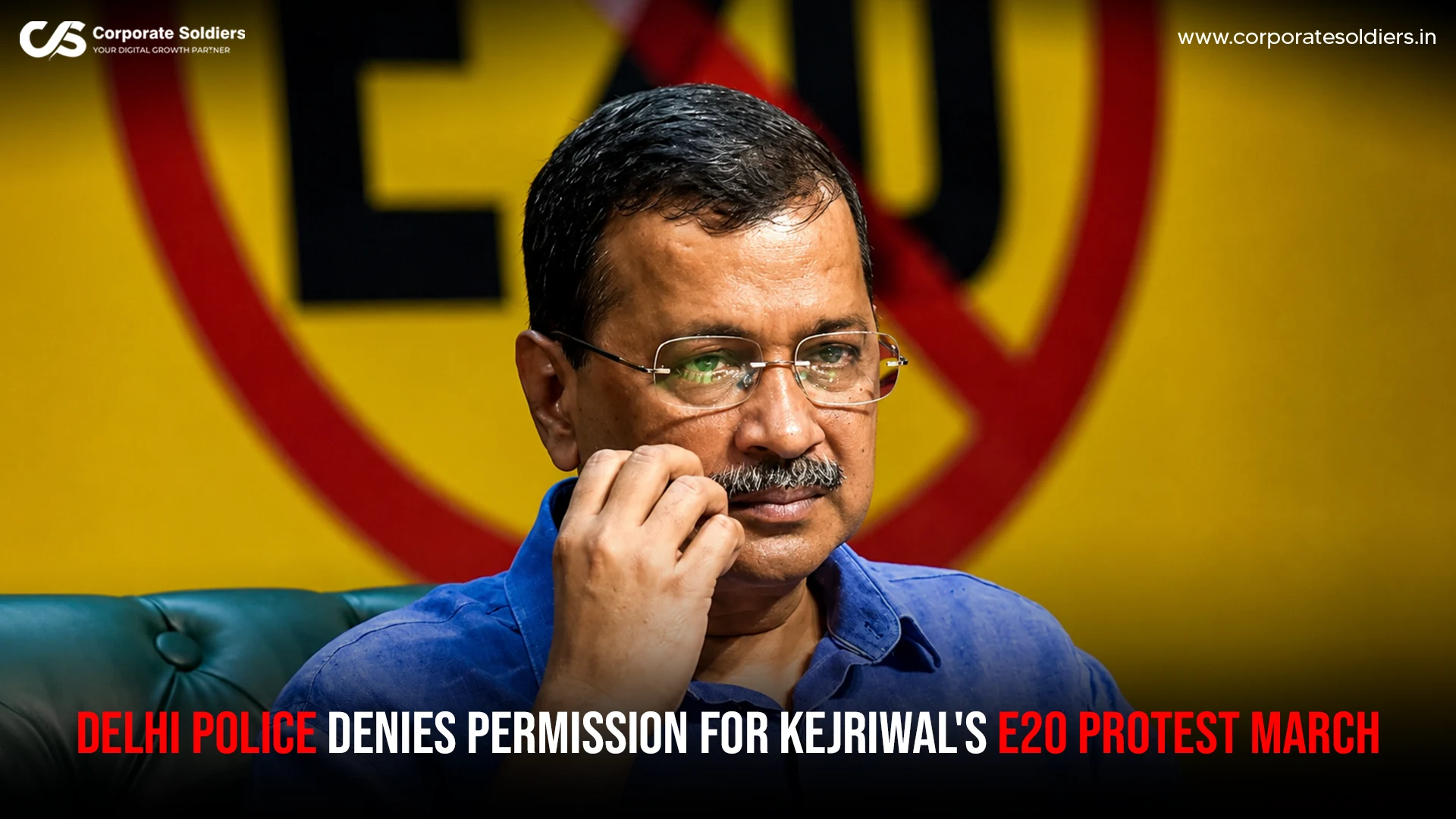
Aam Aadmi Party (AAP) national convenor Arvind Kejriwal has announced that he will lead a protest march towards Prime Minister Narendra Modi’s official residence in New Delhi against the introduction of E20 fuel by the Centre. The party said the march would involve around 100 participants and seek to submit a petition signed by citizens raising concerns about the policy. Delhi Police has however refused to grant permission to the proposed procession claiming there is a restriction to security in the high security district of New Delhi.
The development has given a political perspective to the debate that is going on E20 petrol a fuel mixture that comprises 20 per cent ethanol and 80 per cent petrol a fuel mixture which is part of the wider ethanol-blending programme by the Union government.
Why the Protest Was Planned
The proposed march stems from AAP’s opposition to what it describes as the implementation of E20 fuel without adequate consumer choice. Kejriwal has also claimed that there should be an option of conventional petrol and E20 in fuel stations instead of the consumers being forced to use a blend of higher ethanol.
As per the statements by the AAP chief, the party is planning to hand in a memorandum and petitions allegedly signed by about 2.5 lakh individuals to the Prime Minister. The petition is requesting the policy to be reviewed and increased consumer choice on the choice of fuel.
E20 debate has become a major public policy concern as the ethanol-blending programme by Centre is intended to decrease the imports of crude oil, enhance energy security, assist the agricultural sector and reduce carbon emission in the country. Meanwhile, others, such as AAP leaders, have expressed concerns in the areas of compatibility of vehicles, fuel efficiency and consumer costs. These issues are still under discussion in the society on the policy.
Delhi Police Denies Permission
The proposed march towards the residence of the Prime Minister, a very secured area within the security zone of the national capital, has been refused by the Delhi Police.
Although specific official directives in connection with the E20 march were not publicly circulated when the story was being reported, the Delhi Police has always insisted that protests marches to high security government sites must be pre-approved and be heavily restricted. Equivalent warnings have been issued during the past few weeks regarding planned marches in the New Delhi district on the grounds of prohibitory orders under Section 163 of the Bharatiya Nagarik Suraksha Sanhita (BNSS), of assembly restrictions and of the importance of protecting persons at risk and of important government properties.
In many cases, the agencies employed to provide security around the residence of the Prime Minister provide extra restrictions because of national security reasons, movement of the VIP and maintenance of order.
Statements from Arvind Kejriwal and AAP
Kejriwal announced the protest, noting that he would personally lead the march and give petitions to the Prime Minister. He claimed that citizens were supposed to have the freedom of choice between pure petrol and E20 fuel and demanded a re-evaluation of the existing implementation strategy.
AAP leaders have packaged the campaign as a matter of public interest and not just a political campaign claiming that the people should be more informed on the effects of increasing ethanol blending on cars and fuel consumption. These assertions are the opinion of the party and have not been proven by government agencies on its own.
According to reports, the party was expected to have about 100 participants in the proposed march, but the ultimate participation would be determined by the police restrictions and administrative arrangements.
Administration’s Response
According to the most recent available information, the Prime Minister’s office did not publicly release a detailed response to the demand of the particular protest.
Delhi Police has repeated in similar cases that the illegal marches towards sensitive areas of the government are not allowed without prior permission. The law enforcers have stressed the idea that restrictions are meant to keep the people calm, provide security to the secured installations and avert inconveniences in high-security sectors of the capital.
The Union government has been continually justifying the ethanol-blending programme as a significant aspect of the Indian energy plan, but no new declaration directly in response to the suggested AAP march was accessible at the time of writing.
Security and Traffic Arrangements
When protests are suggested in the vicinity of Parliament, the offices of the central government or the residence of the Prime Minister, the authorities usually mobilize more forces, barricades, and access-control. Delhi Police advisories have also cautioned against attending unauthorised gatherings recently and pointed out that legal action could be taken against those who defy prohibitory orders.
There was no independent traffic advisory issued with regard to the proposed E20 march, as of the time of publication. Delhi Traffic Police would normally communicate any traffic restrictions, should it be necessary, via official avenues.
Legal and Constitutional Context
The case also brings out the question of constitutional right to peaceful assembly and the role of the state to uphold law and order.
Article 19(1)(b) of the Constitution guarantees citizens the right to assemble peacefully and without arms, subject to reasonable restrictions in the interests of the public order, security and sovereignty. Demonstrations held in sensitive areas of the administration in Delhi are usually pre-emptively granted by law enforcement agencies, especially when they are held in secured areas or a large group of people.
Law enforcement can use the provisions of the BNSS and other relevant laws to control assemblies in designated areas where there are security concerns.
Political Significance
The protest suggested is an indication of the increasing political battle on fuel policy and consumer rights. In the case of AAP, the campaign will give a platform to oppose a significant central government initiative and mobilise the people in regard to fuel issues.
To the Centre, ethanol-blending programme is still a marquee energy and sustainability program meant to decrease reliance on imported crude oil and help the country produce its own ethanol. The dispute is thus not limited to a protest march, but it involves more general issues on energy policy, environmental objectives, consumer freedom and economic consequences.
The episode illustrates how public policy issues such as fuel pricing and energy policy can become subjects of political mobilisation.
What Happens Next?
It has been refused permission and it is not clear whether AAP will alter its programme, find other permission, have a symbolic demonstration or take legal action.
Any attempt to proceed with the march without the required permission could invite police action under applicable laws that regulate a group of people in restricted areas.
The next step will be to observe any additional announcements by AAP, reaction by the Centre to the demands by the party, and the progress in the general debate in society on the implementation of E20 fuel.
Final Thoughts
The proposal of the march to the Prime Minister Narendra Modi residence by Arvind Kejriwal has caused the E20 fuel debate to be placed under the national political spotlight. Although AAP has contended that more choice should be given to consumers, in terms of fuel options, Delhi Police have refused to allow the procession citing the security and administrative concerns involved in demonstrations in high security zones within the capital.
The episode highlights the tension that exists between protest and security control in sensitive areas of government amid democracy. In the unfolding of the situation, the question as to whether the organisers change their plans, whether more official reactions can be seen, and the broader debate on the ethanol-blending policy in India will be developing in the next few weeks will be kept in the limelight.