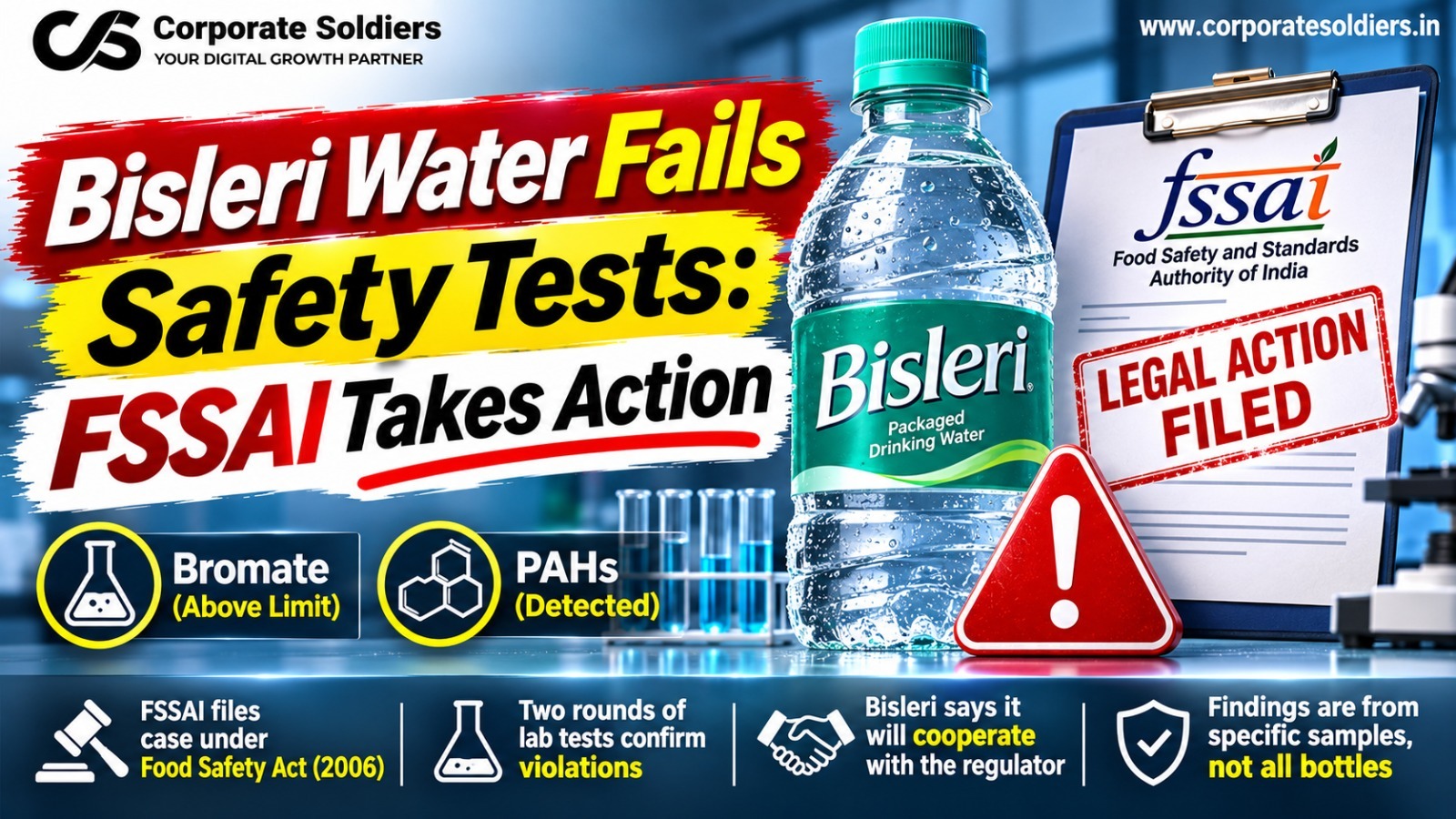
Update: November 23, 2026: India’s popular packaged drinking water brand Bisleri, India’s most sought-after drinking water brand, recently came under the scrutiny of the Food Safety and Standards Authority of India (FSSAI) after its sample turned out to be unsafe for drinking.
This has been declared a national concern as people have trusted this brand for decades. It took just two rounds of laboratory testing to identify all major chemical safety violations in this brand.
Key Highlights
- FSSAI has filed a legal case against Bisleri International under the Food Safety and Standards Act (2006).
- The first round of laboratory tests found a harmful chemical like Bromate levels crossing the limits.
- The laboratory detected polynuclear aromatic hydrocarbons (PAHs) as well.
- As a response, Bisleri challenged the initial findings and said it would cooperate with the regulator.
- The findings are based on some regulatory samples and do not confirm that all Bisleri bottles can be unsafe.
Why Has FSSAI Taken Action Against Bisleri?
On November 22, the food safety regulator sanctioned prosecution against Bisleri International Pvt Ltd under the Food Safety and Standards Act, 2006.
As per the latest report by FSSAI, some harmful chemicals have been collected from a sample of packaged drinking water from the Bisleri brand.
Initially, the examination found that the bromate level exceeded the designated limit in Bisleri water.
Consequently, FSSAI declared it unsafe.
However, Bisleri responded by appealing to the authority to check again. So, the tests were conducted in another laboratory, which also showed the same result. So, after the confirmation, FSSAI took action against Bisleri International Pvt Ltd.
What Are Bromate and PAHs In Bisleri Water Sample?
There are two major harmful chemicals found in this Bisleri water bottle sample:
1. Bromate
During water treatment, ozone is used for disinfection, and when ozone reacts with Bromide naturally, Bromate gets formed.
This chemical is a health concern when exposed to excessively. The International Agency for Research on Cancer (IARC) has classified potassium bromate as Group 2B, which means it is potentially carcinogenic (Possibly Cancerous) to humans.
2. Polynuclear Aromatic Hydrocarbons (PAHs)
Polynuclear Aromatic Hydrocarbons, or PAHs, are classified as a group of chemical compounds produced from the partial burning of organic materials, which includes Coal, Petroleum and Wood.
The catch is, benzo[a]pyrene, which is also found in these compounds, can cause cancer in humans.
How Bisleri Responded To FSSAI’s Action?
In response, Bisleri stated that water safety has always been the primary concern of this brand and that they have strong quality controls.
According to reports, the company previously collected a sample from its Goa facility which contained 12 micrograms per litre of bromate, in comparison to the set limit of 10 micrograms per litre.
However, Bisleri stated that subsequent independent tests commissioned by the company found bromate levels within the prescribed limits.
The company also stated that it would continue cooperating with FSSAI and address the matter through the appropriate regulatory process.
Does It Mean All Bisleri Water Bottles Are Unsafe?
No.
The recent FSSAI results are based on specific water samples. It doesn’t mean that all batches of Bisleri around the country are unsafe for human consumption.
It can be a problem of specific facilities and misconduct on the part of authorities designated there.
It is advised that consumers check some important details before buying the Bisleri water bottle:
- Manufacturing Date
- Expiry Date
- Brand Logo, Name, Identity
- Batch Number
- FSSAI Licence
- Packaging Seal
However, you won’t be able to identify contamination by the bottle’s appearance, taste, or smell.
This recent action by FSSAI has once again highlighted the significance of controlled quality checks and transparent testing in India’s food and water industry.