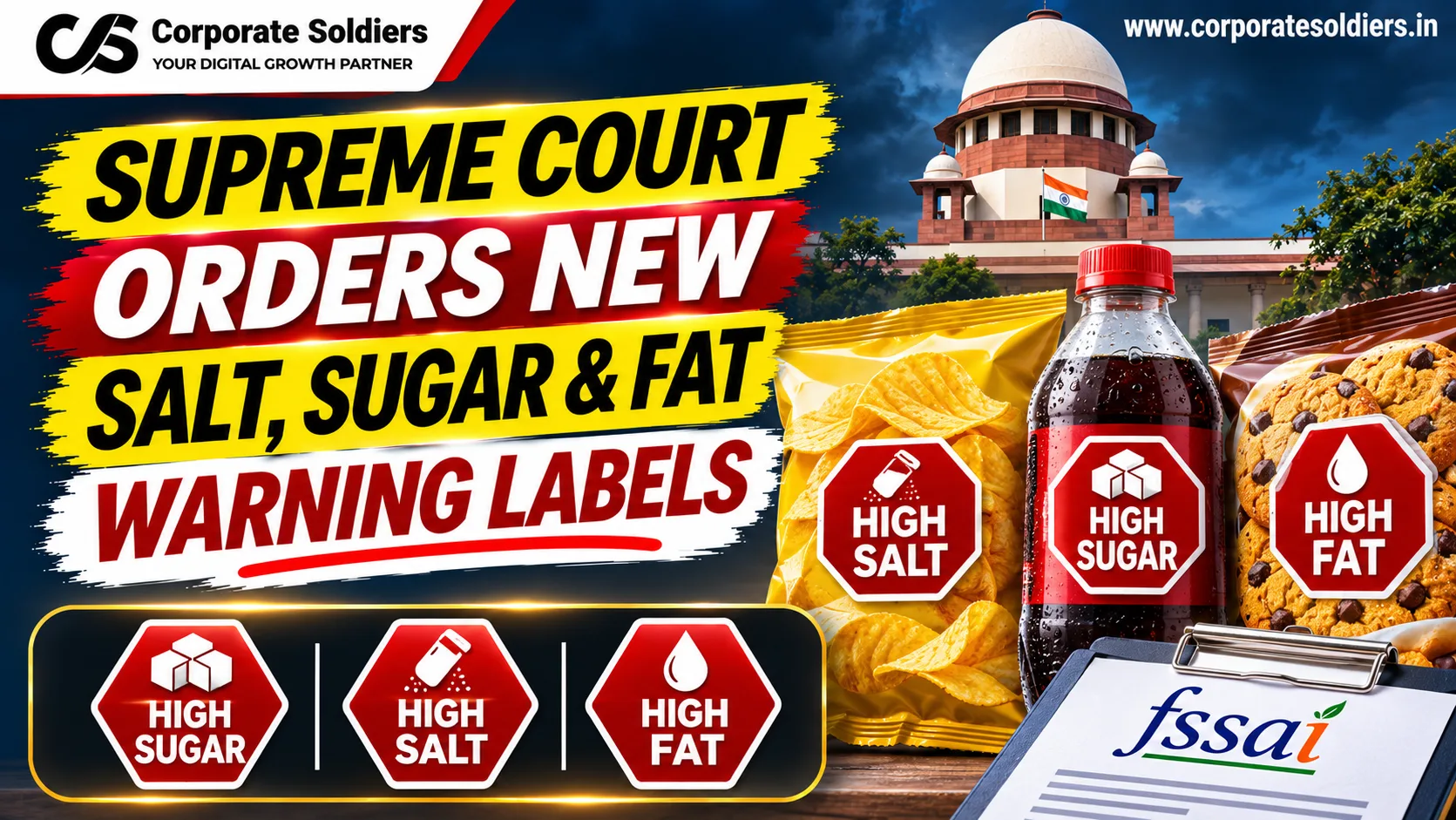
Food Safety and Standards Authority of India (FSSAI) has been ordered by the Supreme Court of India to revise the food warning labels on all product categories of Food and drinks.
The plan is to make separate warning labels on all packaged food products about the high levels of sugar, salt, and fat and their types.
The SC aims to revise and clean up food products with greater nutritional transparency and help consumers decide rightfully about what they should put in their stomachs.
On November 26, 2026, a bench comprising of Justices JB Pardiwala and K Vinod Chandran made a judgment for FSSAI to improve the Front-of-Package Nutrition Labelling (FoPNL) framework of India.
Initially, the Court rejected this proposal of mentioning a combined warning symbol. But then, it improvised the proposed approach by ordering separate red hexagonal labels for each nutrient that exceeds the prescribed limit.
Key Highlights
- Separate warning labels: Individual red hexagons for high sugar, high salt and high fat.
- Pictorial warnings: The selected food product label has to display a standardised bold pictogram alongside the words “HIGH SUGAR”, “HIGH SALT” or “HIGH FAT”.
- Label size: Each warning should occupy at least 4–5% of the package’s display panel.
- Revised nutritional value: FSSAI must consider total sugars and saturated fat, rather than only added sugar and added fat, alongside salt.
- Final Implementation: FSSAI has about a four-month period to finalise the draft regulations.
Why Has the Supreme Court Ordered Separate Food Warning Labels?
When this proposal was initiated, it mentioned a combined warning label of all nutrients on food packages.
So, the court rejected this request of this warning-level format because consumers might feel confused in identifying high nutrient content.
But it doesn’t mean that the entire proposal was rejected. The intent is important, and so is the health of all people in this nation.
So, after a discussion, SC ordered a revised plan to mention food warnings separately with pictograms and bold fonts, so consumers can easily identify the excessive sugar, salt, and fat content.
The Court directed FSSAI to consider total sugars and saturated fat instead of only added sugar and added fat. It also asked the regulator to revise the nutritional thresholds using scientific evidence.
The Court cautioned that thresholds set too low could result in excessive warning labels, while excessively high limits could allow unhealthy products to escape scrutiny.
How Will the New FSSAI Rules Affect Consumers and Food Companies?
1. Impact on Consumers
With newly revised food warnings and nutrient label layout, people will be able to make mindful decisions about their health.
Consumers will be able to identify this bold ‘HIGH SUGAR’ warning on biscuits and chips, instant noodles, and sugary beverages; consumers will be able to identify products containing excessive sugar, salt, or saturated fat through separate front-of-package warning labels.
This could help parents make more informed food choices for children, allow health-conscious shoppers to compare products more easily, and encourage people to monitor their nutritional intake.
2. What does it mean for food manufacturers?
Food manufacturers and label designers have to change their designs and content and make adjustments to product formulations.
The Court also linked front-of-package nutrition labelling with the constitutional right to health, the right to food and the right to make informed choices under Article 21.
Additionally, the Union Government has been directed to improve children’s nutritional literacy through school curriculum changes, interactive workshops and co-curricular activities.
When Will the New Packaged Food Warning Labels Be Implemented?
FSSAI has approximately four months to prepare and finalise the draft regulations. The regulator must also report its progress to the Supreme Court within ten weeks.
The proposed regulatory process includes a 60-day consultation period for stakeholder comments. Once the regulations come into force, food business operators will receive a 365 days is described as a voluntary implementation/transition period, after which compliance becomes mandatory.
Also, the Court directed FSSAI to ensure that each hexagon occupies at least 4–5% of the principal display panel. Your point is broadly correct, but use the judgment’s wording carefully.
Therefore, the new warning labels are not immediately mandatory across all packaged food products. Their implementation will follow the notification of the revised regulations.
A Step Towards More Transparent Food Labelling
The Supreme Court’s directions mark an important development in India’s food safety and consumer protection framework. By requiring separate warning symbols and clearer nutritional information, the ruling aims to help consumers make informed dietary choices.
The next step is for FSSAI to finalise the regulations and establish a clear implementation framework for food manufacturers.