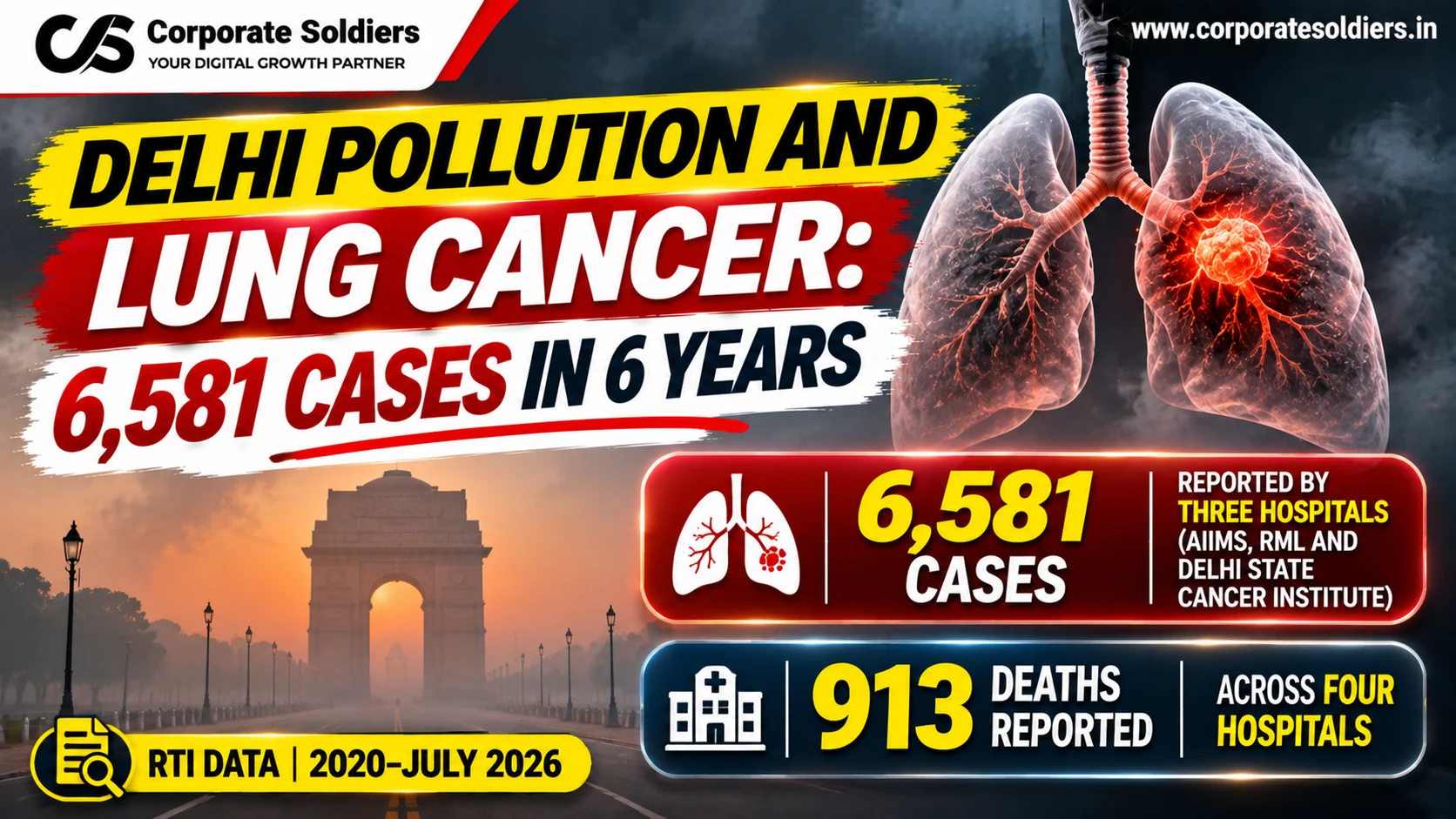
Delhi’s toxic air is once again raising concerns regarding long-term impact on the public’s health. This time, for its possible link to lung cancer.
Recent data obtained through Right to Information (RTI) responses show that four major government hospitals in the capital recorded 6,581 lung cancer cases and 913 deaths between January 2020 and July 2026.
The numbers point to a rising lung cancer burden and raise fresh concerns about the long-term health impact of breathing polluted air.
Key Highlights
- 6,581 lung cancer cases are recorded across AIIMS, Delhi State Cancer Institute (DSCI), and RML Hospital.
- 913 deaths are found in data collectively by four hospitals, including Safdarjung.
- 83 cases every month is the new average across the three hospitals that provided case figures.
- 4,860 cases at AIIMS is the highest number reported by an individual hospital.
- DSCI reported 351 women with lung cancer during the period.
- There were two childhood lung cancer cases in 2021.
- A chest surgeon reported that around 10% of his lung cancer patients are now in their 30s, with some in their late 20s.
- The same doctor reported that nearly half of his patients are now non-smokers.
Hospital-Wise Lung Cancer Statistics
RTI data reveals:
| Hospital | Cases | Deaths |
| AIIMS | 4,860 | 158 |
| Delhi State Cancer Institute | 1,613 | 354 |
| RML Hospital | 108 | 8 |
| Safdarjung Hospital | N.A. | 393 |
| Total | 6,581* | 913 |
These figures represent cases recorded at the selected government hospitals and should not be considered the total number of lung cancer cases in Delhi, as some of these hospitals also treat patients from neighbouring states.
How Is Delhi’s Air Pollution Linked to Lung Cancer?
Long-term exposure to outdoor air pollution is an established lung cancer risk factor. Fine particulate matter, particularly PM2.5, can penetrate deep into the lungs and contribute to inflammation and cellular damage.
And air pollution is a risk factor even for people who have never smoked.
Dr Arvind Kumar, a chest surgeon at Medanta, has raised concerns about the changing patient profile, reporting that around 10% of his lung cancer patients are now in their 30s, with some in their late 20s. He also observed that nearly half of his patients are non-smokers.
The International Agency for Research on Cancer (IARC), part of the World Health Organization (WHO), classifies outdoor air pollution and particulate matter as carcinogenic to humans.
However, pollution is not the only cause of lung cancer. Smoking, passive smoking, genetic factors, and occupational exposure also contribute. The RTI figures do not establish that air pollution directly caused the reported cases or deaths.
What Makes the Findings More Concerning?
Doctors say they are treating younger patients and a growing number of non-smokers, though the four hospitals did not provide specific data on patients who had never smoked.
Late detection is another worry, since lung cancer may show no clear symptoms in its early stages. A persistent cough, blood in the cough, unexplained weight loss, chest pain, or breathlessness should prompt a medical check-up.
Short-term winter curbs will not be enough to tackle Delhi’s air crisis. Sustained emission control, stronger cancer surveillance, and early diagnosis are needed to ease the long-term health burden.