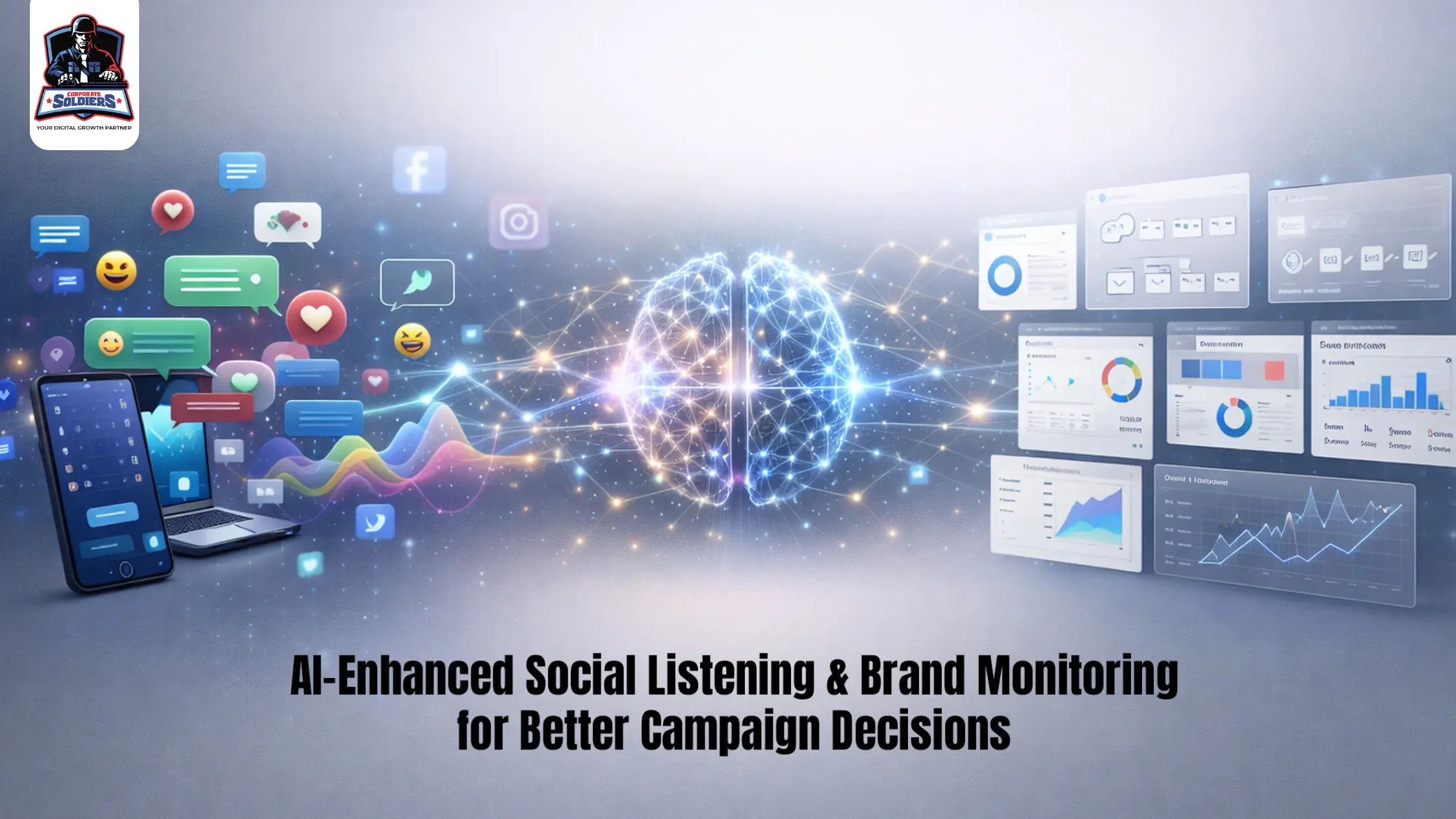
In the current hyper-competitive digital environment, a brand is no longer competing based on price or product alone, it is competing based on customer understanding, relevancy and timeliness. The current rate of social discussions, as well as the increase in consumer expectations, has rendered conventional methods of monitoring ineffective. Consequently, social listening as well as brand monitoring enhanced by AI have become invaluable instruments that marketers need to make data-driven campaign choices and construct strong first-party data strategy.
This shift reflects the evolution of brand tracking from reactive monitoring to predictive, real-time consumer intelligence, i.e. brands can no longer just watch what people are saying: they need to know why, how, and with what purpose.
This blog discusses the role of AI in changing social listening, enhancing first-party data strategy as well as speeding up smarter campaign decision-making.
What Is AI-Enhanced Social Listening and Brand Monitoring?
Social listening refers to the process of tracking online conversations on social media in order to gauge consumer sentiment, emerging trends, brand image, and competitive indications.
Brand Monitoring is, in its turn, concerned with particular brand mentions, reputation management, and presence in digital touchpoints.
In case these processes are enhanced with the Artificial Intelligence, the outcome is:
- Automated noise reduction and relevance scoring
- Contextual understanding of language and intent
- Trend forecasting and predictive insights
- Recognition of intent and emotion not based on keywords.
AI applications scan through millions of conversations simultaneously, use natural language processing (NLP), sentiment analysis, and machine learning algorithms to give actionable information that manual analysis cannot achieve at scale.
Why AI Matters in Social Listening
Social listening used to be based on the matching of keywords and on the superficial measures of mentions or activity volume. However, this method is no longer applicable because of:
- Data speed — trillions of daily transactions throughout platforms.
- Complex linguistic activity – slang, emojis, speaking more than one language at the same time.
- Noise pollution, including spam, irrelevant chatter, and bot-generated mentions.
Artificial intelligence contributes to improving social listening in that it:
- AI Enables Marketers to Understand Context Rather Than Relying Only on Keyword Tracking
With AI NLP models, they are able to understand intent and nuance, where a complaint, comparison, joke or recommendation are able to be understood even when there are no brand keywords mentioned.
- Predictive Insights in Real Time
Rather than post-hoc analysis, AI alerts to emerging trends, including increasing dissatisfaction or viral trends, before these trends reach a peak, and then it can be far too late to make a strategy change.
- Scalable Noise Filtration
The machine learning classifiers automatically filter out irrelevant information, and only show marketers useful signals that need to be acted on strategically.
- Sentiment with Depth
Unlike unintelligent sentiment scoring, AI identifies mixed sentiment (e.g. sarcastic praise) and scores emotional intensity – delivering more detailed interpretation of audience perception.
First-Party Data Strategy: The Missing Link
First party data is the data that a brand gathers directly about its audiences via owned properties – such as:
- Website behaviors
- CRM interactions
- App usage
- Email engagement
- Loyalty program activities
Unlike third-party data, which is compiled by external sources and is deteriorating because of privacy alterations (e.g., the phase-out of third-party cookies), first-party data is:
- Strategically owned
- Legally compliant
- Highly accurate
- Individualised at a personal level.
Most organizations however, are not challenged to collect first-party data but to activate it into action in order to drive campaign decisions.
Here, the concept of AI-enhanced social listening and brand monitoring will be paired with first-party data strategy to create exponential value.
The Strategic Value of Combining AI, Social Listening, and First-Party Data
- Integrating Intent Signals Inter-Channel
Social listening based on AI detects intent and sentiment of external conversations. Integrated with first-party behavior (e.g., product pages read or email inbox opened), the brands can have a 360 degree customer journey.
For example:
A surge of negative opinion on an item launch in social media, and a rise in abandoning the product page, will signify a quality perception problem – prior to sales starting to slow down.
- Better Personalization and Segmentation
The AI models can find micro-segments based on both: instead of generic audience segments.
- The First-party interaction patterns.
- Preferences and social conversation behavior.
This will allow targeting campaigning in a highly relevant way, increasing click-through rate, conversion, and retention of customers.
- Real-Time Campaign Optimization
With AI, insights are not static snapshots but dynamic inputs that shape real-time campaign decisions. For example:
- In case the mood of the audience changes towards the negative during a campaign – AI prompts a change in messaging.
- Social signals that are of high value may be fed back into CRM in order to update customer preference profiles.
This completes the circle of listening, learning and action.
- Stronger Competitive Intelligence
The first party data provides information on what your customers do. Social listening with AI informs you of what they say about the competitors. Through collaborating between brands, gaps can be discovered, value propositions can be optimized or weaknesses in competitor positioning can be pursued.
Artificial Intelligence Applications to Improve Campaign Decisions
- Early Trend Detection
AI flags rising issues before they become mainstream – allows the brands to create a campaign that is riding the trend wave rather than on its heels.
- Crisis Prevention
Real-time sentiment analysis can warn the marketing departments of possible PR problems before they can worsen, avoiding escalation and negative publicity.
- Precision Messaging
Knowing the tones and the intent of emotions, marketers can create a message that will appeal to a particular segment of the audience.
- Product Innovation Insights
Social conversations often express unmet needs. AI categorizes feedback themes that become inputs for product development and positioning.
Best Practices on Implementation
The following are strategic steps that should be embraced by organizations in order to create maximum impact:
- Integrate Across Platforms
Make sure that your AI listening devices are linked to CRM, Customer Data Platform (CDP) and analytics suites to enable a smooth flow of data.
- Create KPIs in Line with Business Objectives
Measure the insights based on business impact – conversion lift, sentiment lift, retention lift, etc. not vanity metrics.
- Make sure Data Privacy Compliance.
Build privacy-friendly first-party data captures and AI processing solutions, including consent, privacy, and privacy laws, including GDPR.
- Empower Human Oversight
AI aids in decision making, strategic interpretation by marketing experts makes it relevant and context adjustments.
Conclusion
In the digital acceleration age, leading brands succeed not only through strong products, but through deeper customer intelligence and faster responsiveness.
Social listening and brand monitoring with AI, closely combined with an approach to first-party data, offer that competitive advantage – allowing marketers to make more intelligent, faster, and accurate decisions when it comes to campaigns.
Instead of using summary data or relying on backward-looking performance data, empowered organizations can know how their audience thinks, speaks, and acts in real time and can convert insights into quantifiable business results.
With the change of privacy-related regulations and the disappearance of third-party targeting, the brands that have developed AI and their own first-party data system will not just survive but flourish.