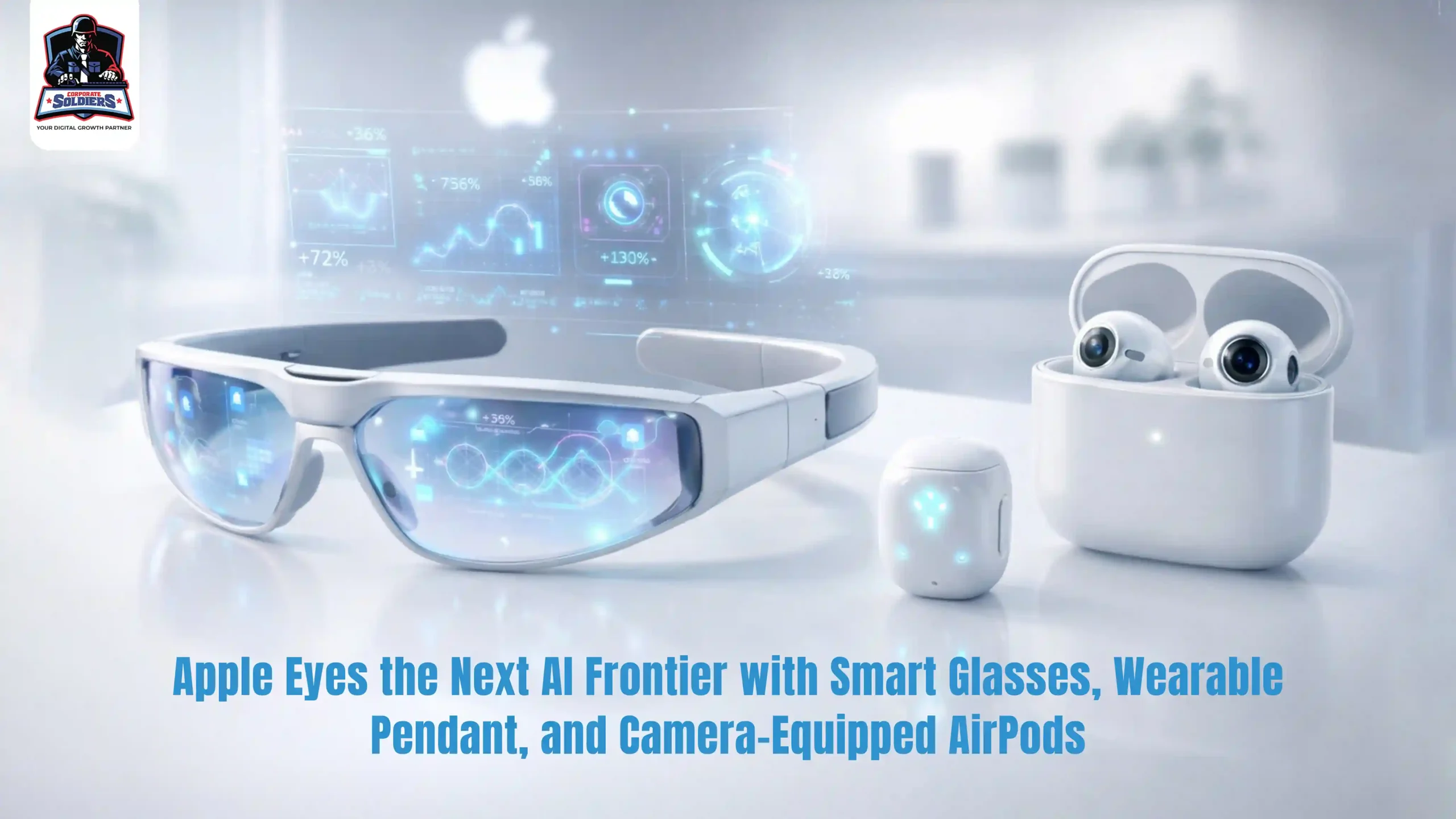
As Apple looks beyond the iPhone to define its next computing platform, the new trio of wearables powered by AI can transform the manner of interaction between users and the world by providing visual intelligence.
The personal technology space is about to change radically as Apple, the Cupertino-based technology giant, accelerates its push into the emerging AI hardware market. Apple is developing three ambitious wearable products internally and according to recent reports by The Times of India and Mark Gurman of Bloomberg, they include smart glasses powered by AI, a wearable version of Siri called a pendant, and AirPods with built-in camera systems. This marks Apple’s biggest hardware expansion since the Apple Vision Pro, as the company explores the possibility of a post-smartphone future, a future where users no longer rely on phones as primary tools, but interact with AI through ambient wearable devices a constant, pervasive companion powered by artificial intelligence.
The Context: Apple’s Response to the AI Hardware Race
Over the years, the wearable market was characterized by sound and fitness tracking. But now, with the burst of multimodal Large Language Models (LLMs), the situation has shifted. The decision to enter AI-enhanced wearables is motivated by the necessity of Apple to secure the dominance of its ecosystem in the presence of intense competition.
Meta already has its second-generation Ray-Ban smart glasses that make the user identify landmarks, translate text and answer questions through an onboard AI that is able to see what the user sees, having already achieved surprise success. In the meantime, other startups such as Humane and Rabbit have tried, with different levels of effectiveness, to introduce specific AI hardware. The strategy at Apple is understandable: use its current technology of Apple’s expanding visual AI capabilities, including camera-driven contextual recognition features, and transfer it to the face, ears, and the chest.
Breaking Down the Next Generation of Apple Wearables
AI-Powered Smart Glasses
In contrast to the Vision Pro, which is a large spatial computer, destined to be used in an immersive way, the smart glasses made by Apple will be designed to be worn all day long.
- The Concept: It is not supposed to be a high-fidelity display and full AR glasses at the beginning. Instead, they will be concerned with Smart Glasses functionality, i.e. having cameras, speakers and microphones.
- Technical Integration: The glasses will probably outsource much of the processing to the iPhone, which will identify objects in the environment, give navigation prompts or condense documents on a desk.
- Timeline: Internal reports suggest a production start in late 2026, with a likely consumer launch in 2027.
Camera-Enabled AirPods
Apple is investigating the possibilities of attaching low-resolution camera sensors to the AirPods shape in what is arguably the most distinct engineering dilemma.
- How They Work: These earbuds, reportedly codenamed B798, according to supply-chain reports, would scan the environment of the user, using infrared or the low-power sensors. Apple Intelligence would process this data to give an audio response on the environment of the user.
- Functionality: Think about when you are strolling through a grocery store and your AirPods remind you of the items on your list or give the visually impaired real-time spatial notifications.
- Timeline: It is also rumored to be in an earlier stage of development, and it might be released as early as 2026.
The Wearable AI Pendant
Following the example of the AI Pin idea, another wearable that Apple is developing is the pendant.
- The Idea: A compact, wearable or clip-on gadget that will feature built-in Siri and an integrated camera system. The device would be a specific interface with Apple Intelligence allowing the user to engage with AI without having to draw out a phone or strap something in their face.
- The Uncertainty: The pendant is the most experimental out of the three projects. According to industry analysts, Apple can incorporate the functionality of the pendant into the glasses or AirPods should the format fail to impress internal tests.
Industry Impact: The Battle for “Visual Intelligence”
The entry by Apple into this segment is a direct threat to Meta and Google. The next big technological battleground is the market of Visual Intelligence. The data provided by the Grand View Research has shown that the global wearable technology is expected to expand with a compound annual growth rate (CAGR) of 14.6 to 2030, with the integration of AI being the main driver.
The issue faced by Apple is that it has to balance hardware restrictions with its hardline policy on user privacy. Bloomberg reporter Mark Gurman says that Apple aims to take the power of visual processing of the Vision Pro and actually put it on your face on the street. To accomplish this, Apple has to find the solution to the thermal riddle that is how to fit cameras and AI chips into small frames without having them overheat, and at the same time make sure that people in the background do not feel like they are being spied on by these ubiquitous cameras.
Consumer Expectations & Trends
According to market research, there is increasing demand in AI-based wearables, particularly those that minimize screen addiction.
The major trends contributing to adoption are:
- Hands-free computing is in demand
- Expansion in voice assistant applications
- Curation of interest in health + situational awareness
- Spatial computing ecosystem expansion
Analysts predict that the smart wearable industry world will continue to expand steadily over the decade with AI integration serving as the major source of value and not hardware.
The next breakthrough, according to which AI can look around and process visual information, is visual intelligence. Cameras with real-time AI may restructure the search, learning, shopping, and navigation processes of users in the real world.
Consumer Trends and Expert Outlook
The consumers are shifting towards more glanceable information. Apple Watch was a success because it showed people the importance of being connected without being attached to a screen. The researchers hold that AI cameras will transform communication by eliminating the discomfort of the photography and search process. Your glasses will just tell you what you are looking at without you having to take a picture of it before determining what it is.
Industry analysts however caution that Apple should not fall into the traps of its predecessors. Google Glass struggled due to social friction, particularly privacy concerns around always-on cameras and the Humane AI Pin because of bad battery life, and slow processing. Another strength Apple has is its vertical integration; its own silicon (A-series chips), combined with a smooth iOS ecosystem, gives Apple the opportunity to provide a certain level of reliability unattainable by competitors.
Conclusion & Outlook
One of Apple’s biggest post-smartphone hardware bets is reportedly the development of AI smart glasses and a wearable pendant and camera-enabled AirPods. Collectively, the devices allude to a future that does not put AI on a screen but rather on what a user wears, hears, and sees.
Timings are tentative, and AirPods may be launched first in 2026, then smart glasses in 2027, and the pendant will have a future, depending on market acceptance and privacy.
The larger point is evident: the future computing platform might not be the one that users are holding in their hands, but rather the one that they wear. And Apple would like to be the heart of that change.
With the pace of AI hardware accelerating, industry observers will seek early prototypes, developer frameworks, and integrations of the ecosystems that will provide indications of how Apple will make ambient intelligence useful -and socially acceptable.