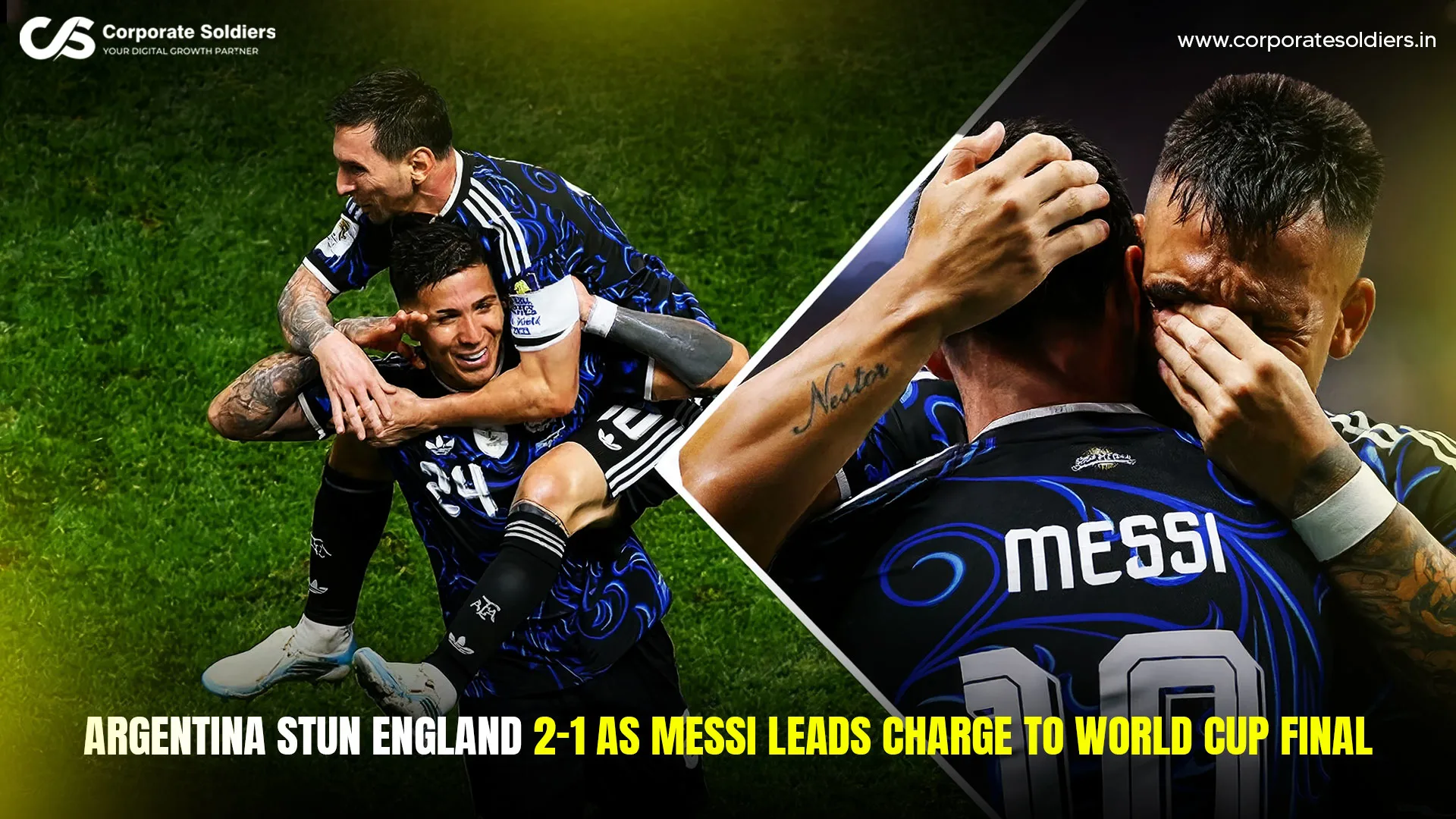
Argentina delivered another iconic FIFA World Cup performance when Lionel Scaloni led his team to come back and beat England 2-1 in the semi-final in Atlanta, Mercedes-Benz stadium to get a spot in the 2026 FIFA World Cup final. Lionel Messi was decisive again, masterminding Argentina to a late comeback and providing the assist to the winning goal as the defending champions were just a win away from keeping the biggest football trophy in the world.
The outcome meant that England had lost the hopes of playing their first World Cup final since 1966 and this showed that Argentina could be calm in the crucial moments of tournament football. It is Argentina that will now have to play Spain in the final and England are left to ponder on another erroneous exit at the world cup.
Match Overview
- Result: England 1-2 Argentina
- Competition: FIFA World Cup 2026 Semi-Final
- Time: 8.35 p.m. local time (2.35 am in London)
- Stage: Semi-Final
It seemed like the match was going in the direction of England when Anthony Gordon scored England the lead in the middle of the second half. But Argentina staged a late charge, drawing even with a goal by Enzo Fernandez in the 85th minute and then Lautaro Martinez netted a flamboyant late goal on an assist by Lionel Messi.
In the case of Argentina, the win symbolised another act of endurance that has typified their recent success on the international stage. To England it was a heartbreaking failure, having led so far into the game.
First Half Analysis
The first 45 minutes were typical of the tension that was anticipated between two traditional football giants in a FIFA World Cup semi-final.
England looked dangerous on the counterattack, while Argentina appeared focused on controlling the tempo of the game. The side of Thomas Tuchel was aiming to be tight during the periods of possession and fast in their attacks via transition and wide spaces. Argentina, in their turn, continued with their usual style of possession, passing the ball around the middle of the field and trying to overload Messi.
Argentina appeared comfortable on the ball for long periods and sought to dictate the rhythm of the match. England was picky in pressing and appeared threatening when attacking, whereas Argentina concentrated on tempo and territory.
The first 45 minutes had been goalless, yet the tactical battle was giving the impression that eventually, the game would be won by moments of quality as opposed to the dominance of both sides over time.
Lionel Messi’s Influence
Lionel Messi at the age of 39 years again showed why he is one of the most influential figures in football.
Although he did not score, Messi’s impact was felt throughout the match. He was the main creative engine of Argentina, who connected the midfield and the forward to the goal, who controlled the moments of possession, and constantly attracted the defensive players of England to his side. His action opened spaces to his teammates and his passing remained to form the attacking structure of Argentina.
It was a highlight in the stoppage time. As England withdrew under constant pressure, Messi scored the dagger assist that enabled Lautaro Martinez to tally the final goal and take Argentina to the final.
In addition to the statistics, the leadership of Messi was obvious. Argentina never seemed to panic when they were on the backfoot and their captain was at the heart of the faith and fighting strategy of the team. His mastery of rhythm, space recognition and control of critical moments eventually came into play.
Key Moments That Changed the Match
Anthony Gordon Breaks the Deadlock
England took the lead when Anthony Gordon scored in the second round which meant that the Three Lions were 1-0 ahead and were on the verge of making an appearance at the final that was to be historic.
Argentina’s Growing Pressure
Arguing in line with the ambitions of England, Argentina escalated in the intensity of their attack. Scaloni’s side committed more players to attack and spent more time in advanced areas as they searched for a way back into the match.
Enzo Fernández Equalises
In the 85th minute, the perseverance of Argentina paid off, as Enzo Fernández scored the goal to draw the game to a 1-1 draw. This aim changed the tide of war completely and revealed the increasing defensive weakness of England.
Lautaro Martínez’s Stoppage-Time Winner
It was the climax during added time. Messi made the vital pass and Lautaro Martinez scored the goal to clinically finish the comeback of Argentina and win the game in a dramatic manner 2-1.
There was no major VAR controversy that came out as a determining factor in the result as per the reports of the matches.
England’s Performance
England gave a disciplined performance throughout much of the time and seemed to have the ability to get to the final.
Tuchel’s tactical plan initially worked well. England was also well organised defensively and they were able to restrict clear Argentine opportunities throughout most of the game. The aim of Gordon seemed to justify the course of staying small and taking advantage of transition opportunities.
But England found it hard to keep the lead. Instead of threatening Argentina further, they slowly withdrew further and gave the defending champions control of territory and possession. This change put more pressure on the back line and ultimately resulted in the late collapse.
The midfield battle increasingly favoured Argentina during the closing stages taking away the capability of England to relieve pressure and keep possession. Although Jordan Pickford saved England at crucial moments, they could not hold back Argentina with their series of attacks.
Argentina’s Tactical Strengths
Defensive Organisation
Although Argentina had to be the first to concede, it was structurally disciplined. Their defensive formation did not allow England to create a steady flow of opportunities following the goal by Gordon.
Midfield Control
Argentina’s midfield became increasingly influential as the match progressed. Their power to recycle possession and maintain attacks put England into extended periods of defensive play.
Transition Play
Although they possessed control, Argentina was still a danger in the attacking transitions. The rapid dribbling and smart passing coupled with the creativity of Messi continuously disrupted the defensive line of England.
Press Resistance
Their playing under pressure has been one of the strengths of Argentina during the tournament. They operated calmly against England, even when falling behind without making any hasty decisions and adhering to their plan of action.
Player Performances
Argentina
Lionel Messi
Messi was the star of the game. His creative skill, calmness and decisiveness served him throughout his timeless worth at the top.
Enzo Fernández
It was one of the most crucial goals of Argentina’s campaign since it was given by the midfielder to equalise the situation and to regain momentum.
Lautaro Martínez
Brought on as a substitute, Martínez was the match-winner with a stoppage-time goal. His dribbling and scoring were vital.
England
Anthony Gordon
The outstanding English attacking player not only scored the first goal but also provided an option when making transitions.
Jordan Pickford
The England goalkeeper also intervened on several crucial occasions and held his team in the competition for extended periods until Argentina broke through towards the end.
Road to the Final
The path of Argentina to the World Cup final has been marked by quality and perseverance.
The champions of the defending side won their group then went through tough knockout games. They defeated Switzerland in the quarter-finals and then drastically defeated England to win another chance to appear in the largest football game.
The win takes Argentina into their second consecutive World Cup final where they will face Spain. It also gives a chance to be back-to-back world champions which has been achieved by only a few nations in the history of football.
My Opinion: Why Argentina Deserved the Victory
Argentina had a right to play in the final as they were the better team in the time when it really counted.
Although England implemented the defensive strategy of the game quite successfully throughout the game, tournament football is usually determined by the team which can keep the ball. When England was in the lead they were more passive and could not hold on to the possession. Argentina realised that change and gradually gained more and more dominance over the territory.
Messi’s influence was particularly important. Despite not scoring, he dictated the pace of the game and was the most significant creative source of Argentina. The fact that he has the capacity to stay calm during emergencies has assisted Argentina in not panicking when they are behind schedule.
Argentina also proved to be more tactically flexible. The purposeful attack by the Scaloni side did not stop but they believed in their structure and eventually had solutions in the form of midfield advancement and rational movement in the end third.
England had moments of supremacy and had done great service to the cause of defence, and had not been able to turn the point into a second goal. Argentina, in their turn, did not hesitate in case there was an opportunity.
Finally, the semi-final reaffirmed a general fact of elite tournament football: efficiency, calmness and decisive action can be more important than extended periods of possession or territorial dominance.
Broader Football Significance
Messi’s World Cup Legacy
The recent World Cup game played by Messi adds another incredible international legacy to an already great one. He is 39 years old, and still able to make decisions on the top level, leading Argentina back to a World Cup final.
Argentina Among Football’s Elite
The fact that Argentina has made it to consecutive World Cup finals is a testament to the fact that the country is among the model countries in international football. This generation is still characterised by the combination of tactical organisation, technical quality and competitive mentality.
Questions for England
To England, the loss poses the same old questions of turning talent into major tournament triumphs. The team enjoys a lot of quality, yet the failure of the semi-final is an additional lesson that one has to learn how to handle difficult situations with pressure.
Looking Ahead
The result may affect the future performance of the two national teams in future international competitions. Argentina are the champions of modern tournament football, and England needs to figure out how they can turn potential into a trophy.
Final Thoughts
The tactical discipline, strength and decisiveness in the final moments saw Argentina win the FIFA World Cup semi-final over England 2-1. England seemed to be within reach of the last after Anthony Gordon scored, yet Argentina reacted with the calmness and belief of champions.
Lionel Messi once again produced on the biggest football stage, but this time it was not his goals but leadership, creativity and a match winning assist that produced the desired results. The final touches were provided by Enzo Fernández and Lautaro Martinez, yet Messi was the one who made Argentina come back.
England proved to be good and organised in most of the contest but failure to turn a marginal victory into victory cost them. Argentina, in its turn, demonstrated why talented teams in elite tournaments are characterized not only by talent but also their ability to capture the crucial moment when it all is at stake.