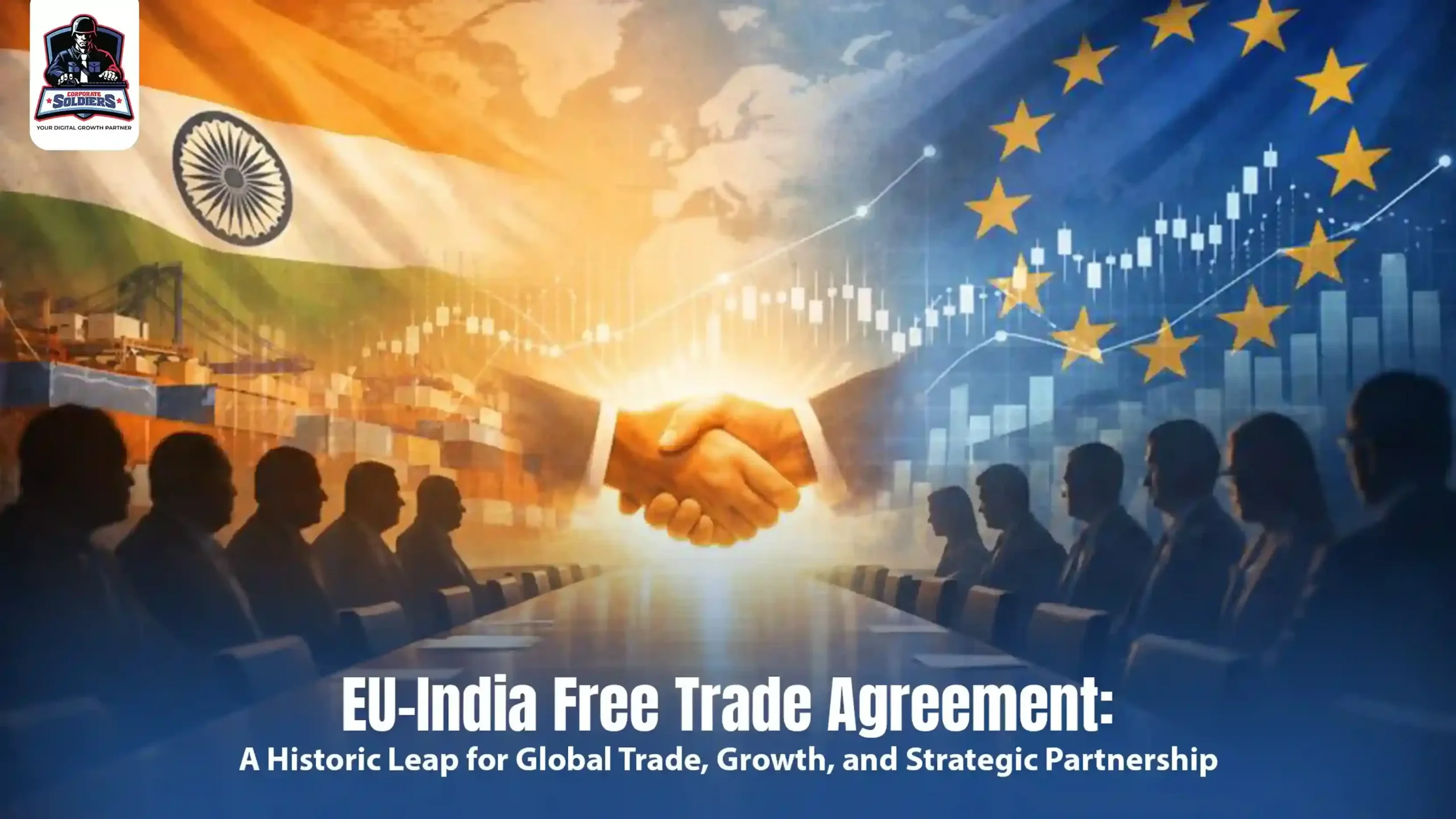
India and the European Union (EU) have finally arrived at an agreement on one of the most ambitious and strategically important Free Trade Agreements (FTA) in the recent history of world commerce. The agreement was finalised on 27 January 2026, after approximately 20 years of consultation and coordination, and it reshapes the economic relationships between a 1.45-billion-strong India and a 27-country bloc the EU, which is one of the largest economic blocks in the world representing nearly a quarter of the global GDP.
According to the official European Commission press release, this is the largest free trade agreement ever concluded by either side and is expected to significantly strengthen economic and political ties between the two partners.
The treaty is much more than a cut in tariffs, a glimpse into the future of open markets, predictable frameworks, and sustainable economic integration, it places both sides in a position to grow and work together in the future.
1. Background: A Two-Decade Journey to a Transformative Deal
The EU-India FTA dates back to negotiations that started in 2007 and was fuelled by a desire by both sides of the deal to have closer economic integration and increase bilateral cooperation. The discussions were interrupted and reinsisted, especially in 2013, but they were reinstated with a new determination in 2022.
The agreement is now one of the biggest and most all-inclusive FTAs ever signed by either party-an accomplishment in the Indian global trade policy and the EU wish to secure diversified economic relationships with the changing background in geopolitical developments.
2. What the Agreement Covers: Trade, Services, and Strategic Linkages
Fundamentally, the EU / India FTA is designed in such a manner that it provides profound tariff liberalisation, market access enhancements, and deep economic interconnection, especially in major areas:
Goods and Tariffs
- Elimination or reduction of tariffs on the large majority of traded goods by value – those on 96.6% of EU exports and 99% of Indian exports.
- European industries including machinery, chemicals, pharmaceuticals, automobiles and agri-food products have the benefit of the large and growing Indian market.
- The country tariffs of foreign cars in India (which were previously as high as 110%) will be lowered over time, making the country more competitive and integrated to the global value chains.
Services and Investment
Besides goods, the treaty contains major undertakings in:
- Liberalisation of the service sector which has given foreign service providers a greater access to the markets such as finance, maritime transport and professional services.
- Facilitation of investments: to make Indian and European firms more interdependent, enhance cross-border capital flows and close economic ties.
Mobility & Human Capital
The agreement goes further to codify practices on professional mobility that allows skilled labor force and business people to move which is a strategic move in the face of modern service economies.
3. Strategic Economic Significance
Market Size & Trade Potential
The merger unites markets of more than 2 billion consumers and a combined economic output of about 25 percent of the world GDP, forming a huge economic zone that has extensive implications.
The trade in goods alone between EU and India has reached extremely high levels in recent years with India having a higher export value of more than 75 billion to the EU. Additional impetus came with services trade which is largely interdependent and can be grown.
Benefits for Key Sectors
- Manufacturing & Exports: Indian industries that include textiles, gems and jewellery, leather and chemicals are likely to experience a rapid growth as barricades to tariffs and non-tariffs are relaxed.
- Agri-Food Opportunities: The treaty will begin to open up European agricultural markets (with a carefully managed quota and tariff reduction on goods such as wine, olives and processed foods) without placing significant pressure on health and safety standards.
- Automotive/Technology: The high technology manufacturing sector in Europe such as the automobile components and high accuracy engineering will get new horizons in the Indian markets that were previously constrained by high tariff barriers.
4. Beyond Trade: Sustainability and Strategic Cooperation.
This agreement is forward-looking in contrast to a traditional FTA:
- Sustainable Development: Special provisions in favor of climate action, environmental standards, labor rights and women empowerment – balancing the growth with global sustainability.
- Intellectual Property: The better protection of Intellectual Property promotes innovation and confidence in the business, harmonizing legal frameworks and business operations.
Also, the agreement envisages further collaboration on climate platforms and sustainable transformation of the industrial sector, supported by planned EU investments.
Next Steps: Ratification and Implementation.
The agreement has not yet taken effect although it has been finalised. It needs:
- Legal review and translation to all official languages of the EU.
- The European Parliament and EU member states have to agree.
- Government of India: Ratification.
Both parties to the agreement project an official entry into force in the future, in 2026, in case of these domestic procedures.
Conclusion: A New Era in EU–India Relations
The EU India FTA is not simply a trade agreement, but a complete economic, strategic and diplomatic system that fits the 21st century globalized economy. It enhances economic relationships, increases the market penetration by businesses of all scales, and portrays the desire to pursue a growth that is cooperative in a multifaceted international environment.
To India, the agreement makes it a great economy and a rising global ally. To the EU, it is the diversification of economic connections and helps in finding competitiveness in the mobile world trade system. This historic accord is a milestone in the global trade partnership – one that will influence the economic histories in decades.