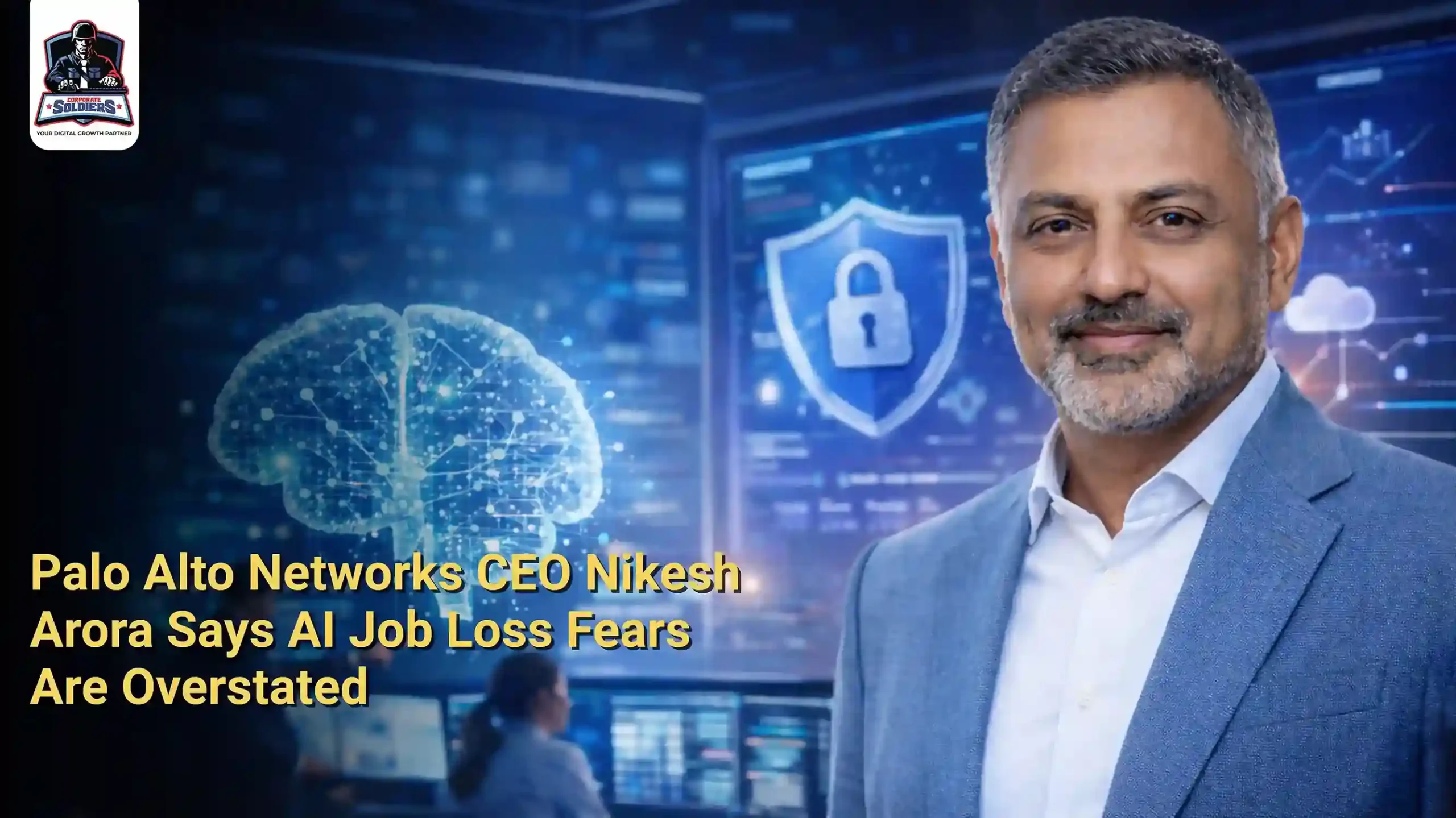
The cybersecurity leader says the industry requires five times more skilled professionals as AI applications expand.
Concerns that artificial intelligence will cause mass layoffs are exaggerated, according to Nikesh Arora, chief executive of Palo Alto Networks. In comments, cited by The Times of India, Arora claimed that the technology industry, especially in the area of cybersecurity, had a dearth of skilled staff and not a workforce crisis. “We need five times more skilled people,” Arora said, refuting the existing discourse according to which AI will reduce the workforce significantly.
His remarks come at a time when governments, corporations, and workers worldwide are grappling with how rapidly advancing AI systems will reshape employment trends.
Who Is Nikesh Arora and Why His Views Matter?
Since 2018, Palo Alto Networks has been led by Nikesh Arora, under whose leadership the company has expanded into AI-based cybersecurity and cloud security solutions. Prior to working in the cybersecurity company, Arora had served in top positions at Google as Chief Business Officer and then at SoftBank as President and COO.
Under Arora’s leadership, the company has grown into one of the world’s largest cybersecurity firms, serving businesses and governments globally. The company incorporates AI in threat detection solutions, automated response systems, and network protection solutions, and it has become a central topic in the discussions on the deployment of AI and digital risk management.
As a leader with experience in working in technologies globally and as the leader of a cybersecurity company that is deeply integrated into AI implementation, the views of Arora are significant in the discourse on the impact of automation on the high-skilled sectors.
The Core Argument: AI Does Not Eliminate Talent Needs
Arora’s argument centers on the complexity of AI implementation. Although AI can be used to computerize routine processes, the system that is needed to operate these systems safely and efficiently necessitates a greater human response. Arora suggested that while roles may evolve, overall demand for skilled professionals is rising. According to him, the industry did not need a reduction in the number of people; it required five times more skilled people to be utilized in an AI-enhanced world.
This is a critical need especially in areas such as AI engineering, data science and automation management. Arora believes that AI is a force multiplier. The technology can provide the human workers with high-level strategy and complex-level problem-solving, by doing the monotonous “drudge work” of data processing and simple pattern recognition tasks. Nonetheless, there is a need for a workforce that understands the dynamics of underlying AI models — a talent pool that remains insufficient to meet global corporate demand.
The AI Job Disruption Debate: A Global Context
Arora’s optimism enters an already crowded debate about the future of work. Organizations such as the International Monetary Fund (IMF) have estimated the exposure rate of AI at almost 40 percent of the total employment globally and 60 percent in developed economies. Likewise, Goldman Sachs (2023) indicated in a report that AI would be able to replace the equivalent of 300 million full-time jobs.
These figures, however, tend to target on exposure as opposed to replacement. According to the Future of Jobs Report 2023 published by the World Economic Forum, 85 million jobs can be lost as a result of a shift in the division of labour between humans and machines, but 97 million new jobs can be created which are better adjusted to the new division of labour. Arora’s claim that economic growth may be limited not by job scarcity but by a shortage of skilled workers aligns with this more optimistic view.
Cybersecurity and AI: Increasing Complexity, Swelling Demand
AI is also changing the work of cybersecurity very quickly. The current threat detection systems are based on machine learning algorithms to detect anomalies, anticipate vulnerabilities, and react to attacks in real time. Nevertheless, AI systems need supervision to avoid the false positives, bias, or misuse by enemies.
Organizations are putting a lot of money on AI-based security platforms as cyber attacks continue to advance. This growth leads to the growth of the security analysts, cloud engineers, AI experts and risk management experts.
Palo Alto Networks, in its turn, encompasses AI in its product portfolio, providing automated services of threat detection and response. The company’s strategy reflects a broader industry shift toward more intelligent, adaptive security systems that require skilled human oversight.
The cybersecurity skills gap is growing, which highlights the argument of Arora: AI adoption has been accompanied by increased demand for high-level technical skills rather than the opposite.
Broader Economic and Workforce Implications
These remarks by Arora can be part of a bigger argument regarding the transformation of the workforce in the age of AI. According to the arguments of many economists, although some routine jobs may be completed by automation, new skills are also needed.
Reskilling and upskilling are becoming the core policy concerns. Schools and colleges are changing their programs to incorporate AI literacy, the basics of data science, and cybersecurity education. Companies are also spending more on internal training to equip workers to work in AI-based processes.
It is not the sheer quantity of jobs that is difficult, but the rate at which the transition must take place. Employees who are ousted out of routine jobs, or repetitive tasks, might need the systemic avenues in order to move to the new technology-based jobs.
Provided that Arora is right, the process of workforce growth, in particular, in high-skill sectors, might characterize the AI economy, as opposed to general contraction.
Counterpoints and Realistic Concerns
Although positive forecasts are made, there are still valid anxieties. The routine administration jobs, customer service, and some analytical workflow can be automated by AI systems. Automation can cause a decline in the number of employees in an industry that depends on manual work to survive.
It also depends on the geography and industry. The developed economies with effective digital infrastructure can have more rapid movement of workforce, and the developing markets can be more disrupted in the low-skill spheres.
Experts warn that without targeted reskilling efforts, the risks of displacement may increase. Moderate policy frames will also be needed so that automation benefits can be widely distributed.
The viewpoint of Arora does not rule out these issues but reformulates the discussion: it is perhaps not so much about job loss but rather an adjustment of the skills.
Conclusion
Nikesh Arora challenges one of the most common narratives about automation, arguing that fears of widespread AI-driven job losses are overstated. He reinforces the argument that the real challenge is a shortage of qualified talent, insisting the industry needs five times more skilled professionals to meet rising demand.
Although this trend of automating jobs is bound to transform some professions, the new evidence suggests that AI is creating demands and positions of highly specialized skills as well. The larger labor force will be affected by the level of effectiveness with which institutions, corporate and governments invest in reskilling and education.
With AI becoming an integral part of the main business processes, the argument is evolving not on whether or not jobs will be eliminated but on how they will be transformed. The particular problem of the AI age, according to Arora, consists in the lack of talent, rather than the lack of work.