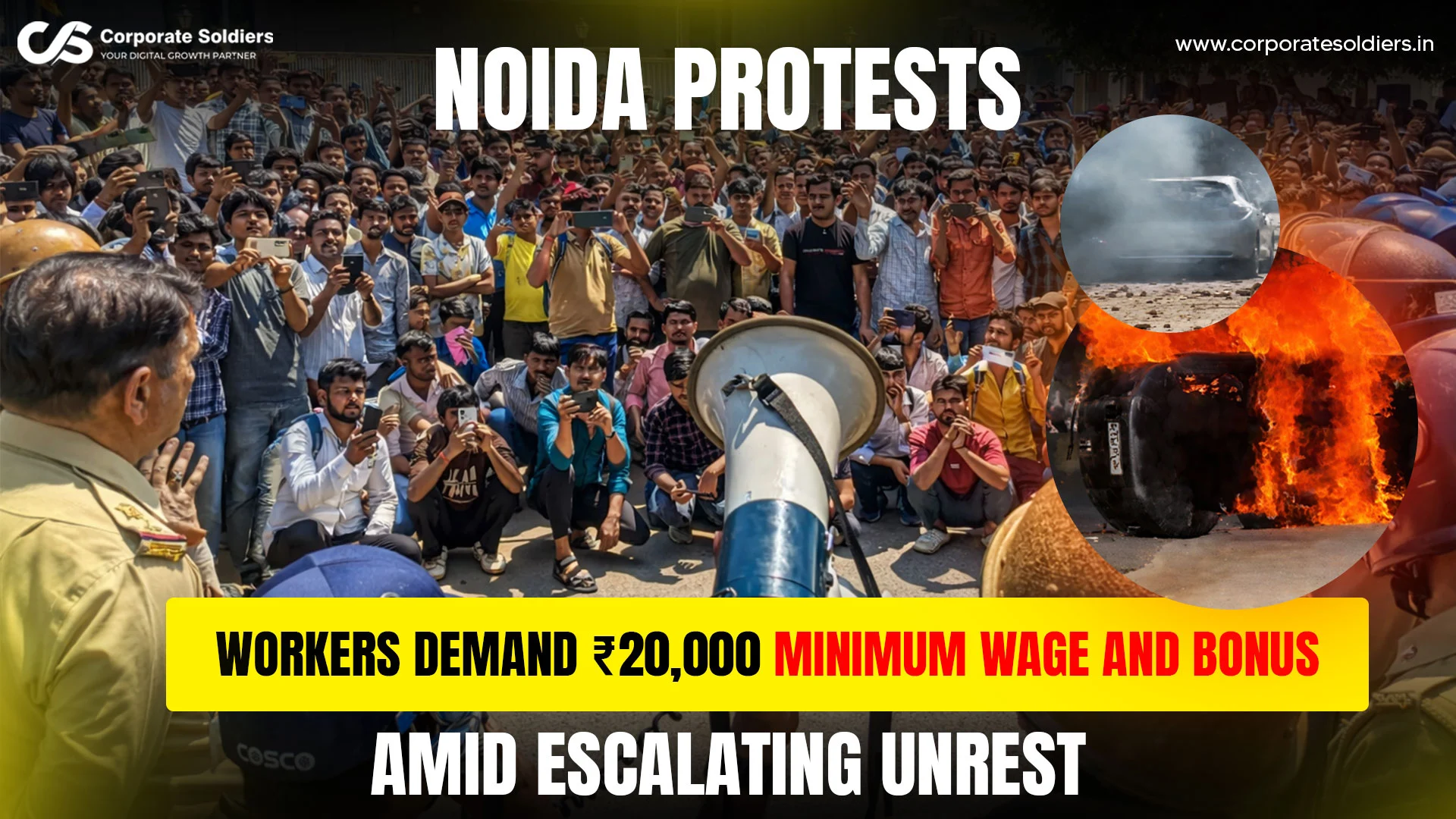
The Noida industrial belt has had its fair share of labour unrest as the mass protests by factory workers escalated on April 13, 2026. What started as an agitation due to wage issues has escalated into violent clashes due to a number of days of continued protests. The scenario has interfered with industrial processes and public mobility and attracted immediate administrative attention, raising concerns about labour conditions in the area.
What Triggered the Protests
The demonstrations started in the Phase 2 industrial area of Noida, where employees had allegedly been protesting for almost three days. Employers and authorities had not taken appropriate action to respond to repeated complaints by workers about wages and working conditions, according to worker reports.
What was perceived as no action taken in regard to these grievances added to the growing frustrations that culminated in massive mobilisation and confrontation.
Key Takeaways (TL;DR):
- The Crisis: Mass protests in Noida’s Phase 2 industrial area escalated into violence on April 13, leading to the deployment of the Rapid Action Force (RAF) and over 50 arrests.
- The Main Demand: Workers are demanding a ₹20,000 minimum monthly wage for an 8-hour shift, citing high inflation and the need for parity with neighboring Haryana.
- The Impact: Key transit routes, including the DND Flyway and Chilla Border, were paralyzed by blockades, while several factories reported arson and property damage.
- The Resolution: While the District Administration has mandated weekly offs and overtime pay, the core wage hike remains pending a decision by the State Cabinet.
Key Demands of Workers
The central demand of the protesters is a minimum monthly wage of ₹20,000 for an 8-hour shift. At present, the majority of the employees in the area claim to earn between 11,000 and 13,000 a month.
Wage Parity with Haryana:
One of the primary catalysts of the protest is the recent decision by the Haryana Government (to be put in effect April 1, 2026) to raise minimum wages by approximately 35 %, in which the unskilled workers will earn about ₹15,220 and skilled workers ₹18,500. Employees in Noida are insisting on matching wages since there are similarities in job descriptions on both sides of the border.
Overtime and Bonuses:
Protesters are insisting that they receive double overtime wages and get annual bonuses paid by November 30.
Workplace Dignity:
Poor working conditions are alleged, such as managers harassing employees, not providing weekly offs and safety problems, particularly among women employees.
Timeline and Impact (April 2026)
April 9–10: The demonstrations started in the Hosiery Complex (Phase 2) and close to NSEZ Metro Station in a peaceful way.
April 13: Things got out of control as blockades at DND Flyway, NH-9 and Chilla Border led to a serious traffic jam.
Violence and Arson: Stone-pelping, vandalism, and burning of vehicles were reported in Sectors 59, 60 and 84.
Police Response: RAF was deployed, tear gas and mild lathicharge was used and several arrests were made.
Wage Reality and Worker Concerns
The wage gap between the expectations of the workers and their existing wages is one of the key issues of the protests. Many workers are reported to be receiving between ₹11,000 and ₹13,000 a month, which they claim is not enough to sustain basic living costs.
Employees refer to the increase in rent, cooking gas and food prices. Wage disparity with nearby Haryana where revised minimum wages are much higher greatly affects the need to revise the minimum wage to ₹20,000.
Escalation and Law & Order Situation
This led to violence during the demonstrations on April 13, 2026. Massive numbers of workers blocked key transit routes such as the DND Flyway, NH-9 and Chilla Border, causing a terrible traffic jam between Delhi and Noida.
There were reports of violence and arson including stone-pelling, factory property destruction like Richa Global and Samvardhana Motherson, and the burning of a number of vehicles, including police vans in Sectors 59, 60 and 84.
The government sent in the Rapid Action Force (RAF) and tear gas and mild lathicharge to break up protesters. More than 50 people were arrested in relation to rioting and setting fire.
Government and Administrative Response
Upon the growing unrest, the government of Uttar Pradesh under the leadership of Yogi Adityanath issued directives to address the situation promptly. Officials were asked to make sure that the issue is resolved within 24 hours.
District Magistrate Medha Rupam has listed major administrative steps, which included:
- Mandatory weekly offs for workers
- Double pay for overtime work
- Salary disbursement strictly by the 10th of every month
- Setting up a 24/7 labour grievance control room with dedicated helplines
The management however made it clear that any official change to minimum wages to ₹20,000 can only be resolved at the state cabinet level.
Uttar Pradesh Chief Minister, Yogi Adityanath, ordered authorities to eliminate the situation in the next 24 hours and threatened to take tough measures against those who were involved in violence within the relevant provisions of the law.
The sudden wage increase has raised concern among industry players such as the Noida Entrepreneurs Association (NEA), which fears that small and medium enterprises may be affected by this increase.
Industry Impact and Wage Comparison
This abrupt increment in wages has already become the subject of concern to players in the industry like the Noida Entrepreneurs Association (NEA) which is apprehensive that with minimum wages increasing by 35-50%, small and medium enterprises will become financially unsustainable and may lead to job layoffs or even shut down of factories.
Current Minimum Wage Comparison (April 2026)
| Category | Uttar Pradesh (Current) | Haryana (New Rate) | Worker’s Demand |
| Unskilled | ~₹11,314 | ₹15,220 | ₹18,000–₹20,000 |
| Skilled | ~₹13,940 | ₹18,500 | ₹22,000+ |
Summary of Status
As of mid-April 2026, the situation remains tense. While the local administration has addressed secondary issues such as overtime, bonuses, and workplace safety, the core demand for a ₹20,000 minimum wage remains unresolved. Workers have indicated they may continue the strike until a revised wage notification is issued by the Uttar Pradesh government.
Legal and Labour Context
The protests are also indicative of larger issues of adhering to labour laws. Employees have been calling on the provisions of new labour laws in which they have claimed that various firms have failed to meet the required standards.
Concerns that have been raised are non-adherence to wage norms, overtime benefits and welfare of workers. Such claims indicate the loopholes in the implementation and supervision of industrial facilities.
Final Thoughts
The Noida protests highlight a very crucial crossroads of wage inequality, increasing living expenses, and issues of work conditions. Higher minimum wages, better benefits and compliance with labour laws are the demands that show systemic issues that need to be intervened upon in a timely and structured manner.
Compliance with labour laws and institutional mechanisms for addressing grievances will be crucial to restoring stability and keeping industry productive in the region.