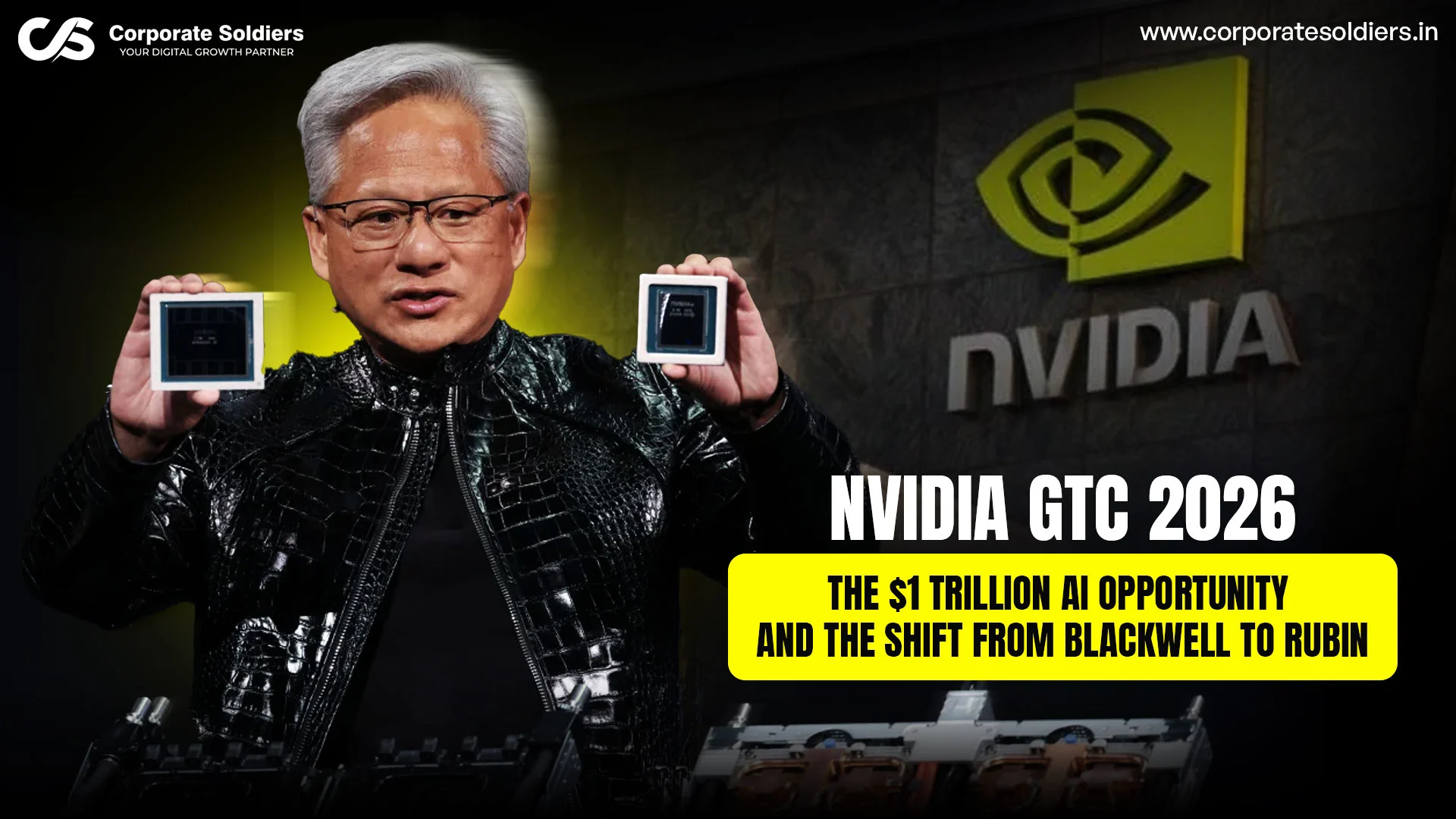
Historically, the Nvidia GTC (GPU Technology Conference), has been the platform where Nvidia has announced the future of accelerated computing, artificial intelligence and global data-center architecture. Jensen Huang, CEO of Nvidia, speaking at GTC 2026 in San Jose, indicated a turning point in the development of AI infrastructure – one that marks a shift in industry focus from generative model training to large-scale AI inference workloads and sets an ambitious outlook for the years ahead.
The $1 Trillion AI Market Opportunity
In 2026, Nvidia changed its long-term expectations of AI-related computing demand, forecasting a potential AI infrastructure opportunity exceeding $1 trillion for its next-generation AI chips and systems, the first time it had indicated demand over $500 billion by 2026. This new forecast effectively doubles Nvidia’s earlier estimate, underscoring the rapid acceleration in enterprise AI adoption.
This projection focuses on the demand for Nvidia’s Blackwell and new Rubin architectures through 2027. Huang indicated that approximately 60% of this demand is expected to come from hyperscalers and large cloud providers seeking to support real time AI services and responsive AI applications.
The dynamics of cloud adoption and the accelerated maturity of generative AI make a computing economy, where businesses are increasingly investing in infrastructure capable of supporting next-generation AI workloads, in particular, those that react to user manipulations, but not just train models. Huang emphasized the fact that the industry no longer focused on training-only deployments; it has shifted to systems that have to reason, think, and produce at scale.
What the $1 Trillion Forecast Means for Your AI Bill
The projected $1 trillion AI infrastructure opportunity is not just a measure of market size, but also a signal of changing economics in AI deployment. As Nvidia continues to optimize architectures like Blackwell and Rubin for inference workloads, the cost of running AI models is expected to decline significantly on a per-token basis.
For businesses, this means lower operational costs when deploying AI at scale, particularly for real-time applications such as customer support, recommendation systems, and automation workflows. A reduction in cost per token directly improves return on investment for enterprise AI adoption.
For startups and developers, this reduces the barrier to entry, making AI applications more scalable and cost-efficient.
AI Inference: The Next Major Battleground
Although Nvidia has been a powerhouse in training AI, where a hardware accelerator is used to create AI models, GTC 2026 was about strategizing to focus on AI inference, the stage where an AI model is used to execute tasks in applications in the real world. Jensen Huang called this phase the “inflection point of inference,” placing it at the heart of the second age of AI computing. The industry is now shifting from model development toward large-scale, real-time deployment for ubiquitous use.
Simply put, inference is what facilitates the calculation involved in the generation of responses by the AI systems, predictions, or ongoing analysis in the production environments. This change is indicative of the understanding that low latency inference workloads that are sustained (conversational AI, personalization engines, and autonomous systems) are becoming the most important commodities in computing demand. The comments made by Huang highlighted that the requirement of inference workloads was incompatible with training and forced Nvidia to innovate both in hardware and software.
GTC 2026 in Plain English
- Inference: When an AI system generates responses or performs tasks in real time
- Token: A unit of text used by AI systems for processing and billing
- AI Infrastructure: The hardware and systems that power AI applications
- Inference Cost: The cost required to run AI models at scale
LPU: A specialized processor designed for extremely fast AI inference
Agentic AI: AI systems that can perform tasks independently, not just respond
Nvidia’s Chip Evolution: From Blackwell to Rubin
Blackwell represents Nvidia’s current-generation architecture for AI compute workloads. It forms the basis of the current Nvidia GPU product range deployed widely by cloud-based providers and business systems. Nevertheless, the strategic shift of the company, toward Rubin, the next-generation microarchitecture of Nvidia that will be more widely deployed in the second half of 2026, was highlighted in GTC 2026.
Rubin is a next-generation microarchitecture that significantly increases AI performance, especially for inference workloads. It is designed to provide better throughput and efficiency than Blackwell using the development of high-bandwidth memory, optimized FP4 performance, and tight integration with Nvidia’s Vera CPU platform.
Rubin is an architectural enhancement that is aimed at reducing the cost of inference per token – one of the most important data center metrics in executing large-scale AI services – and increasing the overall compute capacity. The improvements in Rubin build on Blackwell’s strengths, enabling the newer architecture to handle higher sustained loads with significantly reduced energy and other overhead costs. Nvidia has also highlighted significant gains in performance efficiency with its next-generation systems, with the Vera Rubin platform—combining the Rubin GPU and Vera CPU expected to deliver substantial improvements in performance per watt compared to its predecessor.
Should You Wait for Rubin? A Gamer’s Upgrade Guide
| If you own | And want to play | Recommendation based on GTC 2026 |
| RTX 4090 | 4K / 144Hz | Wait for Rubin; DLSS 5–driven AI rendering could be a major breakthrough (similar to a ‘GPT moment’ for graphics), making future GPUs significantly more powerful |
| RTX 3070 | 1440p / 60Hz | Consider upgrading to Blackwell; better availability and performance |
AI-based rendering improvements, especially the expected evolution toward DLSS 5, could mark a major leap in graphics technology similar to a “GPT moment” for gaming—making upgrade timing a far more strategic decision for gamers.
Gamers may want to delay upgrades depending on their current setup and performance needs, as the next generation could bring a significant leap.
Quick-Start Guide to Building Your First AI Agent with Nvidia Tools (e.g., NemoClaw)
For developers and AI enthusiasts, Nvidia’s evolving ecosystem opens new opportunities to build real-time AI applications. Using Nvidia frameworks such as NemoClaw, developers can begin experimenting with agent-based systems.
A practical starting point includes:
- Exploring Nvidia’s AI development frameworks and tools
- Using cloud-based GPU infrastructure to experiment with AI workloads
- Building small inference-based applications to understand real-world performance
- Gradually developing agent-based systems capable of executing tasks autonomously
As the industry shifts toward inference-driven computing, developers focusing on real-time AI deployment will be better positioned to leverage emerging advancements. Developers should begin experimenting with real-time AI deployment now to stay ahead of this shift.
Strategic Positioning of Nvidia in AI Infrastructure
The approach of Nvidia remains dependent on its unified ecosystem of AI hardware, starting with GPUs and CPUs all the way to system software and data-centre scale infrastructure. Nvidia, via its roadmap, is establishing its infrastructure as a fundamental facilitator to cloud providers, enterprise AI implementations and AI-centric industries.
The efforts of the company demonstrate a deep involvement of the key hyperscalers and partners, with Vera Rubin–based cloud instances expected to be deployed in 2026. This places Nvidia at the center of AI inference infrastructure demand – a market that is set to expand fast as AI use cases expand into industries.
Industry Implications
The inference-based roadmap of Nvidia has wide-ranging implications in the AI ecosystem. In the case of cloud providers, optimized inference hardware implies that it is possible to provide responsive AI at scale at a reduced cost and improved performance. In the case of startups and enterprises, this change in hardware will make AI applications more accessible and will allow the creation of new areas of innovation in real-time data processing and autonomous systems.
Competitors and complementary technology providers must change as Nvidia bolsters its infrastructure leadership. CPU providers, custom accelerator designers, and AI service providers are all starting to refocus their business approaches to the emerging influence of inference workloads, which was in part triggered by the announcements of Nvidia at GTC 2026.
In the future, the AI roadmap as broadened by Nvidia, starting with the Blackwell to Rubin and beyond transformation, is an indication of a wider change in the way the industry designs, implements, and designs, deploys, and scales intelligent systems. These trends are creating a foundation to a future where inference performance efficiency and cost will define the next generation of AI-based enterprise transformation.
Threat or Opportunity? Industry-Level Impact of Nvidia’s AI Roadmap
| Industry | GTC 2026 Signal | What It Means for You |
| Ride-Hailing | Nvidia Drive AV adoption | Robotaxis may become mainstream in major cities |
| Auto Manufacturing | Growth in Level 4 autonomous vehicles | Future cars may become fully self-driving |
| Cloud Computing | $1T infrastructure demand | AI services may become faster and more affordable |
| Gaming | AI-driven rendering (DLSS evolution) | Major leap in gaming realism and performance |
My Key Takeaway & What I’m Watching For
The most important signal from GTC 2026 is the shift toward inference-driven computing. While advancements in architectures such as Rubin are significant, the real transformation lies in making AI faster, more efficient, and more accessible in real-world applications.
The other important pattern is the development of the AI infrastructure that is not confined to the classical data centers. The idea of space-based AI infrastructure (such as Vera Rubin Space One) can be rather futuristic, yet it demonstrates the desire of Nvidia to take computing outside the box. This indicates that the future will be more decentralized and scalable in computing to allow AI to work in a variety of settings.
Going forward, I’ll be closely watching which AI applications become significantly faster and more cost-efficient first, as this is where immediate value for businesses and consumers will emerge.