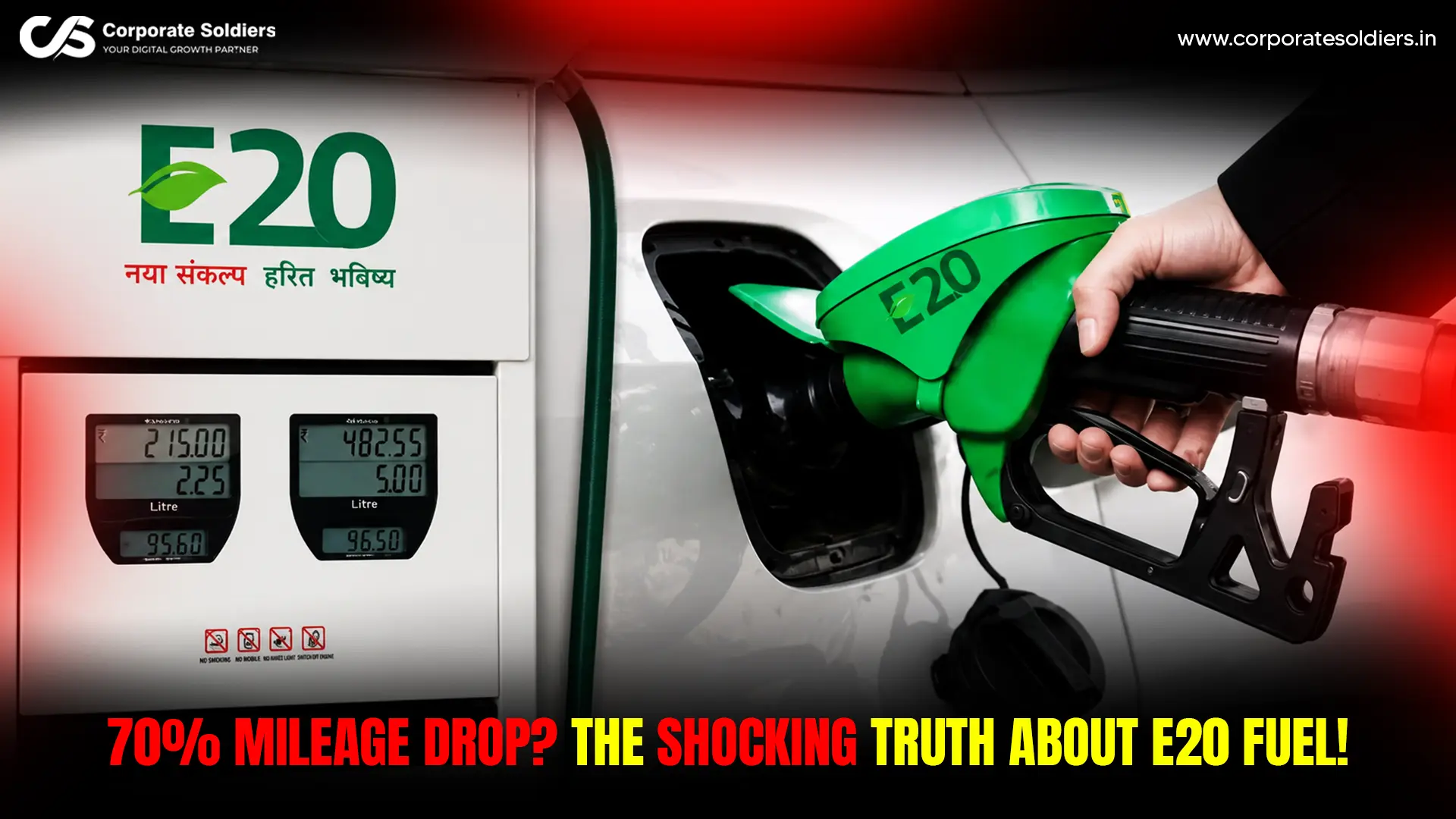
A recent social media scandal about a Mercedes-Benz GLC 300 has caused another social media debate in India on the adoption of E20 petrol. The viral assertion was that the fuel consumption of the luxury SUV dropped to 5 km/l right after fueling with E20 fuel, as opposed to about 17 km/l, which is what the vehicle consumes during its normal fuel consumption. This raised the issue of the potential harm of ethanol-blended petrol to high-end vehicles.
The event swiftly spread in the auto boards, social media and chat rooms. The story seemed to confirm the anxiety of many vehicle owners, especially those who drive luxury cars that ethanol blending will cause them to lose their engines, their fuel economy, and their reliability in the long run.
It is important when the controversy takes place. India is already undergoing one of the largest ethanol blending schemes in the world in an effort to secure her energy and reduce emissions. As a result, any argument, which holds that E20 petrol has devastating effects on the performance of vehicles, garners a lot of interest.
But as far as engineering goes, a very important question arises:
Is it really luxury engines that are being harmed by E20 fuel or is it misunderstanding and misinformation that is driving the controversy?
Answering that question, one should consider the chemistry of fuels, thermodynamics, vehicle calibration, regulatory guidelines, and contemporary engine diagnostics instead of basing his/her answer on anecdotal experiences.
Understanding E20 Fuel
E20 petrol is defined as gasoline containing no more than 20% volume of ethanol mixed with normal petrol that comprises about 80%.
Ethanol is a renewable fuel that is produced as an alcohol in most cases using sugarcane, maize, spoiled food grains and agricultural feedstocks. India has been gradually raising the percentage of ethanol blends over the last ten years, shifting away from single-digit blends, toward national E20 usage.
There are a number of strategic goals behind the policy.
Energy Security
India is a big importer of its crude oil needs. Increasing the domestic production of ethanol will reduce reliance on imported petroleum products and enhance resilience to energy.
Reduction of Foreign Exchange Outflow
Increasing the crude oil imports will result in decreased fuel import bill in the country leading to better macroeconomic stability and increased energy independence.
Environmental Objectives
The oxygen in the molecular structure of ethanol can lead to cleaner burning under specific operating conditions. Policymakers see the blend of ethanol as a part of a larger policy to limit the impact of transportation-related emissions.
Rural Economic Benefits
Production of ethanol generates new sources of revenue to farmers and agriculture industries which helps in developing the rural economies.
Ethanol blending is one of the pillars of the Indian energy transition strategy determined by the Ministry of Petroleum and Natural Gas, and the implementation of E20 is one of the milestones of the national roadmap.
The Official Position: Material Compatibility
Immediate engineering consideration when filling a vehicle with E20 petrol is the compatibility of materials. Ethanol is a strongly polar solvent which acts as a solvent aggressor against pure hydrocarbons. When used in non-compatible fuel systems, high levels of ethanol may lead to the degradation of elastomers, swell plastic parts, and galvanic corrosion in certain metals such as aluminum, zinc and brass.
In response to the viral arguments, Mercedes-Benz India released an official customer warning regarding its engineering and certification preparedness:
At Mercedes-Benz, the safety of customers, the performance and reliability of the vehicles is the most important thing to us. All Mercedes-Benz petrol BS VI vehicles are compatible with E20 fuel materially and certified by the relevant authorities.
Engineering Resilience of BS6 Architecture
Currently in India, original equipment manufacturers (OEMs) have gutted out their fuel delivery systems since the introduction of Bharat Stage 6 (BS6) emission regulations in April 2020. In a contemporary car such as Mercedes-Benz GLC 300, all the parts between the fuel tank and the combustion chamber are specially selected to be resistant to degradation of ethanol:
- Hoses and Lines: Multi-layered fluoroelastomers (including Viton) or more special polyamides have since been used instead of standard nitrile rubber lines to resist the swelling and cracking normally caused by the alcohol fuels.
- Seals and Gaskets: The seals on the fuel pump modules and injector are made of highly engineered synthetic polymers that are designed to resist tensile stresses and elasticity in the presence of highly polar solvents.
- Metallic Substrates: Fuel lines and fuel rail assemblies are either coated or made of anodized aluminum or stainless steel to avoid the micro-pitting and oxidation that are caused by moisture-retaining fuels.
Regulatory and Global Benchmarks
The Ministry of Petroleum and Natural Gas, and the Society of Indian Automobile Manufacturers (SIAM) have continually insisted that E20 fuel has gone through stringent validation to the provisions of Bureau of Indian Standards (BIS) (IS 2796). The government has made it clear that no certified BS6 vehicle is going to fail or be subject to catastrophic degradation in the case of standardized E20 fuel.
Decades of worldwide statistics bear this out. Ethanol blending is an established technology in the global markets:
- United States: E10 (standard pump gas) has long been required as the standard and E15 is commonly available and approved to all vehicles manufactured since 2001.
- Brazil: The nation has a compulsory minimum ethanol mixture of E27 (27% ethanol) in regular cars, and pure hydrous ethanol (E100) in flex-fuel cars.
- Europe: Major European manufacturers including Mercedes-Benz, BMW and the Volkswagen Group have extensive experience engineering vehicles for ethanol-blended fuels. Several BMW models in global markets have been certified for higher ethanol blends, including E25 compatibility depending on market specifications. These developments reflect the broader industry trend toward ethanol-compatible fuel-system materials and engine technologies.
The Science: Why a 70% Mileage Drop Is Impossible
Energy Density of Ethanol
The scientific issue relating to the mileage problem of Mercedes-Benz is the issue of energy density.
The fuel economy can be basically associated with the concentration of chemical energy in a specified amount of fuel.
Actual lower heating values are:
| Fuel type | Energy Density |
| Petrol | ~32–34 MJ/L |
| Ethanol | ~21–24 MJ/L |
Ethanol contains less energy per litre than petrol.
This fact is often cited as evidence that E20 must significantly reduce mileage. However, the actual mathematics tells a very different story.
Blending Mathematics
Assume:
- Petrol energy density = 34 MJ/L
- Ethanol energy density = 24 MJ/L
An E20 blend contains:
- 80% petrol
- 20% ethanol
Therefore:
E20 Energy Density
= (0.80 × 34) + (0.20 × 24)
= 27.2 + 4.8
= 32 MJ/L
Compared with pure petrol:
34 MJ/L → 32 MJ/L
Energy reduction:
≈ 5.9%
This is to say that the theoretical maximum of fuel economy improvement is typically on the low single digit scale.
This decrease can be partially compensated by optimized combustion control, ignition timing and adaptive fuel strategies, which could be made available by modern engine management systems.
Why a 70% Mileage Drop Is Thermodynamically Impossible
The viral statement implied a drop in the fuel economy, which was around 17 km/l to 5 km/l.
That is a decrease of about 70%.
To mix pure ethanol solely to get such a drop, E20 fuel would have to have much less chemical energy in it than the known fuel chemistry would permit.
Physics just does not lend that conclusion.
Ethanol blended with 20% cannot extract 70% of the accessible combustion energy.
With the worst-case theoretical assumptions, the energy difference between E0 and E20 is nowhere near enough to account for such a drastic mileage collapse.
The difference shows that there was another factor that was probably involved.
| Metric | Viral Claim | Engineering Reality |
| Expected Mileage Drop | 70% | 3%–5% |
| Suspected Cause | E20 | Mechanical fault, sensor issue, ECU fault, or fuel-quality issue |
The Correlation vs. Causation Problem
The main tendency of the so-called Mercedes-Benz mileage scare is a psychological bias that is called post hoc ergo propter hoc, the human tendency to believe that because something has happened after event A, the event A must have caused the event B. In this particular incident, the owner of the vehicle fueled his SUV and then a few seconds later, he saw an enormous drop on his dashboard computer and immediately reported the fuel.
Correlation in the context of engineering diagnostics does not mean causality. Follow up reports and discussions on the incident indicated that the incident might have been caused by a vehicle specific mechanical or electronic defect and not the E20 fuel itself. Although the specifics of the case do not play the central role in the discussion as a whole, the episode draws attention to the significance of professional diagnostics prior to forging the problems with performance on a specific fuel mixture. Contemporary cars are operating on sophisticated engine control and issues with sensors, fuel delivery system, ignitions, and computer tunings can have the symptoms that are misdiagnosed as fuel quality.
Potential Mechanical and Diagnostic Causes
When a luxury car, especially a modern car, suddenly and radically loses its fuel economy, a senior technician seeks certain hardware or sensor malfunctions:
- Oxygen Sensor / Lambda Sensor Failure: The ECU uses the upstream oxygen sensor to measure the leftover oxygen in the exhaust gas. Should this sensor malfunction or become clogged it can indicate a false lean condition. The ECU will then respond by pouring in too much fuel in the engine cylinders making the engine to run rich and reducing the mileage by a staggering margin.
- Mass Air Flow (MAF) / Manifold Absolute Pressure (MAP) Sensor Problems: The sensors are used to determine the mass of air entering the engine. Dust or oil vapor contamination leads to inaccurate readings, inaccurate fuel-injection calculations and extreme efficiency losses.
- Glitches with ECU Calibration Software: The very sophisticated maps of modern direct-injection turbocharged engines are glitchy. The ECU may be forced into a “limp-home” or rich safe-mode by a software glitch or a sensor is out of its acceptable operating range, preventing it from running at high efficiency.
- Fuel Injector Malfunctions: In case an injector sticks open or has a lack of atomization caused by inner debris, it will overfill the cylinder with raw fuel, lower fuel pressures and ruin economy indicators.
- Ignition System Misfires: Older spark plugs, or malfunctioning ignition coils allow incomplete combustion. The unburnt fuel is forced into the exhaust as is and the trip computer records the efficiency as incredibly low with the risk of thermal overloading of the catalytic converter.
The E10 Fuel Cap Confusion
Another commonly misinterpreted aspect by owners of premium cars is that of having an E10 label on the inside of the fuel filler cap of a vehicle that was manufactured between 2020 and 2023. The fact that this label is structural evidence that the filling of the vehicle with E20 fuel will result in instant mechanical damage is perceived as a truth by many owners.
This needs to be differentiated between material compatibility and software optimization:
- Material Compatibility: Mercedes-Benz India has stated that its BS6 petrol models are materially compatible with E20 fuel. However, owners should always follow the latest manufacturer guidance for their specific model and production year.
- Software Optimization: E10 fuel cap label is the particular fuel standard to which the factory ECU of the engine was actually calibrated and certified in the course of the emissions testing.
A closed-loop control system of the engine finds it easy to control the transition when a vehicle with an E10 calibration is filled with E20. The increasing content of exhaust oxygen (because of increased ethanol content) is picked up by the oxygen sensors. The ECU corrects itself by changing its long-term fuel trims (LTFT), by slightly increasing the fuel injector pulse width to ensure the right stoichiometric air-fuel ratio.
Although the vehicle is safe in its operation and the structural parameters are safe, it might not be optimized to achieve maximum thermodynamic efficiency of the E20 blend. The new models also have revised ECU software maps that maximize the cooling characteristics and high octane rating of E20 fuel that helps in reducing any slight deficits in mileage.
Fuel Adulteration Risks in India
Although ethanol, in itself, is not a problem to compatible vehicles, quality of the fuel remains a crucial factor.
Water Contamination
Ethanol is hygroscopic i.e. it takes in moisture that is in the surrounding environment.
The over contamination of water can have adverse implications on the quality of fuel.
Ethanol Hygroscopic Properties
In cases where the fuel handling systems are not well maintained, the moisture that is absorbed can lead to issues in its operation especially in long storage durations.
This is the reason why the fuel logistics companies enact very stringent quality-control measures.
Storage Practices
The quality of fuel is very much dependent on:
- Tank maintenance
- Storage infrastructure
- Distribution controls
- Water monitoring systems
Low Turnover Fuel Stations
Stations that have a low rate of fuel turnover can have more difficulties in ensuring maximum fuel is in fresh condition than large volume outlets.
This is why a large number of professionals suggest buying gas at well-known large-volume stores of the large fuel producers.
The problem with such cases is not the chemistry of ethanol but the quality management of the fuel.
Should there be an abrupt decline in the mileage:
Actionable Troubleshooting Guide for Vehicle Owners
Step 1: Verify Fuel Quality
- Fill up with a good station.
- Retain fuel receipts
- Trends of document fuel consumption.
- Monitors engine performance.
Do not count on one-tankful of gasoline.
Step 2: Check Sensors
Check important engine-management gauges such as:
- Oxygen sensors
- MAF sensors
- MAP sensors (where necessary)
Before it begins causing some evident drivability, sensor faults often impact fuel economy.
Step 3: Run ECU Diagnostics
Carry out a skilled diagnostic scan.
Review:
- Fuel trims
- Stored fault codes
- Oxygen sensor activity
- Airflow readings
- Misfire counts
The answers given by modern diagnostics are much more reliable as compared to anecdotal observations.
Step 4: Visit Authorized Service Centres
Luxury cars have advanced engine control systems.
Technicians, authorized by the manufacturer have access to:
- Factory diagnostic tools
- Technical service bulletins
- Software updates
- Engineering support resources
When there are considerable changes in fuel economy, then professional analysis is required.
Step 5: Monitor Long-Term Fuel Trends
Significant fuel economy analysis needs:
- Multiple refueling cycles
- Consistent driving conditions
- Comparable traffic environments
- Long-term observation
Single trip calculations often give false inferences.
The Future of E20 in India
The ethanol project in India is not just about mere blending.
National Ethanol Roadmap
Through concerted actions involving: the country is gradually moving towards wider use of ethanol.
- Vehicle manufacturers
- Fuel suppliers
- Agricultural stakeholders
- Regulatory agencies
Flex-Fuel Engines
Powertrains in the future should be able to handle broader ethanol blends, such as much higher ethanol blends.
Flex-fuel technology has already proved to be successful in other markets like Brazil.
OEM Adaptation Strategies
Manufacturers are implementing:
- Ethanol-resistant materials
- Improved fuel system parts.
- Advanced combustion strategies
- Adaptive ECU calibrations
These enhance compatibility and performance of different fuel compositions.
Future Calibration Improvements
With the growing use of E20, OEMs will further optimize software calibrations to:
- Fuel economy
- Emissions performance
- Cold-start behavior
- Driveability characteristics
The long-term trend implies that more technologies that are friendly to ethanol will be integrated as opposed to abandoning ethanol blending.
Closing Thoughts
The viral uproar surrounding the Mercedes-Benz GLC 300 mileage drop serves as a case study in how social media narratives can misinterpret engineering facts. Thermodynamic principles indicate that a standardized E20 blend alone cannot realistically account for a 70% reduction in fuel economy. As field data and the vlogger’s eventual retraction confirm, large changes in fuel economy are caused by genuine mechanical or electronic component failures rather than standardized ethanol blends.
For modern luxury car owners, the takeaway is clear: E20 petrol is a thoroughly validated, scientifically safe fuel choice for all compatible modern vehicles. Ensuring optimal engine health relies on regular maintenance and sourcing fuel from high-turnover retail outlets. In an era of shifting fuel technologies, driver diagnostics and sound engineering facts should always carry more weight than unverified online claims.
Frequently Asked Questions (FAQs)
- Does Mercedes-Benz have a safe E20 fuel?
Yes. Mercedes-Benz All petrol vehicles that meet the BS6 emission standards (since 2020) are fully certified and can be materially compatible with E20 fuel. Their engine components, fuel lines, and seals are designed to be able to resist the chemical properties of 20% ethanol mixtures.
- Will E20 hurt the luxury car engines?
No, there will be no harm of a standardized E20 fuel to a compatible luxury car engine. Only in the event of high-ethanol blends, or in the event of the high-ethanol blends being used in older, non-compatible pre-BS6 vehicles, and in the case of highly contaminated water in the fuel at the retail outlet, damage is likely to occur.
- Is E20 decreasing mileage?
Yes, but it is only a slight decrease. Because of the low-energy content of ethanol, an E20 mixture causes a minor penalty of 3-5 percent on the fuel economy. Any abrupt reduction below this range is an indication of mechanical problems or bad fuel quality.
- Why will ethanol decrease the fuel economy marginally?
The bound oxygen molecules present in ethanol make it contain about 34% lower energy per unit volume as compared to pure gasoline. When mixed with 20 percent the total energy content of the fuel is reduced by about 6.8 per cent and this leads to a slight decrease in volumetric efficiency.
- Are E20 compulsory in India?
E20 petrol is being rolled out across India as part of the national ethanol blending programme. Availability and implementation vary by region, fuel supplier, and vehicle category.
- Can E20 fuel be used in old cars?
Some older vehicles not designed for higher ethanol blends may experience accelerated wear of certain fuel-system components over extended periods. The owners of old or old cars are advised to monitor the condition of their fuel lines or use high-quality high-octane fuels which have lower ethanol content with varying concentration rates depending on the situation on the ground.
- What do I do to detect the fuel adulteration?
Water contamination normally leads to adulteration with instant engine symptoms that are rough idling, extreme hesitation during the acceleration, sputtering, or lighting up of the Check Engine light. A physical fuel sample of a phase-separated tank will either appear cloudy or will have a clear water layer at the bottom.