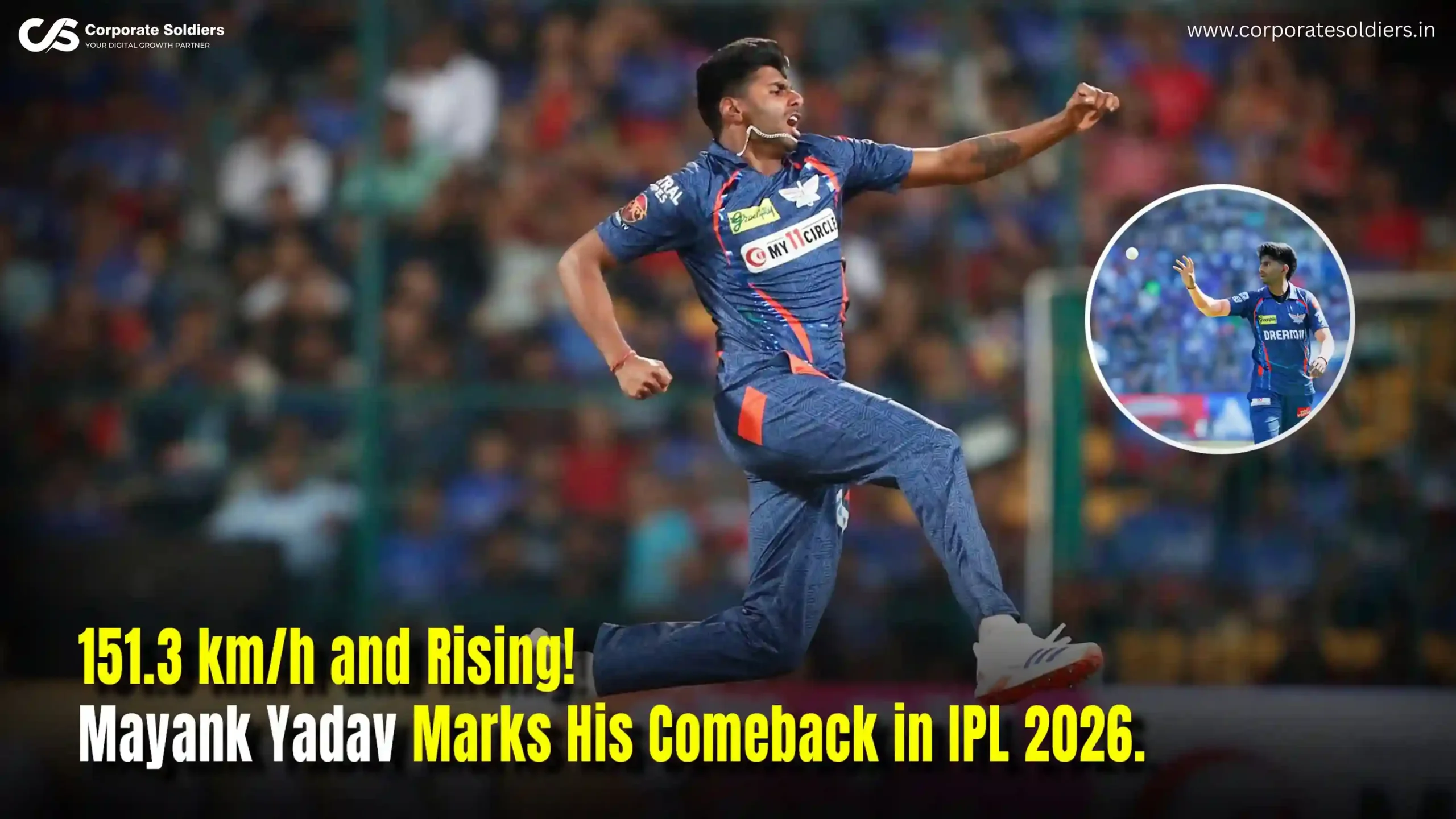
The news that Mayank Yadav would be back playing in the IPL 2026 was met with great expectations, especially after a long break of 353 days out of the field due to injury. All the attention was on the young fast bowler and his reception in the highly competitive Lucknow Super Giants/Rajasthan Royals game as it was almost a year since he had played at such a high level.
Although the game delivered both positive and negative results, there was one thing that was very evident and that was his speed had not deteriorated. But, predictably after such a long break, match fitness, rhythm and consistency issues soon arose into the limelight. Dominance was not the main theme of his comeback; restoration was.
The broader takeaway from his comeback is that Mayank Yadav still possesses elite pace potential, but returning to full effectiveness will require time, workload management, and tactical refinement.
The Speed Gun Highlights
The speed at which Mayank Yadav would bowl was one of the most anticipated factors in the IPL 2026 comeback and the numbers just validated him as being among the fastest bowlers in contemporary cricket.
The highlight came when he delivered a ball at 151.3 km/h delivery (among fastest of the season), which was one of the fastest deliveries of the season, reinforcing his elite pace credentials. What was more promising to his camp was the regularity of speed at the beginning of his spell- he touched 150 km/h multiple times in his very first over and this shows that his mechanism of pace has not been broken.
This performance was the natural one which could be compared to his former high. Even ahead of IPL 2024, Mayank was already in the news as he had recorded the fastest speed of his career of 156.7 km/h making him one of the fastest bowlers in the world.
The crucial lesson of this outing is very important: although his injuries have caused a lengthy pause in his training, there is no apparent loss of his maximum speed limit. As per Mayank Yadav Speed, the statistics affirm that his raw pace remains at the global level.
Key Takeaways (TL;DR): Mayank Yadav’s High-Speed Return
- The Big Return: After a 353-day injury layoff, Mayank Yadav finally returned to the field for LSG in their clash against Rajasthan Royals.
- Elite Speed Intact: He silenced doubts about his recovery by consistently hitting 150+ km/h, with his fastest ball of the night clocking 151.3 km/h.
- Reality Check: While the pace was there, the precision was missing. Mayank finished with expensive figures of 0/56 in 4 overs, highlighting significant match-rustiness.
- Pace vs. Precision: Rajasthan Royals’ batters expertly used his velocity, proving that raw speed without consistent line and length is a liability on flat IPL tracks.
- Physical Fitness: The most positive sign was his ability to bowl at full tilt without visible discomfort, suggesting his biomechanical recovery is complete.
- Looking Ahead: For Mayank, this match was about calibration, not dominance. LSG will likely focus on his rhythm and death-over execution in the coming games.
The Performance Breakdown (Reality Check)
The speed measures were impressive, but there was a more complicated picture with the overall performance in bowling.
Mayank Yadav concluded his spell with 4 overs, 56 runs, and 0 wickets, highlighting how raw pace alone does not translate into effectiveness at the elite level.
His costly spell was due to various reasons:
- Loose deliveries under pressure: Batters capitalized on a few fast but inaccurately placed balls.
- Batters acclimatizing to the raw pace: the Rajasthan Royals squad seemed to be set up to deal with his pace through depth in the crease, and controlled aggression.
- Tactical execution issues: The variations in the length, and line were not consistent and this minimized the accumulation of pressure.
This indicates that it was not a decline in talent, but rustiness after a lengthy competitive layoff. Fast bowling requires a high level of muscle memory accuracy and even a slight failure in performance may be severely penalized on IPL level.
It would be more of recalibration than dominance in terms of performance as Mayank Yadav vs Rajasthan Royals was concerned.
The Journey Back (Injury & Recovery)
The background to this comeback that is the most significant is the 353-day comeback period that led to this comeback. To a fast bowler who is subjected to such a lengthy layoff this is not just a physical challenge, but also a biomechanical and psychological one.
Bowling that is fast results in a lot of stress to:
- Lumbar spine
- Hamstrings and quadriceps
- Shoulder rotation systems
- Explosive load stability (core).
In the case of bowlers who belong to modern Indian Fast Bowlers, there is a slender line between the optimum performance and injury re-occurrence. The fact that it is continuously possible to maintain speeds more than 150 km/h raises the performance value and the risk of injuries.
The psychological aspect is also noteworthy. Full-force delivery is usually subconsciously inhibited in returning bowlers particularly during competitive games such as the IPL. Nevertheless, the fact that Mayank was able to breach 150 km/h at the moment implies that he was well-prepared psychologically, alongside his physical recovery.
The Mayank Yadav Injury Comeback is therefore not only a way of rehabilitating, but also rejoining one of the most challenging positions in the game of cricket.
Looking Ahead (Future Prospects)
As a team management, this comeback offers not only reassurance but also has definite development goals.
The overlaying conclusion is that Mayank remains a high-impact asset in terms of pace, but requires to be exposed to work and in phases to be fully productive.
Some of the areas of improvement are:
- Consistency of line and length: It will be essential to minimize the number of concessions of boundary deliveries.
- Control under pressure: Developing the ability to maintain pressure with the ball in multiple deliveries, as opposed to single fast deliveries.
- Development of variation: To supplement the raw pace, improvement of slower balls and seam movement.
The history of cricketing indicates that fast bowlers who had taken a long break before coming back, usually needed a series of matches to get back in rhythm. As soon as timing and coordination are restored, the bowlers of the profile of Mayank are usually able to transition rapidly from being expensive to becoming a match-winning threat.
He can still be a good candidate to be a decisive strike bowler in future IPL matches considering his ceiling.
The broader context of the Fastest ball in IPL 2026 debate will still have him at the center stage should he stick to the same range of velocities whilst learning how to control it.
Final Assessment: The Comeback Trail
The reappearance of Mayank Yadav in IPL 2026 did not have any statistically significant effect, but had significant symbolic and strategic implications.
Although the numbers, 4 overs, 56 runs, no wickets, present a poor scorecard, the story behind the scorecard is not as simple. The fact that he has been able to sustain 150 km/h and has been able to achieve 151.3 km/h, indicates that his core weapon is still in full functionality.
The comeback strengthens one important aspect in the contemporary game of cricket: it is not the speed that is necessary but when it is accompanied by smoothness and rhythm it becomes the game-winning weapon.
Mayank Yadav is a unique breed to the fast-bowling ecosystem of India as he has remained an out-and-out pacer with the ability to transform the game dynamics with sheer pace.