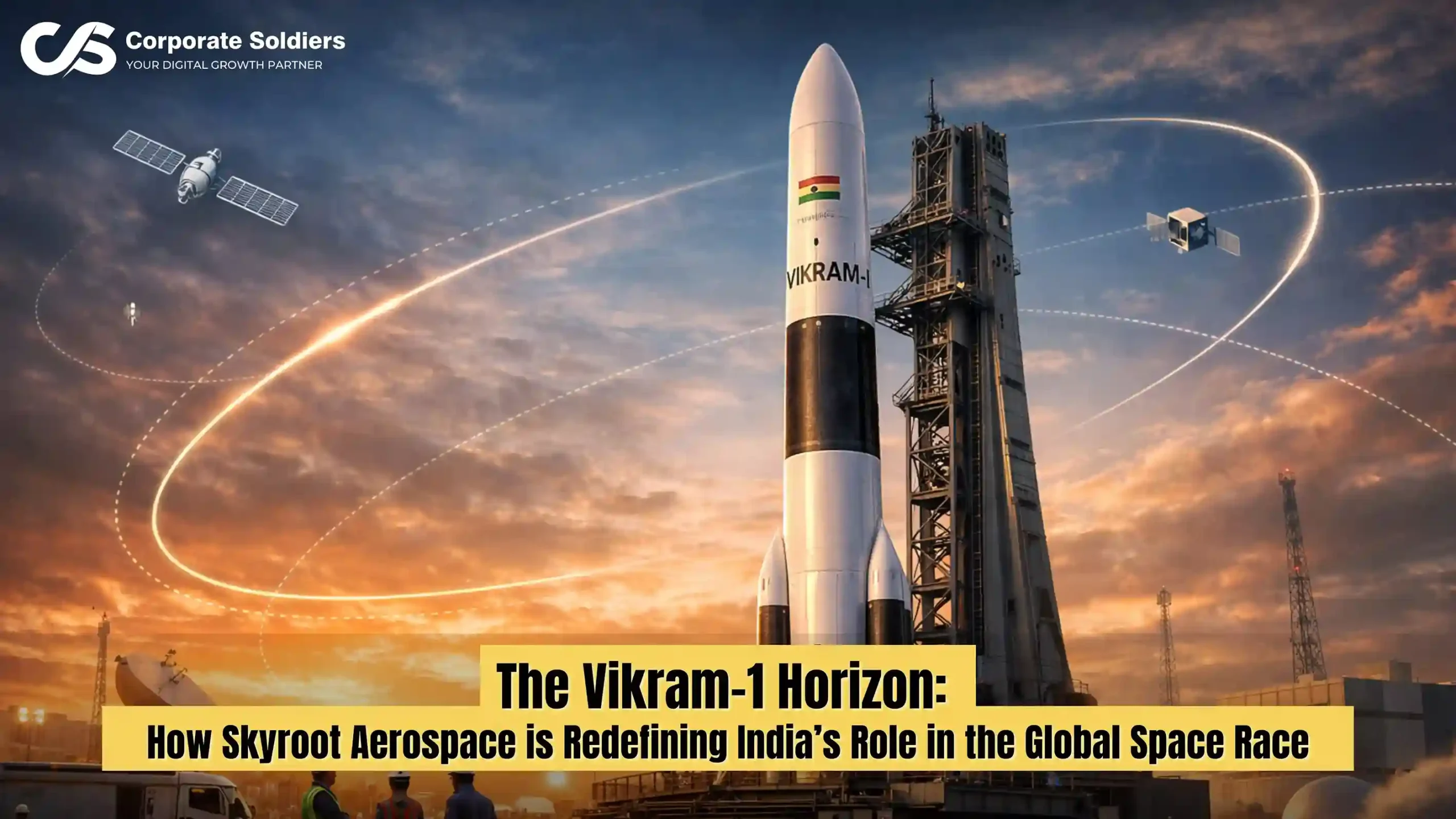
The Indian space industry is changing its structure. The Indian Space Research Organisation (ISRO) has decades of successes and now a vibrant ecosystem of private space is being complementary to its long-established legacy policy-driven, entrepreneurial, and global market opportunity. The heart of this development is Skyroot Aerospace and its launch vehicle of orbital level, Vikram-1. Planned as the first privately developed rocket in India to reach space, Vikram‑1 represents not only an engineering achievement but also a strategic and economic milestone for India’s emerging space economy.
Background: India’s Emerging Private Space Industry
Throughout most of its history, India had an access to space, which was propelled by the low-cost and scientifically ambitious missions of the state space agency of India, which is ISRO. Nonetheless, this has changed since 2020 with the establishment of the Indian National Space Promotion and Authorisation Centre (IN-SPACe) and the liberalisation policies since then, the space sector began to be accessible to the private sector. These reforms will enable the private firms to design, construct, and operate space systems, such as the vehicles of launches, satellites, and downstream uses. This regulatory change has triggered a surge in the Indian space startup and investment inflows, which have seen India become one of the fastest-growing space ecosystems in the world.
We now see the emergence of private companies throughout the space value chain, designing satellites and developing data analytics and propulsion systems and launch services, introducing a commercial energy to the long-standing government-oriented space processes in India. It is not an open system that is designed to substitute scientific and interplanetary missions of ISRO but a system that is organized to increase national capacity and provide an additional industrial base.
Skyroot Aerospace: The Startup that is Fueling Innovation
Skyroot Aerospace is a private space company based in India and is a flagship of the Indian private space movement, which was founded in 2018 by former ISRO scientists. The company is an example of how entrepreneurship can help to speed up national capabilities with massive funding, state-of-the-art facilities, and emphasis on state-of-the-art propulsion and manufacturing. The Skyroot rocket development campus integrated in Hyderabad is one of the largest privately owned aerospace campuses in India and an indicator of the level of technical prowess and technological infrastructure that is being developed in the industry.
Skyroot plans to launch Vikram-S, the sub-orbital rocket of the company, and this route currently penetrates Vikram-1, the first commercial orbital launch vehicle operated by a company (Gus, 2016). Another factor that contributes to the expansion of the startup is the cooperation with the international partners who introduce the services of international launch and mission integration to the Indian market.
Inside Vikram‑1: Technology and Capabilities
The Vikram Launch Vehicles are modular rockets called Vikram in honour of Dr Vikram Sarabhai, the father of the Indian space programme. They are small satellite oriented designs with modern materials, advanced projections and adaptable mission profiles. The Vikram-1, the first of the series to have orbital capability, demonstrates some of the main technological advances:
- Carbon-Composite Construction: The body of the rocket is made of the all-carbon-fibre material, decreasing the mass of the structure at the same time as keeping its strength high, which enhances performance and saves time during manufacturing.
- 3D -Printed Engines: Additive manufacturing reduces engine weight by approximately 50% and cuts production lead times by up to 80%, enabling rapid development and scalability.
- Payload Capacity and Flexibility: Vikram -1 is designed to switch between payload of up to ~350kg to Low Earth Orbit (LEO) to Sun-synchronous Orbit (SSO) with several mission variants being available including dedicated launches, rideshare, and multi-orbit.
- Quick Turnaround: The design and infrastructure considerations of the vehicle would enable assembly and launch in less than 24 hours at the location of an appropriate launch site, something that could be a game changer in turnaround response to orbit.
These abilities also match the requirements of a booming small-satellite market and reflect the level of sophistication that is currently being introduced to space launch technology by the privately owned firms in India.
The Small Satellite Launch Market Why It Matters
The expanding use of small satellites, low costs, compact communication, Earth observation, remote sensing, and other emerging satellite applications such as the IoT are all driving global space economic development. Analysts estimate that the world market in small satellite launches might be a multi-billion dollar industry within the next 10 years, fuelled by both commercial and government clients. The vehicles designed to launch into this segment have dedicated and agile access to certain locations in orbit that are not necessarily available through larger and more traditional rockets.
In the case of India, creating local launch capacity in this segment implies value capture that would go to overseas launch vendors. It also enhances national sovereignty in access to space, lessens reliance on foreign vendors and local skills which are transferred to larger aerospace manufacturing and research systems.
Impact on India’s Space Economy and Global Competition
The introduction of the services of a private launch has strategic and even economic consequences. It has within its country generated high-skilled employment, has drawn venture capital and has also created ancillary industries around it including materials science, avionics and satellite services. The space sector in India has been experiencing an increase in the rate of investment, with large funding cycles aiding in the management of startups and infrastructure.
On an international level, the emergence of the Indian private launchers, like Skyroot, puts India in direct competition with other established small-satellite launch operators including the Falcon 9 rideshare market offered by SpaceX, Electron offered by Rocket Labs, and other new entrants. The competitiveness of India in terms of cost, coupled with responsive launch services, might make it a favorite location to global satellite operators who would need cheap and timely access to orbit.
As a strategic measure, a successful private space industry can make a country more resilient. It complements ISRO’s science-based agenda, provides redundancy in the launching capabilities, and is part of national security as space continues to assume a central role in communications, navigation, and defence.
Conclusion: Future of privatized space launch in India
The launch of Vikram‑1 and the emergence of startups like Skyroot Aerospace are landmark events in India’s space history. This shift from a government-dominated model to a collaborative, innovation-driven ecosystem that is innovation-driven indicates a wider trend that is redefining the space industry around the world. In promoting competitive national businesses, India is establishing a bigger presence in the small-satellite launch sector as well as strengthening its strategic independence and economic possibility.
With Vikram -1 on the verge of its maiden launching and more versions set to occur in the future with more capacity and capabilities, India is set to be a major player in the global economy of space. The private launch service success will not only open up new business opportunities but also make the current aerospace industry in the country encourage the upcoming generation of innovators and entrepreneurs.
Subscribe on LinkedIn