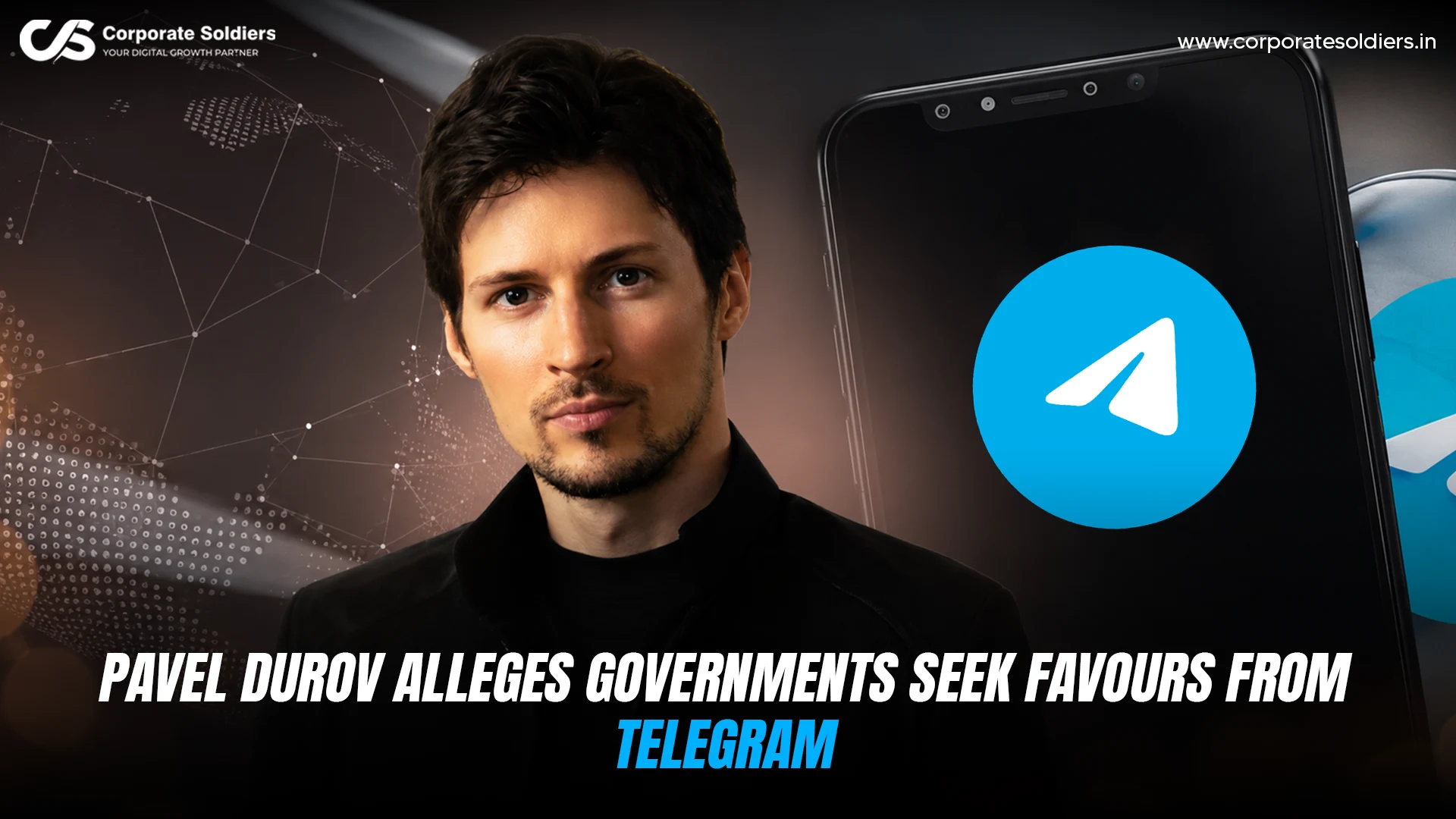
In a statement published on X and Telegram, Telegram founder Pavel Durov alleged that governments in different parts of the world have privately approached the platform with requests for political cooperation.
Durov made the statement on the second anniversary of his arrest by French authorities in Paris in August 2024. Durov questioned the continued French investigation and suggested that it could have a political dimension, comparing the case with regulatory actions he associates with authoritarian regimes.
The accusations reflect a growing tension between tech giants of the world, state sovereignty, and privacy of users and the content regulation, which raises the essential questions of the digital freedom and access of law enforcement.
What Pavel Durov Alleged
Durov published a statement on his Telegram channel indicating that two years prior, he was detained in Paris and that the case of the investigation of Telegram by the French was still open. He was wondering why Telegram was the only platform to be targeted by stating that the moderation and collaboration with the authorities were not always worse than the ones of other large platforms.
Then, Durov claimed that during the last two years, a trend had been observed in various countries. He alleged that governments had covertly pressured Telegram into giving him, according to him, political favours, such as censorship and surveillance, which he said was illegal.
Durov says that in certain instances, Telegram refused to act on such requests, which were then succeeded by campaigns in local media and by non-governmental organisations which depicted the platform as a significant source of crime. He mentioned in particular child sexual abuse material charges and terrorism charges.
Durov also asserted that the authorities later put more focus on criminality and child welfare in the case of platforms which had declined such requests. He contrasted this with the platforms which in his opinion had accommodated government arrangements but still could suffer less serious problems. Durov includes these comparisons in his argument and they have not yet been determined as a general trend among technology firms.
He, too, raised the question of whether the French inquiry into Telegram was political, that it follows the pattern which he thinks is evident elsewhere. That is not a finding that the case in France was made by Durov but an allegation.
Why Telegram’s Independence Is Central to the Issue
Telegram has long positioned itself as a platform focused on privacy, security and freedom of expression. Its policies, however, do not mean that all content is exempt from moderation, nor does the company reject every government or legal request.
The difference between the illegal content and politically undesired content is the major point of contention as it is. A government can be reasonable in asking a material to be removed because it is a crime, whereas a platform can complain when a removal request seems to be aimed at censoring a legal political expression.
It is important that in the case of Telegram, such a difference is especially important due to the ability of its public channels and large groups to spread information to large audiences. Simultaneously, the wide audience of the platform has seen it become a subject of criticism due to illegal content, misinformation and other types of abuse.
The Terms of Service of Telegram themselves forbid a number of different types of behavior, such as spam, scams, promotion of violence and illegal publicly available pornography.
Telegram and Government Pressure: Broader Context
The relationship of Telegram with state regulators has been controversial in the past in various jurisdictions:
- Russia (2018-2020): Russian telecommunications regulator Roskomnadzor tried to block Telegram in the country, after Russian authorities demanded access to encrypted communications and Telegram refused to comply with the FSB’s demands. In June 2020, Russia lifted the block after Roskomnadzor said Telegram had demonstrated a willingness to cooperate in countering terrorism and extremism.
- European Union & Germany: Telegram broadcasting has been under examination by European authorities numerous times under the Digital Services Act (DSA), assessing the need to have strict platform control over its broadcasting channels like with traditional social media networks.
Telegram has also pointed to its own moderation activity as evidence of its efforts to address illegal content. According to the platform’s Safety page, Telegram had blocked more than 23.6 million groups and channels in 2026, including 370,777 linked to child-abuse material and 164,099 linked to terrorist content.
Durov’s History With Government Pressure
The attitude of Pavel Durov towards governance of the platforms is based on his previous experience in Russia. He also founded VKontakte (VK) with a co-founder in 2006 that became the largest online social network in Russia.
After the mass political protests in 2011-2012, the Russian security services insisted that VK disband the opposition groups and give individual information on Ukrainian activists. Durov publicly declined to do so. In 2014, having been heavily pressured and losing control of VK to more state-oriented forces, Durov sold his remaining stake and fled Russia.
After his breakaway, he formed Telegram together with his brother Nikolai Durov and made the company so that it ran in inter-jurisdictions to avoid unilateral pressure by the state.
The Larger Conflict Between Governments and Technology Platforms
The allegations of Durov reveal a systemic conflict between the world technology platforms and the sovereign countries. Digital sources of communication are not restricted to national boundaries but still governments are governed by the national systems of laws that are aimed at preserving national order and security.
Tech platforms are experiencing conflicting demands by three different parties:
- Users: They will expect high-quality data security, end-to-end encryption, and no corporate/political surveillance.
- Governments & Law Enforcement: Demand access to communications data in law enforcement to address violent crime, human trafficking, financial fraud and national security threats.
- Regulatory Bodies: Require active content regulation to reduce hate speech, election interference, and illegal content according to local regulations.
In trying to straddle these conflicting needs, platforms are often torn between accusations of government overreach on the one hand, and accusations of corporate negligence on the other.
Privacy vs Government Access
The Telegram controversy is indicative of a larger technology-policy issue: secure communication can ensure legitimate privacy and it presents difficulties to law enforcement.
Journalists, activists, businesses, common users and political organisations use messaging platforms. Effective privacy controls can assist such users to avoid unauthorized monitoring and misuse of their data.
Meanwhile, governments claim that it is necessary to have lawful ways of information acquisition when platforms are involved in serious crimes. This can be done by authorities requesting subscriber information, metadata, content removal or other types of assistance as per the relevant law.
The privacy policy of Telegram recognizes that some of the information can be released as per a legitimate court-order in eligible criminal cases. It further states that the company does legal analysis of such requests.
The policy question is not then: should governments have access or should platforms deny access? Whether government demands are legitimate, reasonable and under proper judicial protection and whether technological firms ensure that they practice their policies in terms of uniformity.
What Is Known vs. What Remains an Allegation
In order to achieve journalistic objectivity, one needs to separate the facts documented and unverified assertions about the recent statements of Durov.
Established Facts
- In August 2024, in Paris, Pavel Durov was arrested by French police and spent three days in custody as a part of a formal judicial inquiry.
- Durov was placed under formal investigation in France over allegations concerning criminal activity linked to Telegram and the platform’s alleged failure to cooperate sufficiently with authorities.
- Telegram has certain public terms of service concerning content removal, and publishes policy guidance on law enforcement requests.
Allegations Made by Pavel Durov
- There are allegations that several governments have covertly sought unlawful political favors, monitoring, or purposeful censorship by Telegram.
- The allegations that state organs and other associated NGOs implement synchronized media campaigns against Telegram in particular, due to the decline of specific demands.
- Claims that the content moderation of Telegram is fully equalized with that of peer sites, but is selectively applied because of political opposition.
- Imputations that the current judicial inquiry in France is a political initiative, as opposed to a normal law enforcement measure.
Final Thoughts
The most recent remarks of Pavel Durov reflect the continuous tension between the privacy rights of end-users, personal digital platforms, and national power. Although governments insist that the tech platforms should be more legally accountable when it comes to illicit activity on the platforms, platform leaders such as Durov insist that backroom political pressure is a menace to freedom of expression and digital privacy on the planet.
Regardless of whether the argument of political retaliation against Telegram is proved by subsequent legal reviews or refuted by international regulators, the case is a good example of how difficult it has become to control the global communication network in the age of increased geopolitical tension.