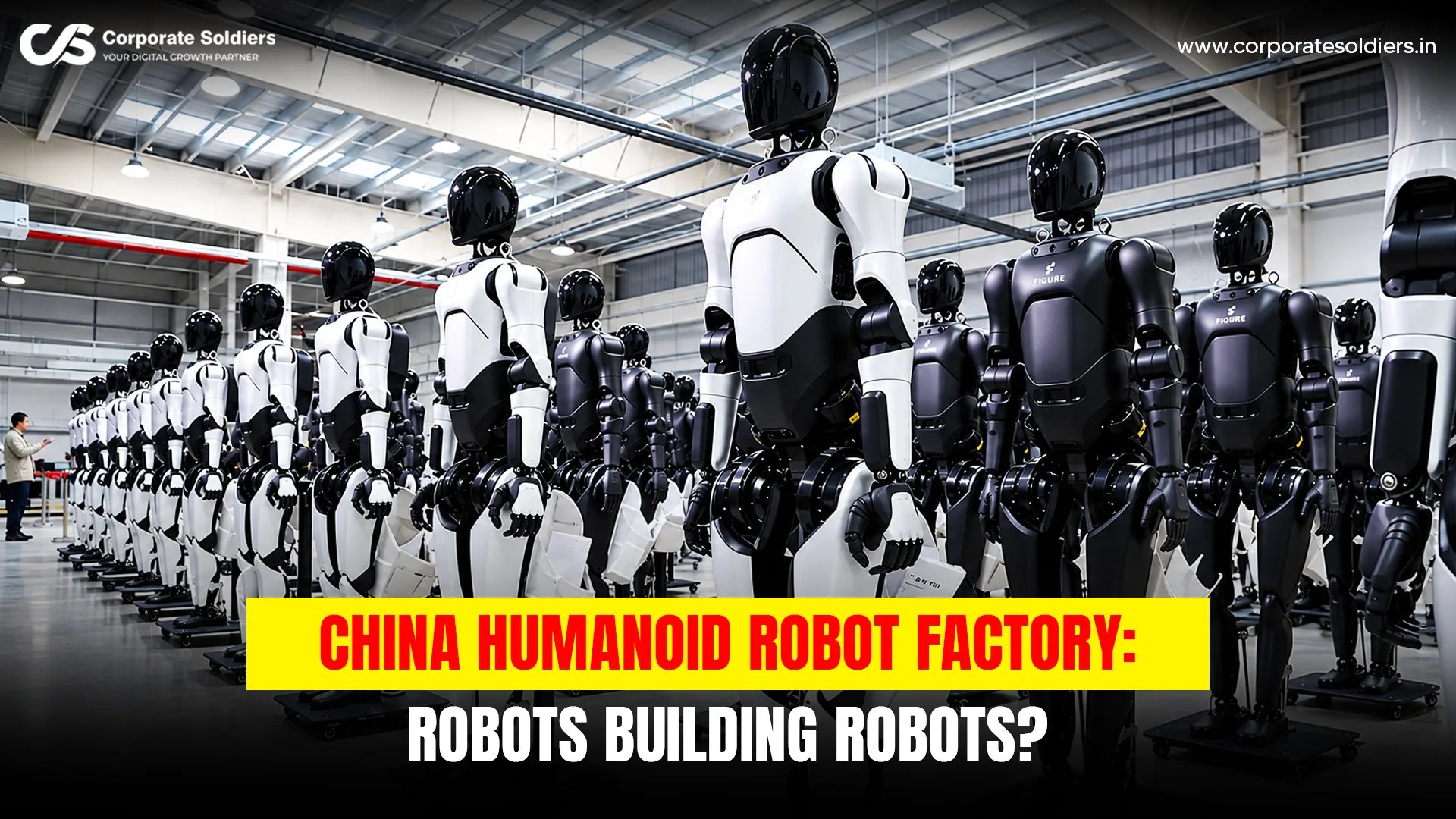
China is making headlines in humanoid robotics with the launch of an advanced factory in Liuzhou, Guangxi, designed to manufacture more than 10,000 industrial humanoid robots a year.
The facility is operated by the company UBTECH Robotics. It is constructed around a smart automated production system and has a stated production-line takt of approximately one humanoid robot every 10 minutes.
The facility marks a shift from experimental humanoid prototypes and limited production runs toward large-scale industrial manufacturing, attracting attention in China, India and other markets.
On September 12, 2026, this China humanoid robot factory reportedly began operations, covering 14,000 square metres and is designed to produce UBTECH’s industrial humanoid robots.
Robots Building Robots: What Is Actually Happening?
Robots building robots? Yes, these are the exact words used to headline this news. The Liuzhou facility in China is employing humanoid robots to make more robots to increase labour production. The factory uses humanoid robots alongside automated machinery and logistics systems to handle selected manufacturing and assembly tasks. The reported 10-minute figure refers to the production-line cycle, rather than one robot independently building another from start to finish. UBTECH humanoid robot system works like this.
UBTECH’s robots are able to perform tasks such as material handling, loading and unloading the spares, palletising, and moving components around the production space. Other advanced automated machinery and logistics systems are also integrated.
However, that doesn’t mean that there is no human involvement in the facility. Human workers remain involved in planning, supervising automated processes, managing production data, and ensuring that manufacturing and assembly remain accurate.
Basically, humans are involved in strategising and keeping everything error-free, while robots are involved in following the instructions fed into their data to make robots every 10 minutes.
Key Statistics at a Glance
Here are the simplified key highlights of a humanoid robot factory in China:
| What You Need To Know | Key Figures |
| UBTECH factory annual capacity | 10,000+ humanoid robots |
| Production-line speed | About 1 robot every 10 minutes |
| Factory size | Around 14,000 sq m |
| China’s share of global industrial robot installations | 54% |
| Industrial robots installed in China in 2024 | Around 295,000 |
| China’s broader robotics market in 2024 | Around $47 billion |
| Humanoid robots installed worldwide in 2025 | Around 16,000 |
| China’s share of 2025 humanoid installations | More than 80% |
10,000 Humanoid Robots a Year
UBTECH says its new factory has been built to produce more than 10,000 industrial humanoid robots annually. At an annual capacity of 10,000+ units, the factory would average roughly 27 robots per day across a full year. This is an annual-capacity figure and should not be confused with the 10-minute production-line cycle.
What Does This Mean for India?
For India, this development highlights the growing importance of artificial intelligence, electronics, and robotics capabilities in modern manufacturing. India has a large manufacturing workforce and growing interest in industrial automation. Humanoid robots could eventually find applications in factories, warehouses, logistics, hazardous environments, and other settings where repetitive physical work is required.
However, China’s current scale should not be interpreted as evidence that India has no robotics ecosystem. India’s robotics sector includes industrial automation companies, startups, research institutions, and manufacturers working on robotic systems and AI-enabled automation.
For Indian manufacturers, China’s humanoid robot factories could provide an early indication of where automation is heading, and where future competition may emerge.
Will Humanoid Robots Replace Factory Workers?
Not immediately.
The current humanoid robot generation is still moving with restrictions due to its production cost, battery life, dexterity, accuracy, and software capabilities. The focus is collaboration between humans and robots. While robots will handle repetitive and hazardous tasks, humans can focus on supervision, planning, investigation, and working on innovation.
The Future of Robots Building Robots
UBTECH’s factory in Liuzhou is not mindlessly building robots with robots but is actually transitioning from limited production to industrial-scale manufacturing. The focus is no longer on whether a humanoid machine can walk, lift objects, or complete a programmed task. The bigger challenge is that it can produce thousands, and eventually millions, of reliable and affordable machines that can perform useful work in real-world environments. China’s new facility is initiating this era of moving A.I. beyond the screens.