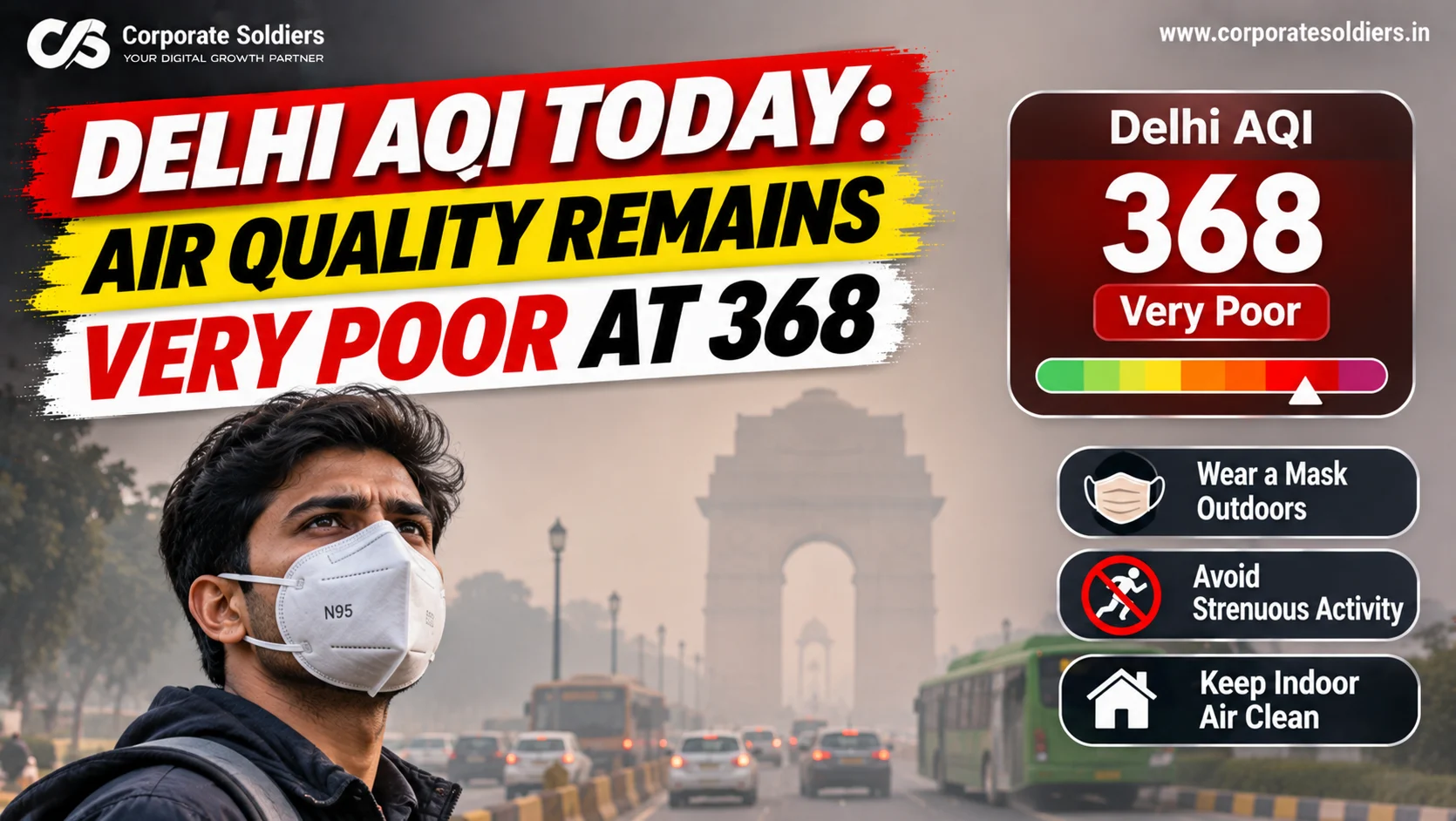
Delhi’s air quality remained in the very poor category on Monday, November 9, 2026, as pollution levels continued to trouble residents following Diwali celebrations. The national capital recorded an Air Quality Index (AQI) of 368 at 7 AM, keeping the city’s air quality in the very poor category and raising concerns about prolonged exposure to harmful pollutants.
Several monitoring stations across the city also reported elevated pollution levels, raising concerns about respiratory health and prolonged exposure to harmful pollutants.
According to data from the Central Pollution Control Board (CPCB), Delhi’s pollution levels remain significantly above the safe limits recommended for daily air quality.
Delhi AQI Today
Delhi recorded an overall AQI of 368 at 7 AM on November 9, placing it in the very poor category under India’s air quality classification system.
Of the 54 monitoring stations reporting valid readings, all recorded AQI levels above 200, while 50 stations reported readings above 300. This indicates that pollution was widespread across the capital rather than limited to a few localities.
An AQI between 301 and 400 falls under the very poor category. According to CPCB guidelines, poor air in this category can cause respiratory illness in healthy individuals and worsen existing respiratory conditions.
Why Is Delhi’s Air Pollution Increasing After Diwali?
The deterioration in Delhi’s air quality follows Diwali celebrations, when firecracker emissions can add significant quantities of particulate matter to the atmosphere.
However, firecrackers are not the only reason behind the capital’s pollution problem. Several factors contribute to the accumulation of pollutants during November.
Major contributors to Delhi’s air pollution include:
- Firecracker emissions: Fireworks release fine particulate matter and other pollutants into the atmosphere.
- Vehicular emissions: Cars, buses, trucks, and other vehicles release pollutants that contribute to poor air quality.
- Construction dust: Dust from construction sites and road activities adds to airborne particulate pollution.
- Industrial emissions: Factories and industrial activities release pollutants that affect the surrounding atmosphere.
- Weather conditions: Low wind speeds, temperature changes, and atmospheric conditions can limit pollutant dispersion.
Together, these factors make it difficult for Delhi’s air quality to improve quickly during the winter pollution season.
How Does Very Poor AQI Affect Health?
Current AQI indicates a serious air quality concern, particularly for children, older adults, and people with existing respiratory or cardiovascular conditions.
Fine particulate matter, especially PM2.5, is a major concern because these tiny particles can travel deep into the lungs and enter the bloodstream.
Prolonged exposure to polluted air may cause:
- Coughing, throat irritation, and breathing difficulties.
- Worsening asthma and other respiratory conditions.
- Eye irritation and headaches.
- Increased risks for people with existing heart and lung diseases.
Even healthy individuals may experience discomfort after spending extended periods outdoors when pollution levels remain very high.
Precautions to Take as Delhi’s AQI Remains Very Poor
With Delhi’s AQI remaining in the very poor category, residents should take precautions to reduce the impact of polluted air.
- Avoid unnecessary outdoor physical activities, particularly during periods of high pollution.
- Wear a well-fitted N95 or equivalent respirator when outdoor exposure is unavoidable.
- Keep windows and doors closed when outdoor pollution levels are high.
- Use an appropriately sized air purifier indoors, if available.
- Children, older adults and people with respiratory conditions should take extra care and follow medical advice if symptoms worsen.
Will Delhi’s Air Quality Improve in the Coming Days?
Delhi’s air quality will depend on several factors, including wind speed, temperature, rainfall and the continued accumulation of emissions from local pollution sources.
Favourable weather conditions, stronger winds and rainfall may help disperse pollutants, while stagnant atmospheric conditions can allow pollution to persist.
Residents should follow CPCB air quality updates and official advisories for the latest information rather than relying on isolated AQI readings.
Delhi’s Air Quality Remains a Growing Concern
Delhi’s AQI of 368 on November 9 highlights the continuing air pollution challenge facing the capital after Diwali. However, Diwali is not the only reason. But due to the massive use of firecrackers, we can’t ignore it. With multiple monitoring stations recording very poor air quality, reducing exposure and addressing major pollution sources remain important priorities as the winter season progresses.