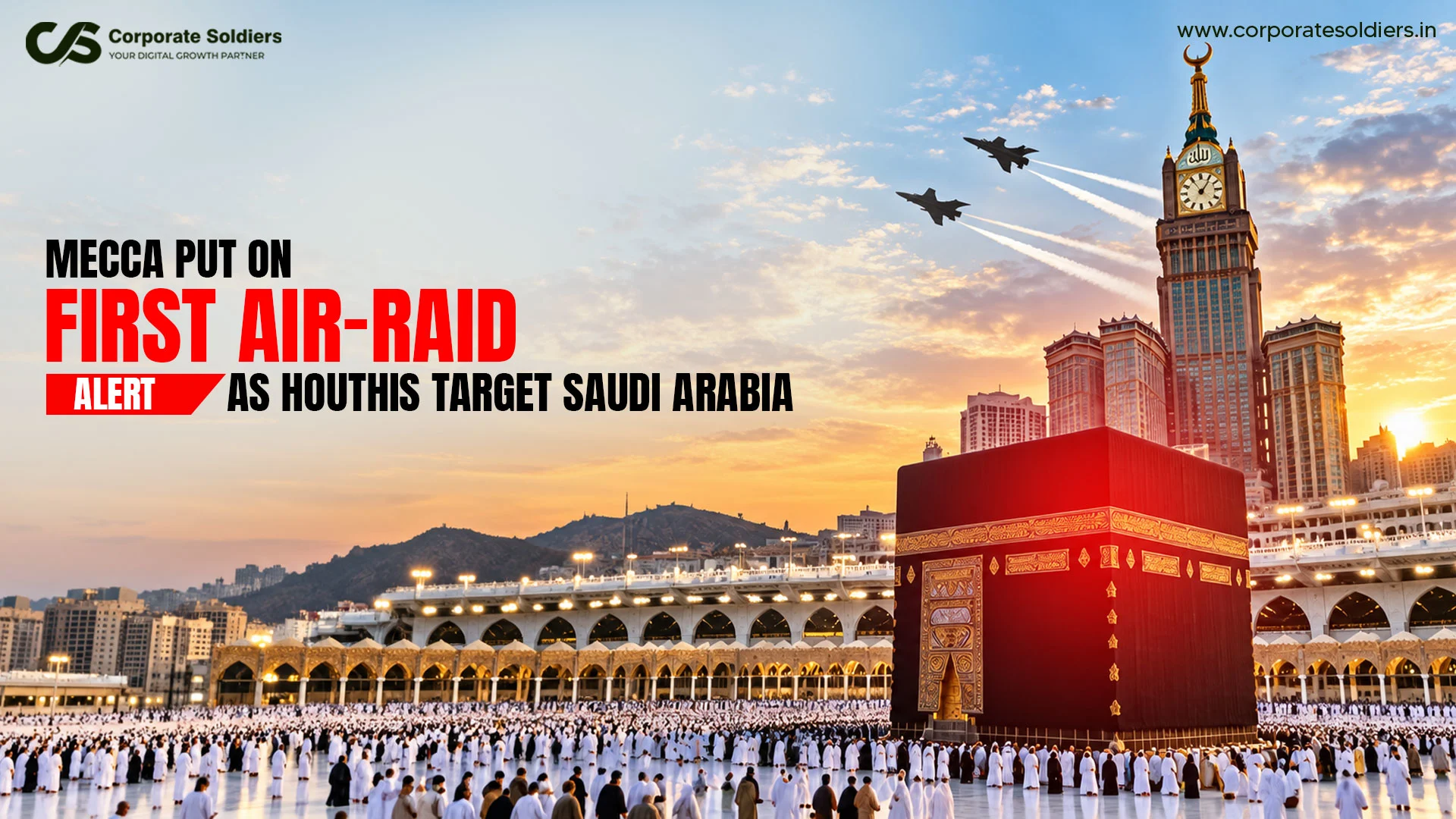
Saudi Arabia issued its first aerial threat alert for Mecca after air defences intercepted and destroyed a Houthi drone south of the holy city, according to Saudi authorities, Reuters and NDTV. The drone was intercepted prior to entering the restricted airspace of Mecca, and thus no drone attack on the city itself was reported.
This was an extension of a broader set of temporary alerts declared throughout western and southwestern Saudi Arabia, as the attacks by the Iran-linked Houthi movement of Yemen escalated. Mecca, Jeddah and Taif were among the areas placed on alert before Saudi authorities reported that the immediate danger had passed.
The alert came amid a sharp escalation in fighting between the Houthis and forces supporting Yemen’s Saudi-backed government. The most recent flare-up has involved the firing of ballistic missiles and drones into Saudi territory, attacks on critical energy and military infrastructures, new combat within Yemen and increasing anxiety over the maritime route of Bab el-Mandeb which is strategically significant.
What Happened in Mecca?
On Tuesday, September 15, Saudi Civil Defence warned about aerial threats via the National Early Warning Platform. It was a warning to both Mecca and Jeddah and Taif and was later removed when the authorities declared that the threat was over. Other parts of the country had also received brief-lived alerts by Saudi Civil Defence in the recent escalation.
According to the Saudi account reported by Reuters, the incident involved the detection of a Houthi drone south of Mecca. The drone was intercepted and destroyed by Saudi air defences before it entered the restricted airspace around the city.
That is a significant difference. Reporting available does not indicate that a Houthi drone flew into Mecca, hitting the city or the Grand Mosque. The Saudi version is that the drone before flying into its restricted airspace was destroyed south of the city.
Reuters said that the event was the second attempt by the Houthi to strike Mecca, after a 2017 incident of a ballistic-missile attack which Saudi Arabia also blamed on the group. The Houthis denied Saudi Arabia’s account that the intercepted drone was targeting Mecca.
Also NDTV had published with reference to the Israeli newspaper Hayom that air traffic to Prince Mohammad bin Abdulaziz International Airport in Medina was halted. This assertion has not been independently verified by an official Saudi aviation source in the source consulted in writing this article, and as such cannot be regarded as a fact, but an attributed report.
Saudi Arabia’s Response
The Saudi led coalition that has been engaged in the war against the Houthis in Yemen denounced the case and cautioned against any attack on Mecca and other holy sites of the country.
Turki al-Malki, spokesperson for the Saudi-led coalition, stated that the two holy mosques and pilgrims were a red line and that the coalition would take all the necessary actions to prevent additional assaults. Reuters separately reported the same warning following the interception south of Mecca.
The statement is the stance of the Saudi-led coalition and does not necessarily determine what military actions are to follow. Fighting in Yemen has escalated and Saudi Arabia has already been carrying out military operations in the country, and the Houthis have been waging attacks on Saudi soil.
The Mecca, Jeddah and Taif warnings were removed because the Saudi authorities concluded that the threat had died away. Other parts of Saudi Arabia have also had similar emergency alerts during the recent escalation such as in Khamis Mushait and Abha.
What the Houthis Said
The Houthis denied the Saudi explanation that the drone that was intercepted was flying towards Mecca.
Houthi political bureau member Hazem al-Assad called the allegation false and said he had heard similar claims about an attack on Mecca before. The conflicting accounts mean that the intended target of the drone remains disputed.
The Houthis have however admitted to conducting some of the recent attacks on Saudi soil. The group has boasted of missile and drone attacks on Saudi military targets and has alleged some of these attacks as revenge for Saudi military intervention in Yemen.
The discrepancies in the narrations are thus important in the evaluation of the Mecca incident. The Houthis also deny attacking Mecca, Saudi authorities claim that the drone was a threat and was intercepted before flying into restricted airspace. The account of either party should be given as not established independently of the reporting available.
Why the Alert Is Significant
Mecca is of special significance to Islam because of the Kaaba and the Grand Mosque. It is the location of yearly Hajj pilgrimage and is visited by extensive numbers of Muslim pilgrims all year round.
That renders the issue of security in and around the city one that is sensitive to Saudi Arabia. According to Reuters, the Saudi authorities saw the security of Mecca as a red line especially due to the presence of pilgrims and the religious importance of the city.
Another important aspect of the development on Tuesday is that the Saudi Civil Defence termed the warning as the first-ever aerial threat alert issued in Mecca. Neither was it a report of an impact or successful attack on the city. The reported interception occurred south of Mecca, before the drone entered the city’s restricted airspace.
Wider Houthi-Saudi Escalation
The Mecca alert came after the rounds of attacks which have led to a new stage of Saudi-Houthi war.
On September 8, Saudi authorities reported that a series of Houthi attacks involving ballistic missiles and drones targeted several locations in southern Saudi Arabia, including Abha, Khamis Mushait, Jazan and Najran. The Saudi-led coalition reported that 73 individuals were injured, and energy facilities were reported to be on fire, and the operations were temporarily impacted at certain places.
Targets, according to Reuters, were Saudi Aramco-related energy plants and an air base in Khamis Mushait. The attacks were one of the major recent Houthi attacks on Saudi Arabia.
On September 14, another wave of attacks led to the civilian casualties of 13 people, by the Saudi-led coalition. Reuters stated that Khamis Mushait, Abha and Taif were the affected locations of the attacks. This is an independent figure of casualties and should not be added to that of the 73 individuals who were injured during the attacks of September 8.
Claims of Saudi military facilities have also been escalated. The Houthis claimed that they attacked King Khalid Air Base in Khamis Mushait with mass use of ballistic missiles and drones. Reuters reported that Saudi authorities confirmed missile and drone attacks in the area, while individual Houthi claims about the attack have not been independently confirmed.
Within Yemen, Reuters quoted two military sources saying that on Monday a Houthi attack in western Yemen killed eight government troops. This occurred as combat escalated between Houthi forces and forces that were in support of the Yemeni government.
What Is Happening in Yemen?
The Houthis are an armed movement that controls large parts of Yemen, including much of the country’s most populated northern region. They are at war with the Yemeni government which is supported by Saudi Arabia and other partners in the region.
Since 2015 Saudi Arabia has been at the head of a coalition against the Houthis. The war later entered into an era of diminished hostilities as a UN-mediated truce in 2022 contributed to significantly reducing the intensity of the hostilities. The relative tranquility has been interrupted by the current escalation. The latest phase of fighting flared up again in July after the Houthis declared a maritime blockade against Riyadh and began targeting Saudi-linked shipping in the Red Sea.
Reuters gave an account of the latest worsening as a result of fresh Houthi movements along the western and Red Sea coast of Yemen. The Houthis have advanced towards the strategically significant regions around the Bab el-Mandeb Strait, and the government-aligned forces have engaged in counter-attacks on multiple fronts.
On September 15, the United Nations reported intensified fighting along Yemen’s western coast as Houthi forces advanced towards the strategically important Bab el-Mandeb Strait. The UN also reported that the government forces had counter-attacked and conflicts had been reported on various fronts in Yemen.
Reuters also reported separately that the renewed conflict had already displaced over 100,000 people within Yemen which put an additional strain to an already critical humanitarian crisis.
The Houthis have also declared a maritime blockade against Saudi Arabia and have targeted Saudi-linked shipping in the Red Sea. Among the reasons why they have claimed to act in this manner have been the retaliation against Saudi military operations in Yemen. The Saudi government and its allied countries are not satisfied with such a justification and have termed the attacks on Saudi territory as a challenge to national security.
Why Bab el-Mandeb Matters
The escalation extends beyond Saudi Arabia and Yemen, with growing concerns over international maritime security.
Bab el-Mandeb Strait links the Red Sea and the Gulf of Aden, and serves as a significant maritime entry point between the Middle East and the rest of the world trading system and Africa. The ships passing through the Indian Ocean route and the Suez Canal route go through the broader Red Sea route.
The Houthi progress along the Red Sea coast of Yemen, has raised the security issue of this route. Commercial shipping through the Red Sea remained operational as of September 15, although the deteriorating security situation was contributing to market anxiety.
Qatar also warned about the potential consequences of disruption to the maritime route. On September 15, Qatari Foreign Ministry official Ibrahim bin Sultan Al Hashmi said the country was already experiencing disruption along the Strait of Hormuz and could not afford the additional impact of a closure of Bab el-Mandeb. He characterised the disturbance of traffic in both waterways as possibly having disastrous effects all over the world.
The latter is a warning about the possible effects of sealing or significantly disrupting the waterway. It does not imply that Bab el-Mandeb is totally closed. Commercial shipping flows along the Red Sea were reported by the UN to be active, according to its September 15 briefing.
The Bab el-Mandeb has become still more strategic in light of the fact that Saudi Arabia has been relying more on export routes to the Red Sea whilst the broader regional conflict has destabilized shipping via the Strait of Hormuz. According to Reuters, the Houthi movement towards Bab el-Mandeb thus becomes a rising threat to Saudi energy exports and international shipping.
US Position
This increase has also led to Saudi Arabia asking the US to provide further aid.
According to Reuters, Saudi Crown Prince Mohammed bin Salman has requested US President Donald Trump to help them in the fight against the Houthis by supplying military support. Trump rejected the Saudi request for direct US military intervention against the group. Instead, Washington provided intelligence sharing and targeting support, as per sources quoted by Reuters.
Trump subsequently reported that the Houthis had reached out to the US administration and said that they did not wish Washington to be actively involved in the conflict. His comments were also reported by Reuters.
The US position, based on the latest reporting, has therefore involved support for Saudi security and maritime navigation while stopping short of direct US military strikes against the Houthis. The administration has not indicated that it is entering the Yemen conflict as a combatant.
High-level attention has also been paid to the issue in Saudi Arabia. Crown Prince Mohammed bin Salman held a meeting on September 14 with the US Central Command chief Admiral Brad Cooper at Jeddah, to discuss the progress of regional developments, as reported by Saudi state media and Reuters.
The Mecca alert is thus framed by a number of intersecting security issues: new conflict within Yemen, Houthi missiles and drone attacks on Saudi airspace, threats to energy infrastructure, advances along the Red Sea coast of Yemen and increasing international attention to maritime security.
The immediate air warnings have since been lifted, but the broader conflict between the Houthis and Saudi-backed forces continues across Yemen and the Red Sea region.