How a primetime broadcast ignited a referendum on digital education, credentialism, and accountability in India’s competitive exam ecosystem.
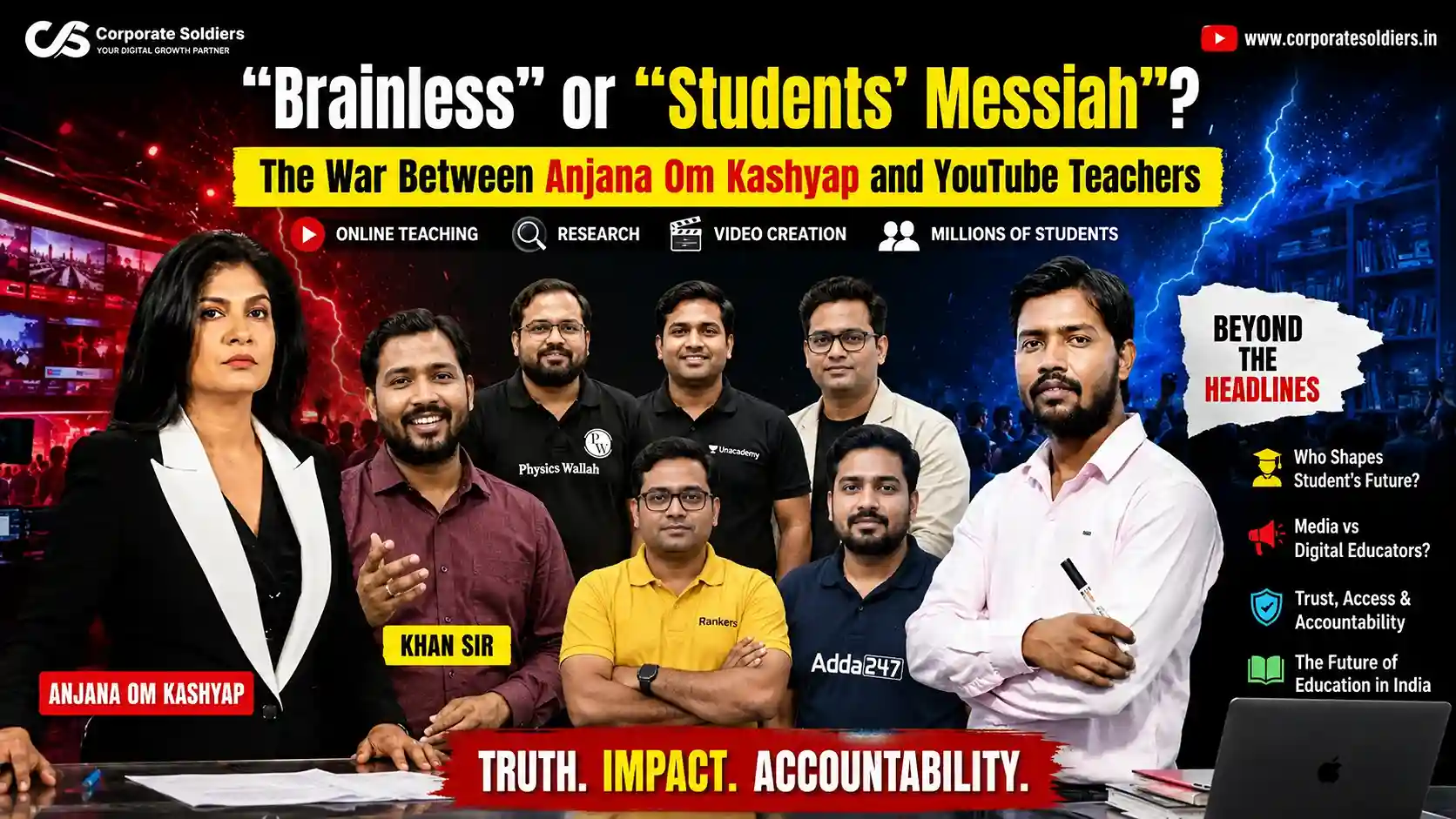
Television news has, in general, not had much to do with the burgeoning space of digital education, which is growing like never before in India. But that tension boiled over into a big confrontation in the open after airing on a widely watched Hindi television news channel at prime-time. Senior journalist and Managing Editor Anjana Om Kashyap made sweeping remarks in a live discussion that covered the systemic issues besetting the major competitive exams, and blamed independent online educators for the same.
The remarks, which included comments about certain teachers on the YouTube platform as “frauds” and “worthless” came across as an instant massive reaction of the digital teaching community in India and millions of students. More than just a media controversy, it has revealed a fundamental change in the way young India uses media, builds trust and is striving for upward social mobility in a high pressure, highly competitive education climate.
Understanding the Controversy
The debate was on primetime television and sparked controversy. The role of digital media and independent commentators came into focus as the panel discussed recent issues of leakage of papers in the National Eligibility cum Entrance Test (NEET) and other on-going structural issues in national competitive tests.
In the exchange Kashyap focused on individual creators that have created huge educational channels on YouTube. Soon the video was trending on various social media, including X (Twitter), Instagram, and YouTube. A typical panel discussion in the studio became a cross-pollination of the broadcast and social media communities, as online creators responded to conventional news outlets.
What Was Said and Why It Sparked Debate
In the popular video of the telecast, Kashyap aired his criticism at the qualifications and agenda of online tutors using very harsh and extreme words. She said she believed that such people “know nothing” and claimed that they use a digital chalkboard and simple visual aids not to teach students, but to take their “views, do drama, and make money off the students.
She triggered the furious public reaction with the Hindi expression ‘do kaudi ke’ which roughly translates to ‘worthless’ or ‘insignificant’. Kashyap said that though they had “no real knowledge” these digital figures had created “misplaced proportion” of their own significance and were assumed to have the final say on complicated regulatory and institutional issues.
The comments were quickly picked up by the media, and their remarks were criticized for a number of reasons:
- Broad-Brush Generalization: The critique didn’t distinguish between unverified content creators who spread misinformation and more qualified and institutionalized online educators who have years of training to educate their students.
- Online Teaching is “Drama” – Online teaching style was perceived as an ‘elitist’ dismissal of the highly engaging and simplified teaching approach that made digital learning possible.
- Elitism: The tone of the broadcast was a bit off-putting for millions of students who depend on these teachers for their livelihoods and academic future, and whose families are in lower and middle class India.
The Rise of YouTube Educators in India
The controversy sparked a lot of reaction and for understanding that it is essential to have a look at the position of YouTube educators in today’s education system of India.
India has a competitive examination system which caters to millions of students every year. Sitting for tests like NEET, UPSC, SSC, Banking, Railway Recruitment, State Public Service Commission etc., generate a huge demand for a cost-effective preparation material.
Coaching institutes had the monopoly of this market in the past. But physical coaching was generally costly and an international setting was necessary, so it was not easily available to students from smaller towns and lower income families.
This was a change brought about by the rapid growth of affordable smartphones, cheap mobile internet and video-based learning platforms.
The creators in education started sharing free lectures, revision sessions, mock tests, doubt clearing sessions and exam strategy content. In time some teachers developed a following similar to that of the mainstream celebrities.
Khan Sir grew to be a popular figure. They were not confined to the classroom but also used to participate in education policy discussions, examination systems and students’ welfare discussions.
The attractions of these sites were simple:
- Access to information, free or on a low cost Basis
- Geographic availability of the service.
- Flexible learning schedules
- Face-to-face learning experience for teachers and students
- Content that is specially designed for competitive exams.
YouTube not only served as an additional tool for students but also as a main source of education for many.
Why Students Relate to Digital Teachers
The existing relationship between Indian students and the YouTubers is a completely different one than the classic teacher-student environment of a top-notch school or coaching centre. It is based on unity of identity, language accessibility and economic sympathy.
- Democratic Access to Resources
It is financially impossible to get to a physical coaching hub for a student residing in a tier 3 town or a rural village in Bihar, Uttar Pradesh, Rajasthan or Madhya Pradesh. YouTube teachers remove the geographic and monetary obstacles, and provide the best preparation classes on a basic cellphone.
- Vernacular and Relatable Pedagogy
As opposed to the informal style of traditional coaching institutes, which sometimes have a formal or rigid teaching approach. Digital educators, by contrast, make a heavy reliance on the local vernaculars, culturally analogous explanations, humor, and motivational monologues. For instance, Khan Sir used colloquial Bihari Hindi when he was teaching high level geopolitical or scientific concepts and made them easily understandable and engaging.
- Emotional Alignment during crises
COVID-19 lockdowns have cemented the relationship between students and digital teachers. Independent YouTube channels continued to conduct marathon lecture sessions when physical classrooms were forced to close indefinitely, to ensure that students didn’t miss an academic year.
In addition, public support, validation of students’ fears, decryption of administrative communications, and explanation of various administrative delays are among the aspects in which the digital educator is often the first public speaker to validate the students’ fears and concerns. These creators are seen as advocates to the student community and as being out of touch and/or negative to the realities of the student community by mainstream media.
Mainstream Media vs. Digital Influence
The controversy highlights a growing structural conflict between traditional legacy media and decentralized digital networks over who controls the narrative in public discourse.
| Feature | Mainstream Television News | YouTube / Digital Education Platforms |
| Primary Business Metric | Television Rating Points (TRP), Prime Advertising Slots | Audience Retention, Subscriber Growth, Direct EdTech Conversions |
| Format Focus | High-decibel panel debates, sensationalized graphics, conflict-driven narratives | Long-form instructional videos, concept breakdown, direct community engagement |
| Audience Relationship | One-way broadcast; top-down delivery of news and opinion | Two-way interactive; active comment sections, live chats, community feedback |
| Perceived Credibility | Declining among youth due to perceived political biases and hyper-sensationalism | High among youth due to measurable, transparent educational utility |
The controversy also sparked broader discussions about the relationship between traditional television media and emerging digital education platforms.
Public Reaction Across Social Platforms
The digital education community’s feedback was rapid, well-coordinated, and well-publicized. The independent educators were filling in the gap in the coverage of news, using their own platforms.
Several online educators publicly criticized the remarks and argued that digital education has expanded opportunities for students from economically disadvantaged backgrounds. Many creators highlighted the role of free educational content in helping candidates prepare for competitive examinations. Supporters of digital learning platforms also pointed to the accessibility, affordability, and reach of online education, particularly for students in smaller towns and rural areas.
Platforms such as X and Instagram had a student response that was overwhelming. Through different trends, many users expressed support for individual teachers and shared personal experiences related to online learning. Students also shared examination success stories and study resources that they had used during their preparation.
The NEET Context and Student Concerns
The controversy timed was an excellent way of boosting its visibility.
The debate took place in the backdrop of the general apprehensions of NEET-UG 2026 and allegations of irregularities in the exam and paper leakage. There was a great deal of interest in the issue nationally due to the size and scope of the examination and the number of students involved. The issue attracted national attention because of the scale of the examination and the large number of students affected by uncertainty surrounding the process.
Several online educators publicly questioned examination processes and called for greater transparency regarding examination-related concerns. The criticism came at a time when several online educators were actively discussing examination-related issues and student concerns, and some audiences were interpreting the criticism based on the current NEET controversy.
Some social media discussions linked the criticism of online educators to their growing influence in conversations surrounding examination-related issues. These interpretations largely reflected opinions expressed on social media and contributed to public discussion surrounding the controversy.
The overlap in the two conversations helped to move a media debate to a more student-centered conversation.
What This Debate Reveals About Changing Information Ecosystems
As a whole, the whole affair may be considered a key case example in the fragmentation of the public sphere in the history of media sociologists.
The Crisis of Credibility and Content Shortages
In India, the traditional media is facing engagement challenges among the youth (under 30s). Younger audiences are giving up on linear, news television because of its formulaic, impersonal nature, and its lack of relevance to their everyday lives. Critics of the mainstream media state that topics like educational reform, joblessness and examination administration typically do not enjoy the same level of continuity as political and breaking news.
The Shift from Institutional Authority to Functional Authority
Historically authority was synonymous with institutions; a historical newspaper seal of approval was always a good sign, or the top radio or television broadcast time. In today’s world the digital natives are functioning within a system of functional authority. A YouTube educator is an educator because of her 45-minute breakdown of an organic chemistry problem or an advanced calculus problem that helps a student understand a problem that they could not in school. In those cases, traditional media, with their institutional influence, is likely to launch a counteroffensive in response to this functional power, losing the trust of traditional media.
Expert Perspective and Industry Analysis
Media and education analysts argue that the controversy reflects a broader tension between traditional broadcast media and community-driven digital platforms. They note that while online education has expanded access to learning, debates around accountability, credibility, and influence continue to shape public discussion.
But, digital learning experts recognize that online learning is not without its challenges. Some teachers offer valuable information to their students, but open platforms can also be used to spread misinformation, overly-optimistic marketing claims and unverifiable educational information.
This has led many to believe that education quality, transparency, credential verification and student protection should be considered rather than the generalities of traditional media or digital educators.
Final Thoughts
Anjana Om Kashyap and India’s YouTube teachers are not just making headlines on social media, they are also ushering in a paradigm shift of influence, trust and authority in the digital era. The episode is a call to action for digital educators and introduces wider questions on the nature and authority of digital trust, particularly with younger audiences.
The episode is a symbol to the digital education community of how they can make a difference in public discussion and demand an explanation from legacy institutions. While the world of education in India continues to grapple with these tricky issues, the actual remedy is not in dismissals in the studios or online counter-campaigns, rather it is to create a transparent, accountable system where both traditional and digital teaching and learning truly meet the needs of the country’s youth.
This article is based on publicly available news reports, social media discussions, and reactions surrounding the controversy. Some interpretations discussed in the article reflect opinions expressed by students, educators, and online communities and should not be treated as verified factual findings.
References
Primary Source
- Hindustan Herald: Anjana Om Kashyap, YouTube Teachers and the Fraud Debate
Reference Social Media Post:
Instagram Reel related to the controversy:
https://www.instagram.com/reel/DY_ZowKIu7h
NEWS: