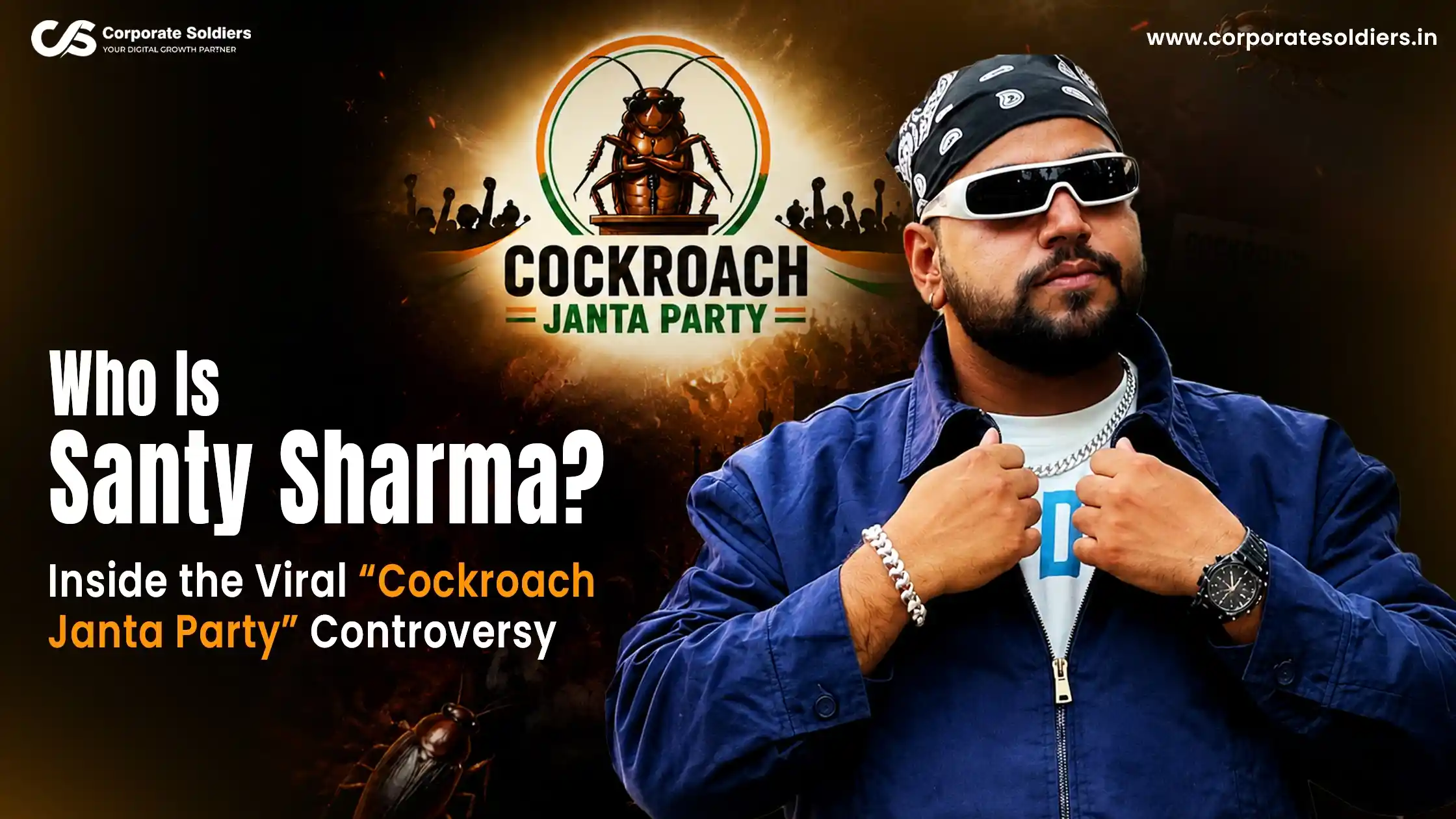
Independent rapper Santy Sharma, of Ratlam, Madhya Pradesh has gone viral accusing the Cockroach Janta Party (CJP) as a political front with alleged connections to the Aam Aadmi Party (AAP). His videos, rants, and politically inclined commentary have triggered widespread discussion across social media.
Key Facts
- Santy Sharma is an Indian rapper and songwriter from Ratlam in the state of Madhya Pradesh.
- He attracted attention with viral videos which criticized the Cockroach Janta Party (CJP).
- On record Sharma claimed that CJP might possess some kind of indirect political links with AAP although there is no official confirmation to prove the allegations.
- The social media amplification of the controversy, the meme culture of the controversy, and mainstream media coverage have made the controversy national trending.
Who is Santy Sharma?
Independent rapper, songwriter and digital creator Santy Sharma is a Madhya Pradesh based independent rapper, songwriter and digital creator who resides in Ratlam. He has slowly gained an online following by local rap music, commentary videos and socially motivated performances.
Online, he is the Santy Sharma rapper, and his work is an emerging group of hyperlocal artists who employ music and digital storytelling to talk about politics, the general mood and internet culture. His songs are said to feature songs like Uddta Parinda, and freestyle commentary videos, which combine criticism, satire and delivery in the form of a spoken word.
In stark contrast to commercial artists in the mainstream, Sharma has become visible on the platform of the short-form content (Instagram Reels, YouTube Shorts, and viral social media clips). His local and direct speaking style have assisted him to reach younger internet users in central India.
The Ratlam rapper crisis is a broader movement in India in which regional artists are using music as a form of communicative, political and social critique more often.
What is the Cockroach Janta Party (CJP)?
The Cockroach Janta Party or CJP is a viral local party that has gained popularity in Ratlam due to the social media buzz, street level publicity and campaigning over the internet.
The group has been publicly depicted in various forms based on the interpretation by the audience:
- It has been termed by some of the social media users as satire or a symbolic grassroots movement.
- Some consider it as performance politics, internet marketing or digital theatre that aims at getting attention of the internet.
- Some critics have also doubted the movement is political or has other affiliations though none have been proven to be official.
Provocative branding, the spread of memes, and local engagement strategies that appealed to the online audience led to increased visibility of CJP. The movement grew to include Ratlam and the wider social media discourse through the use of viral videos, slogans, and short-form videos.
The precise structure of the organization, political motive, and long-term goals of the group are not precisely identified in the publicly confirmed coverage even though it was covered online.
The Controversy: AAP Allegations & Viral Rants
The Santy Sharma controversy grew when the rapper posted videos, claiming that the Cockroach Janta Party can have connections with the Aam Aadmi Party (AAP). These accusations took place in the open with the help of social media posts and rap-style commentary videos.
Notably, these assertions have not been substantiated or proven by AAP or any other concerned authority when the assertions are being reported.
Neither AAP nor CJP has officially responded to or confirmed these allegations in publicly verified reporting.
Sharma spoke out against what he termed as politically-driven influence campaigns and wondered whether the movement could influence local people’s opinion under the name of satire or activism. The commentary was in a rap-and-rant (aggressive) format that greatly improved online interaction.
The viral traction was driven by several factors:
- Instagram Reel-optimized and YouTube Shorts-optimized short-form videos.
- Meme-based political commentary
- Reaction videos and snippets of rap.
- Enhancement using local and national social media pages.
The mainstream media took note of the story later on with the Times of India publishing a story about how the controversy was fuelled by the internet and how people were becoming increasingly interested in what Sharma was saying.
When the videos went viral, the conversation grew beyond Ratlam and was integrated into broader discussions about the topic of political branding, online influence, and creator-driven narratives.
Movement or Marketing Stunt?
The issue as to whether the movement is a real grassroots movement or a well-planned internet movement has become one of the most controversial in the CJP movement.
The reaction online is still highly polarized.
Skeptical Viewpoints
The situation has been characterized by some of the users as internet drama or performance-based virality instead of a political movement. Opponents believe that branding by controversy is becoming a trend in the digital realm and it can easily earn both makers and institutions a name in a short time frame.
Still others think that the feud among the populace could be more of a marketing ecosystem that runs on outrage, meme sharing, and algorithmic interaction.
Supportive Reactions
Conversely, there are those audiences who may see Santy Sharma as a whistleblower character who tries to unveil what he thinks are quiet political stories. The proponents believe that freestanding creators have the ability to bring issues that mainstream platforms might not address.
The scandal underlines the way that contemporary online ecosystems blur the line between:
- Activism
- Satire
- Political commentary
- Entertainment
- Personal branding
Even regional conflicts are likely to become internet phenomena to be discussed nationwide in the era of short-form content.
Timeline of Events
| Date | Event |
| Early May 2026 | Cockroach Janta Party begins gaining visibility in Ratlam through social media and local activity |
| Mid-May 2026 | CJP reports that its primary social media handles were blocked or compromised, triggering widespread viral discussion. |
| May 23, 2026 | Rapper Santy Sharma posts an unfiltered critique on Instagram, alleging CJP has AAP links and acts as “internet drama.” |
| May 24, 2026 | Mainstream outlets (Times of India, Livemint, The Economic Times) report on the Ratlam rapper controversy. |
| Late May | National political figures weigh in; digital platforms remain split over the authenticity of the movement versus propaganda claims. |
| Ongoing | Social media debates continue regarding authenticity, satire, and political intent |
Why This Story Matters Beyond Ratlam
The Santy Sharma scandal is also important as it represents the overall changes in the digital media landscape in India.
Artists in smaller cities are finding their way into the rest of the country without depending upon the established entertainment and news systems. Instagram, YouTube, and X are some of the platforms that enable regional personalities to create narratives quickly via viral content.
The increasing role of the regional rap culture in the general commentary can also be seen in this story. Independent artists currently often treat:
- Political frustration
- Local governance
- Social tensions
- Internet culture
- Youth sentiment
The Ratlam rapper scandal demonstrates the way in which a hyperlocal artist can use authenticity, language knowledge, and digital narratives to gain national interest.
It also shows how viral content can shape local stories and be inundated with the subject before formal institutions or mainstream news coverage make significant inroads on the subject.
The Role of Social Media in Political Narratives
Social media has radically transformed the spread of political discourse in India.
The culture of memes, satire, reaction video, and commentary produced by creators have become regular parts of the discussions in society alongside conventional journalism. Viral controversies frequently are fueled by highly emotional clips instead of a more in-depth political discussion.
The use of Instagram Reels and YouTube Shorts took centre stage in amplification in the case of Santy Sharma and the Cockroach Janta Party controversy.
Key dynamics include:
- Algorithm-driven virality
- Creator-led opinion shaping
- Meme-based political communication
- Rapid audience polarization
- Fragmented information ecosystems
Nevertheless, such dynamics pose threats as well.
False stories and rumors can go viral easily and it is hard to decipher the speculation and the proved coverage. That is why factual attribution and responsible reporting are crucial to speak about politically sensitive attributions.
The scandal highlights the way digital creators are currently at the confluence of entertainment, activism and social impact.
FAQ
- Where is Santy Sharma from?
Santy Sharma is reportedly from Ratlam, Madhya Pradesh, India.
- Is the Cockroach Janata Party a political party?
The Cockroach Janta Party (CJP) has been referred to as a viral movement or an internet-based movement. It is not clear as to whether it has formal political status in publicly verified sources.
- Why is Santy Sharma trending?
Santy Sharma achieved virality by uploading rap-style videos and commentaries on the Cockroach Janta Party and that it has political connections.
- What were the accusations Santy Sharma made?
Sharma publicly made allegations that CJP possibly had an indirect connection with the Aam Aadmi Party (AAP). These assertions have not been verified or confirmed as such.
- Do we have evidence of AAP association with CJP?
To date, there are no publicly proven links between AAP and CJP, no official confirmation.
- What was viral about the controversy?
Such short-form videos, meme culture, political commentary, online arguments, and mainstream media coverage served to fuel the controversy.
Santy Sharma and the New Digital Age of Political Commentary
The Santy Sharma scandal is an example of how fast the internet discourse can turn into a national discourse of the digital age.
What started as a localized critique of the Cockroach Janta Party, quickly grew into a larger discussion of political accusations, meme culture, creator influence, and viral social media discussions. Although the claims about the AAP connections are yet to be confirmed, the scandal itself is indicative of the increasing strength of independent digital voices in influencing the masses.
Instagram and YouTube are also venues used by creators like Santy Sharma to not only entertain their audiences, but also comment, engage in activism, and mobilize audiences.
Regardless of whether or not the charges end up being substantive, the scandal has placed Santy Sharma in the nexus of music, virality on the internet, and political commentary in Madhya Pradesh