Introduction
One of the most widely discussed political controversies in India has transformed a judicial controversy into a viral political satire movement. The outrage erupted after some very controversial comments by the Supreme Court Justice Surya Kant during a court hearing. During his court testimony, Justice Kant is said to have likened unemployed young people who enter into journalism and social activism to “cockroaches” and “parasites.”
Although later judicial commentators clarified the statements, the comments quickly elicited countrywide outrage and mass ridicule and spawned a humorous political web phenomenon called the Cockroach Janata Party (CJP) -or Cockroach People’s Party. This emergence brings to the fore the inherent fears of youth unemployment and civil liberties in India, which is the intersection between judicial responsibility and digital political satire in the contemporary world.
What Happened?
In a court case, Justice Surya Kant said things that seemed to be a criticism of the youth of India and other career options. Remarks attributed to Justice Surya Kant were widely interpreted online as comparing unemployed youth that were resorting to journalism and grassroots activism to pests and calling them cockroaches and parasites.
As the statements spread quickly on the Internet, eliciting a strong backlash, Justice Kant came up with an explanation. He emphasized that he was not referring to the larger group of Indian youth, but only those who have fake and phony degrees and are taking advantage of these careers. But when the clarification came, the early utterances were already drifting into the general online discourse; an irreversible flood of popular outrage and negative satire was already underway.
Key Details and Major Developments
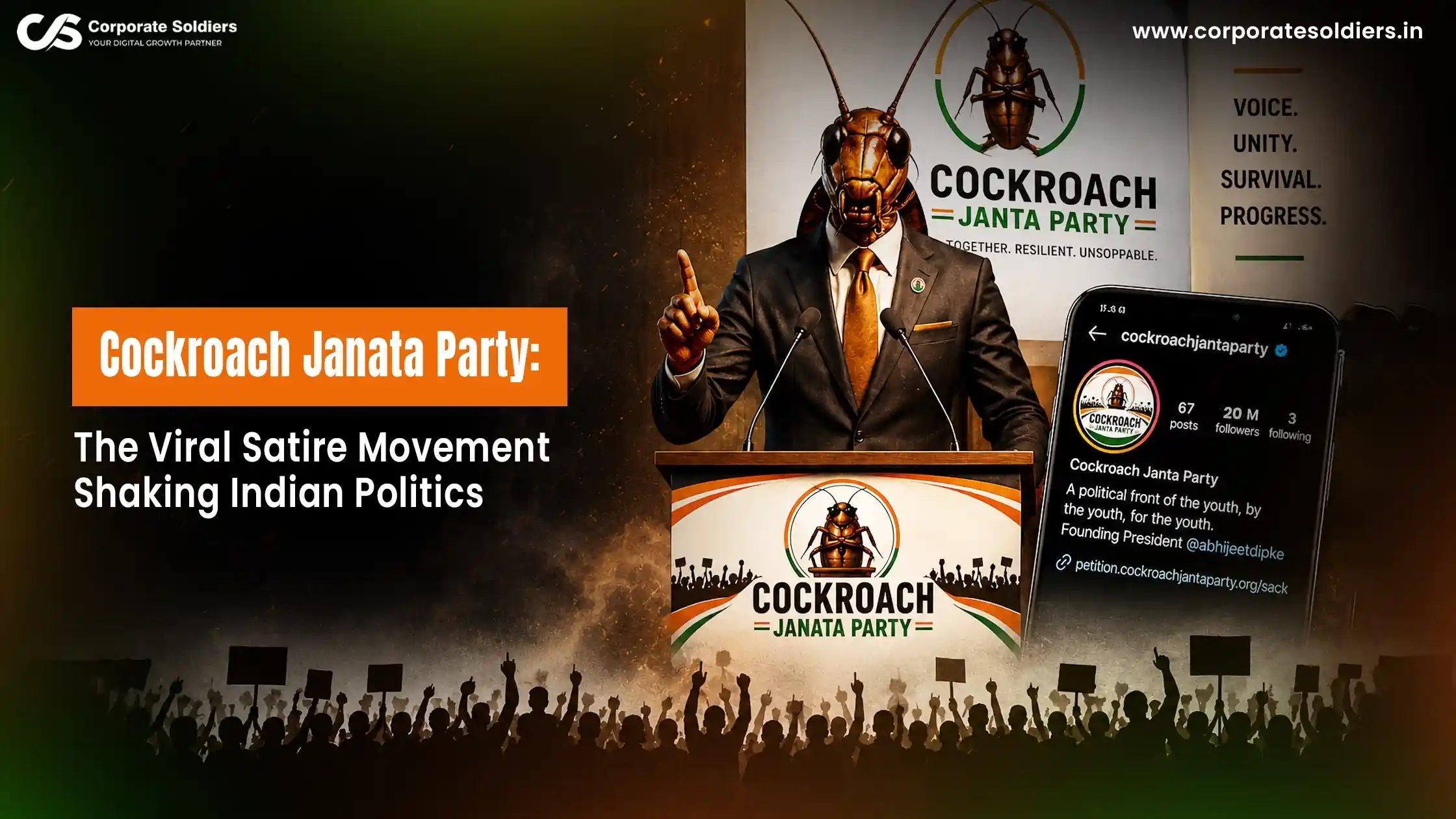
The major expression of the people’s reaction is the so-called Cockroach Janata Party (CJP), an online satirical movement organized in the form of a parody of the ruling political party in India, Bharatiya Janata Party (BJP), which is headed by the Prime Minister, Narendra Modi.
The satirical movement was initiated by digital strategist and public relations graduate Abhijeet Dipke, who launched the Cockroach Janata Party across social media platforms after the controversy gained traction online. The movement rapidly expanded through meme culture, satire, and digital activism, attracting significant engagement from younger internet users.
It is said that the movement quickly spread across Instagram and X and achieved a huge online following within days of its creation. The Instagram page of the CJP allegedly had over 10 million followers, at one point outpacing the BJP official Instagram account, with approximately 8.7 million followers. At the same time, the X account of the movement gained over 200,000 followers until some of its related content was allegedly blocked in India following a reported legal request. The humorous online manifesto of the movement and the membership message in the form of parody were also a contributing factor to its viral popularity with younger audiences.
The movement also gained visibility through the viral hashtag #MainBhiCockroach (“I too am a cockroach”), while several opposition figures publicly engaged with the trend online. Reports noted that the CJP’s Instagram account briefly surpassed the BJP’s official Instagram following, highlighting the extraordinary pace at which the satirical campaign spread across digital platforms. Opposition leaders, including Akhilesh Yadav, also referenced the trend publicly, further amplifying its national visibility. Despite the rapid online rise of the movement, India’s established political forces, particularly the BJP and the opposition Congress party, continue to dominate mainstream electoral politics nationwide.
Dipke, who previously worked with the Aam Aadmi Party (AAP) before studying at Boston University, described the initiative as a humorous digital platform that unexpectedly gained national traction. The movement also extended beyond social media, with some supporters reportedly appearing dressed as cockroaches during protests and public events.
Although the CJP is completely unofficial and has no formal status as a political organization, the movement has been able to mobilize millions of social media users. The movement has satirical membership requirements, which it invites citizens who
- Unemployed
- Chronically online
- Inherently lazy
- Armed with the ability to complain in a professional manner.
The satire reflects growing frustrations surrounding unemployment, political polarization, and institutional accountability in India. In political terms, the parody is a harmless medium of protest against the governing body, and it summarizes the fears of the people towards civil rights in an extremely polarizing context.
Expert Opinions / Official Statements
Close attention to the development has been paid by human rights organizations, media watchdogs, and political analysts. The critics and civil rights groups observe that the satire has a powerful message. They highlight that since the BJP government, which has been in power since 2014, has been subject to constant questioning by international observers over India in terms of what appears to be a deterioration of press freedom and civil liberties.
On the other hand, the high and mighty of the ruling BJP have always denied allegations of waning civil rights, arguing that the institutions of democracy and press freedoms are strong with them. Analysts indicate that the wording used by the judiciary, perhaps intended as a particular reproach of fraudulent qualifications, is a dislocation of the institutions to the economic conditions of young people in the country.
Global and Industry Impact
The viral emergence of the Cockroach Janata Party is a clearer indication of the general change in how the work of communicating politics and dissent is conducted in the contemporary democracies. It also highlights how digital spaces based on algorithms can quickly transform judicial or political discourse into countermovements.
In the case of the media and legal industries, this event highlights the close attention paid to the public officials. Courtroom real-time reporting in an interconnected information ecosystem makes sure that institutional statements are promptly tested by society. Moreover, the incident portrays the use of digital satire as a highly advanced instrument of political commentary that is being more and more exploited worldwide as an alternative to other avenues of protest that are perceived to be limited or polarized. Political satire movements have also influenced mainstream politics internationally. Examples include Italian comedian Beppe Grillo and the Five Star Movement, as well as Volodymyr Zelenskyy, who transitioned from playing a fictional president on television to leading Ukraine politically. In the United States, the political era surrounding Donald Trump also intensified debates around satire, media spectacle, and political performance in democratic societies.
Background and Context
To truly comprehend the seriousness of the reaction of the masses, the event needs to be considered in the context of Indian politics of the past ten years. The interplay of state power and judicial activities, as well as freedom of speech, has been a hotspot of national debate since the rise to power of Prime Minister Modi in 2014. India also has one of the world’s youngest populations, with nearly half of its citizens under the age of 30. However, surveys have indicated relatively low formal political participation among younger demographics, with many expressing frustration over unemployment, representation, and economic uncertainty.
The growing conflict with the state machinery has been a common narrative among independent journalists and digital activists, who have noted that challenges in legislation and branding as a systemic problem are a significant barrier. Therefore, the use of a language that pitted independent professional endeavors against pests by a high judicial body was a tender trigger, with the disparate online communities emerging as one under the same umbrella of satirical opposition.
What Happens Next?
In the future, the Cockroach Janata Party will continue to be a well-known representative of Indian internet culture and political memes, a digital litmus test of the mood of people on the internet. Although it will not become a serious electoral contender, opposition personalities and civil rights movement leaders will, undoubtedly, use the language and metaphors of the cockroach movement to question the usurpation of power by the government and judicial system. It will also be monitored whether the Supreme Court of India will be more rhetorically cautious in future public hearings so as to prevent future public relations calamities like this one.
Final Thoughts
The controversy of the Cockroach Janata Party is a good example of how much digital discourse can be volatile. What started as a very controversial analogy of Justice Surya Kant has developed into a national-level satirical movement of real fears concerning unemployment, the freedom of the press, and democratic responsibility. The fact that the story is still a significant pointer of how citizens are using humor and the power of collective action as they mobilize through digital means to tell institutional power the truth even as millions of people keep on engaging with the viral phenomenon.