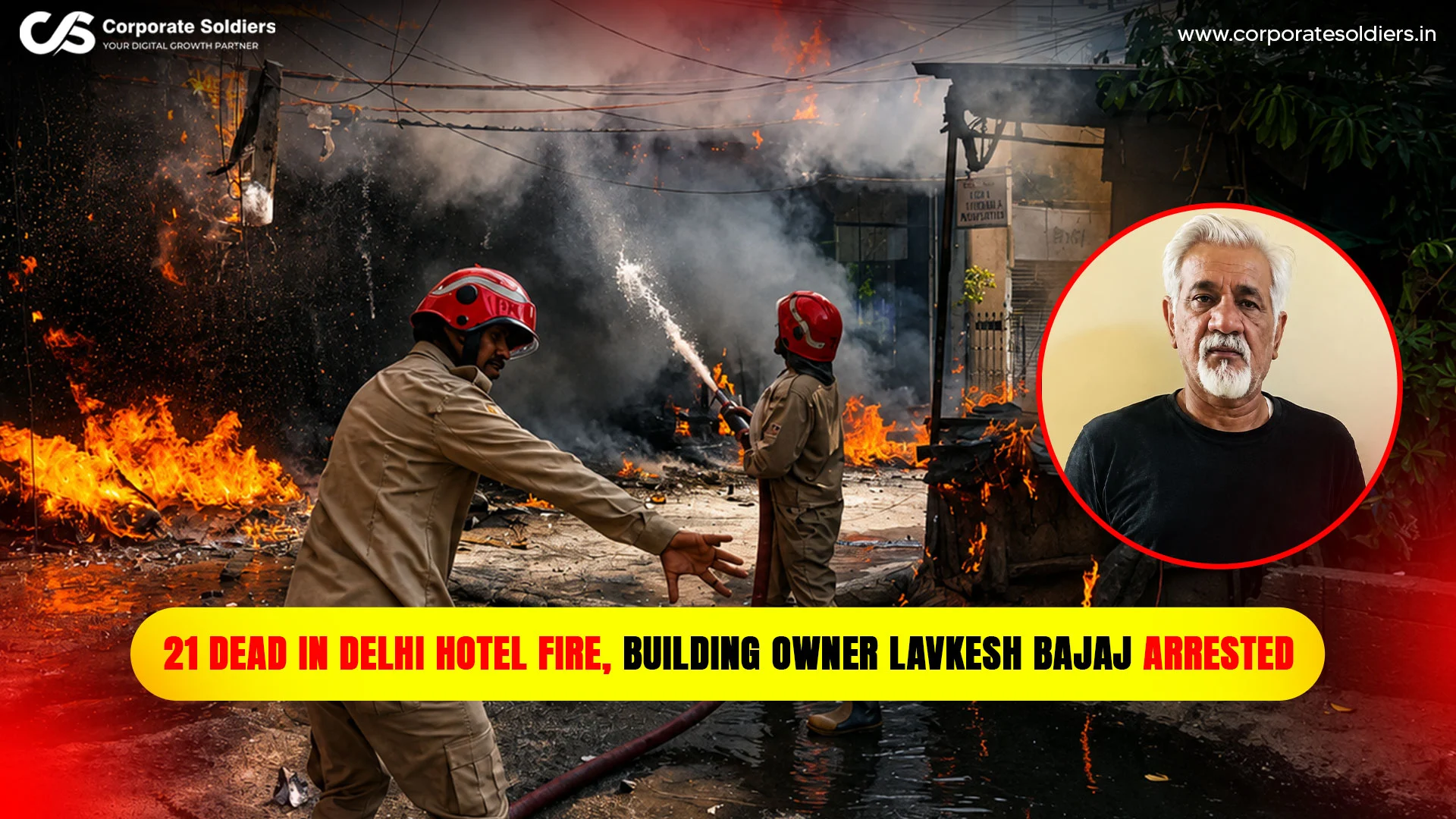
A disastrous blaze in a hotel-cum-restaurant edifice in the Malviya Nagar district of South Delhi has become one of the fatal urban fires in the national capital within the recent years. The fire that broke out on June 3, 2026, left at least 21 people dead and several others injured, which attracted a huge emergency response with the authorities actively investigating the issue.
Following the tragedy, the Delhi Police arrested the hotel owner Lavkesh Bajaj as the investigators began to examine the allegations related to the violation of fire safety, the violation of the regulations, as well as the possible negligence. Not only due to the large number of casualties, but also due to the fact that it has rekindled debates around the issue of enforcement of fire safety in crowded commercial districts of large cities, the incident has attracted the attention of the whole country.
As the authorities persist in investigating, an investigation into compliance standards, emergency preparedness and accountability in commercial hospitality establishments is in place.
What Happened in Malviya Nagar?
Timeline of the Fire
The fire started in the morning on June 3, 2026, at the Flourish Stay Bed and Breakfast facility in the Hauz Rani area of Malviya Nagar, South Delhi. The Delhi Fire Services received emergency calls at around 8:48 to 8:50 am local time according to officials. The fire was initially reported to have begun in a restaurant which was operating in the lower portion of the building and then spread rapidly to other parts of the building.
Firefighters were on hand hastening some fire tenders to the scene and authorities subsequently sent eight fire engines to the scene as the gravity of the situation became apparent. This rescue operation was started at the same time when rescuers attempted to save individuals who were trapped inside the building which was filled with smoke.
The location of the building was a high traffic street in the city and people could hardly save their lives and combat the fire. There were also eyewitness reports of panic as part of the occupants tried to get out of the building through the windows as the thick smoke filled the upper floors.
The authorities after a couple of hours of fire fighting confirmed that the fire was contained.
Casualties and Human Impact
Lives Lost and People Affected
The tragedy that claimed at least 21 lives is one of the latest fires in Delhi. According to the reports of the officials, numerous people were injured and had to be hospitalized. It was reported that a significant number of victims were foreign nationals, who had come to India, allegedly to seek medical attention and other related reasons.
Hundreds of burn victims, smoke inhalation victims and traumatic injury victims were brought to hospitals in the city of Delhi. The day was characterized by emergency medical teams taking care of survivors and providing them with treatment.
In addition to the number of people who have been killed, families in India and other countries have been left mourning the abrupt disappearance of their loved ones. The tragedy has also brought to light the precautions that are taken by visitors who stay in commercial accommodation facilities that are not necessarily required to be safe.
Prime minister Narendra Modi offered his condolences to the families of the dead and promised financial aid to the families.
Arrest of Hotel Owner Lavkesh Bajaj
Why Was the Owner Arrested?
Hotel owner Lavkesh Bajaj was arrested by Delhi Police soon after the incident as part of its ongoing investigation on the fire. Efforts were being made to find Bajaj and his wife as a lookout circular (LOC) had earlier been issued by the authorities.
The police have filed a case in the provisions of culpable homicide and other applicable clauses of the Bharatiya Nyay Sanhita (BNS). The investigators are looking into the possibility that negligence, breach of regulation, or safety failures could have contributed to the magnitude of the tragedy.
The arrest, according to the authorities, is a part of a larger investigation into the ownership, operation and compliance level of the establishment. The authorities have said that accountability will be ascertained by the investigation that is going on.
Investigation: What Authorities Are Examining
Key Questions Investigators Are Asking
There are a number of key areas about the incident that are under investigation.
Cause of the Fire
Initial investigations indicate that the fire might have started in the restaurant part of the building. There are also reports of a potential cylinder explosion, though the police are still investigating the actual cause. The end results will be based on forensic and technical evaluations.
Fire Safety Compliance
Investigators are examining the possibility that the establishment had the necessary fire safety clearances, and that safety systems were operating as mandated. A series of reports show that the police are investigating allegations that the building did not have a valid fire No Objection Certificate (NOC).
Building and Licensing Compliance
Authorities are also reviewing licensing documents, occupancy rights, building permits. Claims are under investigation that the facility was operating at a level that was not allowed under its registration. These are issues that are still under the investigation of the authorities. Preliminary findings cited in media reports indicate that the B&B was permitted to operate only six rooms under the Delhi government’s Bed and Breakfast policy but was reportedly operating around 25 rooms, while investigators are also examining allegations regarding fire safety clearances and the building’s evacuation layout.
Emergency Preparedness
The government is evaluating evacuation plans, availability of exits, emergency response facilities, and whether the necessary fire prevention strategies were installed. Currently, the research is still in progress and no conclusive verdict has been declared.
Fire Safety Concerns Under the Spotlight
Were Safety Protocols Followed?
The tragedy in Malviya Nagar has rekindled the interest of people on the practice of fire safety in hotels, guest houses, and commercial buildings.
The main areas of investigation are:
- Availability and accessibility of fire exits.
- Usability of fire alarm systems.
- Availability of fire suppression system.
- Emergency evacuation planning.
- Adherence to specified building safety guidelines.
- Employee readiness to deal with emergencies.
Law enforcement is still yet to issue a conclusive report on particular safety failures at the premises. Thus, conclusions on compliance should be on the completion of official investigations.
The Bigger Picture: Fire Safety in Indian Cities
Why Such Incidents Continue to Occur
Although the Malviya Nagar fire is being investigated, it draws attention to the larger fire safety issues posed to the fast-growing urban centres in India.
According to National Disaster Management Authority (NDMA) fire-safety guidance, blocked exits, inadequate detection systems, electrical faults, and poor evacuation planning are among the most common factors that increase fatalities during commercial building fires.
The common causes of fires that affect commercial buildings as guidance by the National Disaster Management Authority (NDMA) indicates are:
- Electrical faults.
- Poor storage of flammable substances.
- Inadequate fire detection systems.
- Inadequate upkeep of fire safety equipment.
- Clogged or inadequate emergency exits.
- Excessive occupancy and illegal alterations of buildings.
According to National Crime Records Bureau (NCRB) thousands of fire related incidents have been reported throughout India annually, which highlights the need to instill safety prevention and mechanisms to enforce the same.
Fire safety experts have repeatedly emphasized that early detection systems, clearly marked emergency exits, and routine safety audits are among the most effective measures for reducing casualties during commercial building fires. Government fire-safety guidelines also stress the importance of regular inspections and compliance monitoring in high-occupancy establishments.
City centres are also burdened with the high population density, mixed-use buildings, access roads that are narrow, and old infrastructure. Such aspects may complicate evacuation operations and slow down emergency responses in the case of major incidents.
A recurring theme by fire safety experts and regulators has been to ensure regular inspections, monitor compliance and provide more awareness to the property owners and operators.
Legal Consequences in Cases of Negligence
Understanding Accountability Under Indian Law
The Indian law imposes a lot of duty on the owners and operators of commercial establishments to ensure safe premises.
In cases where negligence or non-observance of the obligatory safety measures are proved in the course of the investigation, the authorities can initiate criminal and civil prosecution, depending on the situation.
Possible areas of liability may be:
- Lack of safety systems that are required by law.
- Breach of fire safety codes.
- Running without the approvals or certifications.
- Careless behavior that leads to injury or death.
- Failure to follow occupancy and building regulations.
In the current case, the police have registered a case under culpable homicide provisions and other relevant sections of the Bharatiya Nyaya Sanhita (BNS), but the ultimate decision of the legal responsibility will be established in the course of the investigative and criminal procedure.
Expert Perspective
What Fire Safety Experts Commonly Recommend
According to urban planning and fire safety experts, as a measure to avert such tragedies, there is a need to stop reactive enforcement and start prevention design. Typical commercial building safety measures are:
- Independent Egress Systems: Each commercial lodging facility should have at least two independent stairwells. External steel fire exits should not be blocked by air conditioning compressors or stores.
- Fail-Safe Access Control: Any electronic or sensor-controlled door system should be provided with a mechanical, fail-safe drop-lock system that automatically opens all exits anytime power is shut off or when a smoke detector is activated.
- Early Detection Networks: Buildings should have hardwired, networked smoke detectors that have battery backups; and localized water sprinkler systems that can suppress local room fires.
- Compulsory Personnel Training: B&B operators and employees of guest houses should be subjected to certified quarterly emergency drills, the main emphasis of which should be put on orderly building evacuation and the correct use of localized first-aid fire extinguishers.
Public and Administrative Response
The size of the 21-person death toll has attracted immediate administrative attention.
Delhi Lieutenant Governor Taranjit Singh Sandhu ordered a month-long fire safety inspection drive across the National Capital Territory following the tragedy. The inspections are expected to focus on hotels, guest houses, coaching centres, nursing homes, restaurants, and other high-occupancy commercial establishments to identify potential fire safety violations and improve compliance standards.
The incident has also renewed public debate about enforcement of fire safety regulations, accountability mechanisms, and regulatory oversight in commercial buildings across Delhi.
Lessons from the Tragedy
The fire of the Malviya Nagar hotel is a grim reminder of the price paid by disregarding safety measures in favor of profit. Reports indicate that investigators are examining whether the establishment was operating beyond the capacity permitted under its registration. If confirmed, the findings could raise important questions about regulatory compliance and safety oversight.
Urban safety can only be guaranteed through the highest levels of transparency, the enforcement of codes by municipal inspectors and a realization among business owners that fire safety infrastructure is a legal requirement that cannot be compromised.
Final Thoughts
The Malviya Nagar hotel fire which killed 21 people has become one of the most memorable reminders of the disastrous outcome that may occur when the risks of fire collide with the overcrowded urban space.
As hotel owner Lavkesh Bajaj was arrested, and several investigative bodies are investigating the events that led to the tragedy, finding responsibility is a top priority. Simultaneously, the event has rejuvenated the focus on fire safety implementation, regulatory compliance, and emergency preparedness throughout the commercial building industry in India.
With the authorities trying to determine the truth, the bigger picture stays apparent: to reinforce the system and introduce strict rules of adherence to safeguard human life and avoid such a tragedy in the future.